



 Chat with AI
Exam 35: Stem Structure and Transport

Exam 1: A View of Life88 Questions
Exam 2: Atoms and Molecules: the Chemical Basis of Life85 Questions
Exam 3: The Chemistry of Life: Organic Compounds95 Questions
Exam 4: Organization of the Cell68 Questions
Exam 5: Biological Membranes77 Questions
Exam 6: Cell Communication73 Questions
Exam 7: Energy and Metabolism76 Questions
Exam 8: How Cells Make Atp: Energy-Releasing Pathways90 Questions
Exam 9: Photosynthesis: Capturing Light Energy80 Questions
Exam 10: Chromosomes, Mitosis, and Meiosis91 Questions
Exam 11: The Basic Principles of Heredity75 Questions
Exam 12: Dna: the Carrier of Genetic Information80 Questions
Exam 13: Gene Expression76 Questions
Exam 14: Gene Regulation77 Questions
Exam 15: Dna Technology and Genomics79 Questions
Exam 16: Human Genetics and the Human Genome78 Questions
Exam 17: Developmental Genetics79 Questions
Exam 18: Introduction to Darwinian Evolution70 Questions
Exam 19: Evolutionary Change in Populations79 Questions
Exam 20: Speciation and Macroevolution91 Questions
Exam 21: The Origin and Evolutionary History of Life89 Questions
Exam 22: The Evolution of Primates87 Questions
Exam 23: Understanding Diversity: Systematics79 Questions
Exam 24: Viruses and Subviral Agents41 Questions
Exam 25: Bacteria and Archaea55 Questions
Exam 26: Protists92 Questions
Exam 27: Seedless Plants80 Questions
Exam 28: Seed Plants78 Questions
Exam 29: The Fungi87 Questions
Exam 30: An Introduction to Animal Diversity79 Questions
Exam 31: Sponges, Cnidarians, Ctenophores, and Protostomes146 Questions
Exam 32: The Deuterostomes90 Questions
Exam 33: Plant Structure, Growth, and Development86 Questions
Exam 34: Leaf Structure and Function76 Questions
Exam 35: Stem Structure and Transport74 Questions
Exam 36: Roots and Mineral Nutrition84 Questions
Exam 37: Reproduction in Flowering Plants89 Questions
Exam 38: Plant Developmental Responses to External and Internal Signals95 Questions
Exam 39: Animal Structure and Function: an Introduction96 Questions
Exam 40: Protection, Support, and Movement101 Questions
Exam 41: Neural Signaling87 Questions
Exam 42: Neural Regulation88 Questions
Exam 43: Sensory Systems111 Questions
Exam 44: Internal Transport104 Questions
Exam 45: The Immune System: Internal Defense85 Questions
Exam 46: Gas Exchange109 Questions
Exam 47: Processing Food and Nutrition119 Questions
Exam 48: Osmoregulation and Disposal of Metabolic Wastes94 Questions
Exam 49: Endocrine Regulation82 Questions
Exam 50: Reproduction104 Questions
Exam 51: Animal Development98 Questions
Exam 52: Animal Behavior77 Questions
Exam 53: Introduction to Ecology: Population Ecology97 Questions
Exam 54: Community Ecology74 Questions
Exam 55: Ecosystems and the Biosphere88 Questions
Exam 56: Ecology and the Geography of Life105 Questions
Exam 57: Biological Diversity and Conservation Biology66 Questions
Select questions type


Figure 35-1
Use the figure to answer the corresponding question(s). 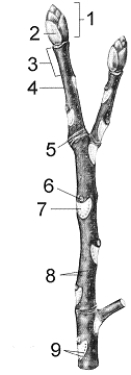 -Lenticels function to:
 (Multiple Choice)
4.9/5  (77)
(77) Figure 35-3
Use the figure to answer the corresponding question(s). 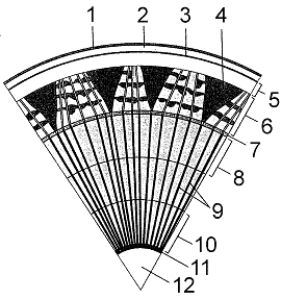 -Softwood is the wood:
 (Multiple Choice)
4.9/5 (81)
(81) Periderm is the functional replacement of the bark.
____________________
(True/False)
4.9/5 (95)
(95) Figure 35-3
Use the figure to answer the corresponding question(s).
-Which structure in Figure 35-3 is responsible for lateral transport of dissolved sugars in this woody plant?
-Which structure in Figure 35-3 is responsible for lateral transport of dissolved sugars in this woody plant? (Multiple Choice)
4.9/5 (83)
(83) MATCHING
Match the tissue with the appropriate description.
a.cork cambium
e.periderm
b.cork parenchyma
f.phloem
c.epidermis
g.vascular cambium
d.ground tissue
h.xylem
-In a monocot, this tissue surrounds the vascular bundles.
(Essay)
4.8/5 (74)
(74) __________ is the wood of flowering plants and __________ is the wood of conifers.
(Multiple Choice)
4.9/5 (80)
(80) In a plant, most water is transported vertically by being pushed to the top.
____________________
(True/False)
4.8/5 (79)
(79) MATCHING
Match the tissue with the appropriate description.
a.cork cambium
e.periderm
b.cork parenchyma
f.phloem
c.epidermis
g.vascular cambium
d.ground tissue
h.xylem
-Cortex is composed of this tissue.
(Essay)
4.9/5 (90)
(90) Unlike herbaceous eudicot stems, monocot stems do not have distinct areas of cortex and pith.Instead, their __________ functions as the cortex and pith.
(Multiple Choice)
4.8/5 (70)
(70) Using severed aphid mouthparts, scientists have verified that in most species the phloem translocates mostly __________, but that __________ may also be translocated.
(Multiple Choice)
4.7/5 (73)
(73) Sucrose is translocated from source to sink.
____________________
(True/False)
5.0/5 (87)
(87) The thin layer of meristematic cells located between xylem and phloem is referred to as the:
(Multiple Choice)
4.8/5 (86)
(86) MATCHING
Match the tissue with the appropriate description.
a.cork cambium
e.periderm
b.cork parenchyma
f.phloem
c.epidermis
g.vascular cambium
d.ground tissue
h.xylem
-How is it possible for water to defy gravity and travel from the roots to the tops of plants? Use the tension-cohesion model to explain your answer.
(Essay)
4.7/5 (85)
(85) 
Filters
- Essay(0)
- Multiple Choice(0)
- Short Answer(0)
- True False(0)
- Matching(0)