



 Chat with AI
Exam 44: Internal Transport

Exam 1: A View of Life88 Questions
Exam 2: Atoms and Molecules: the Chemical Basis of Life85 Questions
Exam 3: The Chemistry of Life: Organic Compounds95 Questions
Exam 4: Organization of the Cell68 Questions
Exam 5: Biological Membranes77 Questions
Exam 6: Cell Communication73 Questions
Exam 7: Energy and Metabolism76 Questions
Exam 8: How Cells Make Atp: Energy-Releasing Pathways90 Questions
Exam 9: Photosynthesis: Capturing Light Energy80 Questions
Exam 10: Chromosomes, Mitosis, and Meiosis91 Questions
Exam 11: The Basic Principles of Heredity75 Questions
Exam 12: Dna: the Carrier of Genetic Information80 Questions
Exam 13: Gene Expression76 Questions
Exam 14: Gene Regulation77 Questions
Exam 15: Dna Technology and Genomics79 Questions
Exam 16: Human Genetics and the Human Genome78 Questions
Exam 17: Developmental Genetics79 Questions
Exam 18: Introduction to Darwinian Evolution70 Questions
Exam 19: Evolutionary Change in Populations79 Questions
Exam 20: Speciation and Macroevolution91 Questions
Exam 21: The Origin and Evolutionary History of Life89 Questions
Exam 22: The Evolution of Primates87 Questions
Exam 23: Understanding Diversity: Systematics79 Questions
Exam 24: Viruses and Subviral Agents41 Questions
Exam 25: Bacteria and Archaea55 Questions
Exam 26: Protists92 Questions
Exam 27: Seedless Plants80 Questions
Exam 28: Seed Plants78 Questions
Exam 29: The Fungi87 Questions
Exam 30: An Introduction to Animal Diversity79 Questions
Exam 31: Sponges, Cnidarians, Ctenophores, and Protostomes146 Questions
Exam 32: The Deuterostomes90 Questions
Exam 33: Plant Structure, Growth, and Development86 Questions
Exam 34: Leaf Structure and Function76 Questions
Exam 35: Stem Structure and Transport74 Questions
Exam 36: Roots and Mineral Nutrition84 Questions
Exam 37: Reproduction in Flowering Plants89 Questions
Exam 38: Plant Developmental Responses to External and Internal Signals95 Questions
Exam 39: Animal Structure and Function: an Introduction96 Questions
Exam 40: Protection, Support, and Movement101 Questions
Exam 41: Neural Signaling87 Questions
Exam 42: Neural Regulation88 Questions
Exam 43: Sensory Systems111 Questions
Exam 44: Internal Transport104 Questions
Exam 45: The Immune System: Internal Defense85 Questions
Exam 46: Gas Exchange109 Questions
Exam 47: Processing Food and Nutrition119 Questions
Exam 48: Osmoregulation and Disposal of Metabolic Wastes94 Questions
Exam 49: Endocrine Regulation82 Questions
Exam 50: Reproduction104 Questions
Exam 51: Animal Development98 Questions
Exam 52: Animal Behavior77 Questions
Exam 53: Introduction to Ecology: Population Ecology97 Questions
Exam 54: Community Ecology74 Questions
Exam 55: Ecosystems and the Biosphere88 Questions
Exam 56: Ecology and the Geography of Life105 Questions
Exam 57: Biological Diversity and Conservation Biology66 Questions
Select questions type


You enjoy a lot of salt on your food.One of the long-term effects will be an increase in blood volume.The increase in blood volume will eventually result in all of the following except:
(Multiple Choice)
4.7/5  (94)
(94) Serum is plasma without the proteins involved in clotting.
____________________
(True/False)
4.7/5 (81)
(81) Figure 44-2
Use the figure to answer the corresponding question(s). 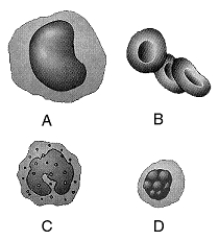 -An inadequate supply of which of the cells depicted in Figure 44-2 may be responsible for anemia?
 (Multiple Choice)
4.8/5 (81)
(81) MATCHING
Match the blood vessel with its description.
a.aorta
d.pulmonary artery
b.capillary
e.pulmonary vein
c.inferior vena cava
f.superior vena cava
-Transports blood back to the heart from the lower portion of the body
(Essay)
4.8/5 (78)
(78) An example of a(n) granular leucocyte is a monocyte.
____________________
(True/False)
5.0/5 (76)
(76) Figure 44-2
Use the figure to answer the corresponding question(s).
-Refer to Figure 44-2.Cell type__________ is/are primarily responsible for the release of histamine in injured tissues and in allergic responses.
-Refer to Figure 44-2.Cell type__________ is/are primarily responsible for the release of histamine in injured tissues and in allergic responses. (Multiple Choice)
4.8/5 (80)
(80) When a blood vessel is cut, why does vasoconstriction take place?
(Multiple Choice)
4.9/5 (80)
(80) Figure 44-4
Use the figure to answer the corresponding question(s). 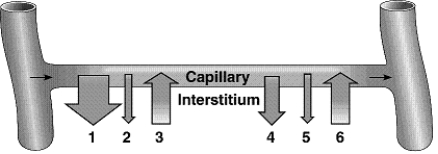 -In Figure 44-4, the arrow most affected by blood pressure changes will be:
 (Multiple Choice)
4.9/5 (74)
(74) Which of the following structures is considered to be the pacemaker of the heart?
(Multiple Choice)
4.9/5 (77)
(77) When impulses are conducted through the heart, transmission is delayed at the __________ so that the __________ may contract before the __________.
(Multiple Choice)
4.8/5 (99)
(99) Figure 44-2
Use the figure to answer the corresponding question(s).
-Refer to Figure 44-2.Which cell type is the source of antibodies?
-Refer to Figure 44-2.Which cell type is the source of antibodies? (Multiple Choice)
5.0/5 (76)
(76) Describe the structure of representative vertebrate hearts from fish through mammals.Briefly explain the circulation pattern supported by one type of non-mammalian vertebrate heart.
(Essay)
4.9/5 (77)
(77) The component in the highest concentration in plasma is __________.
(Multiple Choice)
4.8/5 (83)
(83) Figure 44-1
Use the figure to answer the corresponding question(s). 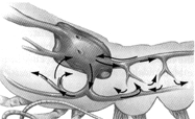 -The type of system depicted in Figure 44-1:
 (Multiple Choice)
4.8/5 (74)
(74) Blood pressure is regulated by all of the following except:
(Multiple Choice)
4.8/5 (87)
(87) Which of the following contributes to an erythrocyte's efficiency in distributing oxygen?
(Multiple Choice)
4.7/5 (75)
(75) Figure 44-1
Use the figure to answer the corresponding question(s).
-The oxygen transporting pigment found in the system depicted in Figure 44-1 is most likely:
-The oxygen transporting pigment found in the system depicted in Figure 44-1 is most likely: (Multiple Choice)
4.9/5 (70)
(70) 
Filters
- Essay(0)
- Multiple Choice(0)
- Short Answer(0)
- True False(0)
- Matching(0)