



 Chat with AI
Exam 51: Animal Development

Exam 1: A View of Life88 Questions
Exam 2: Atoms and Molecules: the Chemical Basis of Life85 Questions
Exam 3: The Chemistry of Life: Organic Compounds95 Questions
Exam 4: Organization of the Cell68 Questions
Exam 5: Biological Membranes77 Questions
Exam 6: Cell Communication73 Questions
Exam 7: Energy and Metabolism76 Questions
Exam 8: How Cells Make Atp: Energy-Releasing Pathways90 Questions
Exam 9: Photosynthesis: Capturing Light Energy80 Questions
Exam 10: Chromosomes, Mitosis, and Meiosis91 Questions
Exam 11: The Basic Principles of Heredity75 Questions
Exam 12: Dna: the Carrier of Genetic Information80 Questions
Exam 13: Gene Expression76 Questions
Exam 14: Gene Regulation77 Questions
Exam 15: Dna Technology and Genomics79 Questions
Exam 16: Human Genetics and the Human Genome78 Questions
Exam 17: Developmental Genetics79 Questions
Exam 18: Introduction to Darwinian Evolution70 Questions
Exam 19: Evolutionary Change in Populations79 Questions
Exam 20: Speciation and Macroevolution91 Questions
Exam 21: The Origin and Evolutionary History of Life89 Questions
Exam 22: The Evolution of Primates87 Questions
Exam 23: Understanding Diversity: Systematics79 Questions
Exam 24: Viruses and Subviral Agents41 Questions
Exam 25: Bacteria and Archaea55 Questions
Exam 26: Protists92 Questions
Exam 27: Seedless Plants80 Questions
Exam 28: Seed Plants78 Questions
Exam 29: The Fungi87 Questions
Exam 30: An Introduction to Animal Diversity79 Questions
Exam 31: Sponges, Cnidarians, Ctenophores, and Protostomes146 Questions
Exam 32: The Deuterostomes90 Questions
Exam 33: Plant Structure, Growth, and Development86 Questions
Exam 34: Leaf Structure and Function76 Questions
Exam 35: Stem Structure and Transport74 Questions
Exam 36: Roots and Mineral Nutrition84 Questions
Exam 37: Reproduction in Flowering Plants89 Questions
Exam 38: Plant Developmental Responses to External and Internal Signals95 Questions
Exam 39: Animal Structure and Function: an Introduction96 Questions
Exam 40: Protection, Support, and Movement101 Questions
Exam 41: Neural Signaling87 Questions
Exam 42: Neural Regulation88 Questions
Exam 43: Sensory Systems111 Questions
Exam 44: Internal Transport104 Questions
Exam 45: The Immune System: Internal Defense85 Questions
Exam 46: Gas Exchange109 Questions
Exam 47: Processing Food and Nutrition119 Questions
Exam 48: Osmoregulation and Disposal of Metabolic Wastes94 Questions
Exam 49: Endocrine Regulation82 Questions
Exam 50: Reproduction104 Questions
Exam 51: Animal Development98 Questions
Exam 52: Animal Behavior77 Questions
Exam 53: Introduction to Ecology: Population Ecology97 Questions
Exam 54: Community Ecology74 Questions
Exam 55: Ecosystems and the Biosphere88 Questions
Exam 56: Ecology and the Geography of Life105 Questions
Exam 57: Biological Diversity and Conservation Biology66 Questions
Select questions type


In mammals, the __________ is a temporary center for the formation of blood cells.
(Multiple Choice)
4.8/5  (79)
(79) Human chorionic gonadotropin signals the placenta to produce large amounts of estrogen and progesterone.
___________________
(True/False)
4.8/5 (98)
(98) Figure 51-1
Use the figure to answer the corresponding question(s). 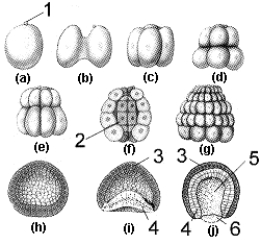 -The structure labeled 2 in Figure 51-1 is the:
 (Multiple Choice)
4.9/5 (83)
(83) The fertilization envelope forms during the acrosomal reaction.
____________________
(True/False)
4.7/5 (84)
(84) Figure 51-2
Use the figure to answer the corresponding question(s). 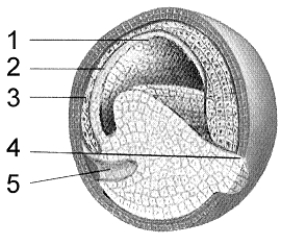 -The developing embryo in Figure 51-2 is representative of development in:
 (Multiple Choice)
4.9/5 (79)
(79) Dizygotic twins are also called fraternal twins.
___________________
(True/False)
4.9/5 (72)
(72) Which of the following statements about sperm entry is true?
(Multiple Choice)
4.8/5 (76)
(76) MATCHING
Match the stage of embryonic development with its description.
a.blastula
c.morula
b.gastrula
d.stage of organogenesis
-the formation of a primitive groove begins this stage
(Essay)
4.7/5 (67)
(67) Figure 51-1
Use the figure to answer the corresponding question(s).
-Which of the stages or structures in Figure 51-1 was formed by the process of gastrulation?
-Which of the stages or structures in Figure 51-1 was formed by the process of gastrulation? (Multiple Choice)
4.9/5 (89)
(89) The chorion is the extraembryonic membrane closest to the embryo proper.
____________________
(True/False)
4.7/5 (86)
(86) The gray crescent region of the amphibian zygote is thought to contain:
(Multiple Choice)
4.7/5 (88)
(88) The release of calcium ions into the egg cytoplasm during fertilization causes all of the following actions except:
(Multiple Choice)
4.7/5 (92)
(92) Figure 51-2
Use the figure to answer the corresponding question(s).
-Refer to Figure 51-2.Which structure will form the blastocoel?
-Refer to Figure 51-2.Which structure will form the blastocoel? (Multiple Choice)
4.8/5 (92)
(92) Which of the following indicates the correct sequence of mammalian egg coverings, beginning at the outside and moving inward?
(Multiple Choice)
4.8/5 (79)
(79) 
Filters
- Essay(0)
- Multiple Choice(0)
- Short Answer(0)
- True False(0)
- Matching(0)