



 Chat with AI
Exam 52: Animal Behavior

Exam 1: A View of Life88 Questions
Exam 2: Atoms and Molecules: the Chemical Basis of Life85 Questions
Exam 3: The Chemistry of Life: Organic Compounds95 Questions
Exam 4: Organization of the Cell68 Questions
Exam 5: Biological Membranes77 Questions
Exam 6: Cell Communication73 Questions
Exam 7: Energy and Metabolism76 Questions
Exam 8: How Cells Make Atp: Energy-Releasing Pathways90 Questions
Exam 9: Photosynthesis: Capturing Light Energy80 Questions
Exam 10: Chromosomes, Mitosis, and Meiosis91 Questions
Exam 11: The Basic Principles of Heredity75 Questions
Exam 12: Dna: the Carrier of Genetic Information80 Questions
Exam 13: Gene Expression76 Questions
Exam 14: Gene Regulation77 Questions
Exam 15: Dna Technology and Genomics79 Questions
Exam 16: Human Genetics and the Human Genome78 Questions
Exam 17: Developmental Genetics79 Questions
Exam 18: Introduction to Darwinian Evolution70 Questions
Exam 19: Evolutionary Change in Populations79 Questions
Exam 20: Speciation and Macroevolution91 Questions
Exam 21: The Origin and Evolutionary History of Life89 Questions
Exam 22: The Evolution of Primates87 Questions
Exam 23: Understanding Diversity: Systematics79 Questions
Exam 24: Viruses and Subviral Agents41 Questions
Exam 25: Bacteria and Archaea55 Questions
Exam 26: Protists92 Questions
Exam 27: Seedless Plants80 Questions
Exam 28: Seed Plants78 Questions
Exam 29: The Fungi87 Questions
Exam 30: An Introduction to Animal Diversity79 Questions
Exam 31: Sponges, Cnidarians, Ctenophores, and Protostomes146 Questions
Exam 32: The Deuterostomes90 Questions
Exam 33: Plant Structure, Growth, and Development86 Questions
Exam 34: Leaf Structure and Function76 Questions
Exam 35: Stem Structure and Transport74 Questions
Exam 36: Roots and Mineral Nutrition84 Questions
Exam 37: Reproduction in Flowering Plants89 Questions
Exam 38: Plant Developmental Responses to External and Internal Signals95 Questions
Exam 39: Animal Structure and Function: an Introduction96 Questions
Exam 40: Protection, Support, and Movement101 Questions
Exam 41: Neural Signaling87 Questions
Exam 42: Neural Regulation88 Questions
Exam 43: Sensory Systems111 Questions
Exam 44: Internal Transport104 Questions
Exam 45: The Immune System: Internal Defense85 Questions
Exam 46: Gas Exchange109 Questions
Exam 47: Processing Food and Nutrition119 Questions
Exam 48: Osmoregulation and Disposal of Metabolic Wastes94 Questions
Exam 49: Endocrine Regulation82 Questions
Exam 50: Reproduction104 Questions
Exam 51: Animal Development98 Questions
Exam 52: Animal Behavior77 Questions
Exam 53: Introduction to Ecology: Population Ecology97 Questions
Exam 54: Community Ecology74 Questions
Exam 55: Ecosystems and the Biosphere88 Questions
Exam 56: Ecology and the Geography of Life105 Questions
Exam 57: Biological Diversity and Conservation Biology66 Questions
Select questions type


An animal must be physiologically ready before it can exhibit a behavior pattern.This is illustrated by all of the following, except:
(Multiple Choice)
4.8/5  (83)
(83) Figure 52-2
Use the figure to answer the corresponding question(s). 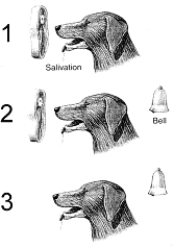 -Refer to Figure 52-2.In this sequence of events the bell is serving as:
 (Multiple Choice)
4.8/5 (75)
(75) Which of the following is not used by animals as a guide for navigation?
(Multiple Choice)
4.9/5 (86)
(86) You see an advertisement on the television with a very good looking person showing off a new, shiny, powerful car.You seriously think about buying that particular car.Therefore, the person in the advertisement could best be described as the:
(Multiple Choice)
4.8/5 (67)
(67) The salivating response to a bell is what Pavlov called an unconditioned response.
____________________
(True/False)
4.8/5 (80)
(80) Animals, like fiddler crabs, that are busiest at dawn or dusk are termed:
(Multiple Choice)
4.9/5 (61)
(61) A squirrel is born and raised in captivity.Once released into the wild, it immediately begins to bury nuts.This is an example of:
(Multiple Choice)
4.9/5 (74)
(74) Figure 52-3
Use the figure to answer the corresponding question(s). 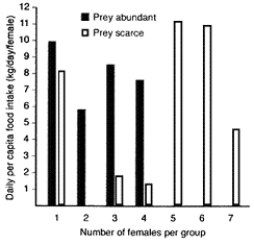 -Which of the following statements accurately reflects the data in Figure 52-3?
 (Multiple Choice)
4.9/5 (81)
(81) Aposematic coloration is also called habituation.
____________________
(True/False)
4.9/5 (76)
(76) Proximate causes of behavior have evolutionary explanations.
____________________
(True/False)
4.9/5 (93)
(93) Which of the following vertebrates has a social structure most closely resembling social insects?
(Multiple Choice)
4.9/5 (83)
(83) A cat and a dog share a space in the barn.The cat gives birth to kittens in the dog's bed and then leaves them alone.Later, you notice that the kittens follow the dog around during the day.This is an example of which type of behavior?
(Multiple Choice)
5.0/5 (81)
(81) Which of the following statements about biological clocks is false?
(Multiple Choice)
4.8/5 (68)
(68) Which of the following statements concerning play is false?
(Multiple Choice)
4.8/5 (79)
(79) Which of the following behaviors is not rigidly genetically programmed for the wasp Philanthus?
(Multiple Choice)
5.0/5 (87)
(87) 
Filters
- Essay(0)
- Multiple Choice(0)
- Short Answer(0)
- True False(0)
- Matching(0)