



 Chat with AI
Exam 13: Monopoly

Exam 1: First Principles233 Questions
Exam 2: Economic Models: Trade-Offs and Trade 25382 Questions
Exam 3: Supply and Demand290 Questions
Exam 4: Consumer and Producer Surplus224 Questions
Exam 5: Price Controls and Quotas: Meddling With Markets227 Questions
Exam 6: Elasticity300 Questions
Exam 7: Taxes298 Questions
Exam 8: International Trade272 Questions
Exam 9: Decision Making by Individuals Firms201 Questions
Exam 10: The Rational Consumer372 Questions
Exam 11: Behind the Supply Curve: Inputs and Costs362 Questions
Exam 12: Perfect Competition and the Supply Curve355 Questions
Exam 13: Monopoly350 Questions
Exam 14: Oligopoly294 Questions
Exam 15: Monopolistic Competition and Product Differentiation262 Questions
Exam 16: Externalities199 Questions
Exam 17: Public Goods Common Resources224 Questions
Exam 18: The Economics of the Welfare140 Questions
Exam 19: Factor Markets and the Distribution of Income369 Questions
Exam 20: Uncertainty, Risk, and Private Information202 Questions
Select questions type


Use the following to answer questions:  -(Table: Demand and Total Cost) Look at the table Demand and Total Cost. Lenoia runs a natural monopoly producing electricity for a small mountain village. The table shows Lenoia's demand and total cost of producing electricity. The price effect of increasing production from 3 megawatts to 4 megawatts is:
 (Multiple Choice)
4.9/5  (70)
(70) A monopolist responds to an increase in marginal cost by _____ price and _____ output.
(Multiple Choice)
4.7/5 (77)
(77) Mr. Porter sells 10 bottles of champagne per week at $50 per bottle. He can sell 11 bottles per week if he lowers the price to $45 per bottle. The quantity and the price effects on total revenue would be, respectively, an increase of _____ and a decrease of _____.
(Multiple Choice)
4.9/5 (76)
(76) When a natural monopoly is regulated to charge a price equal to average total cost, producer surplus decreases, but total surplus increases.
(True/False)
4.8/5 (91)
(91) Use the following to answer questions:  -(Table: Lunch) Look at the figure Lunch. Joe makes and sells picnic lunches to people taking all-day rafting trips on the river. The marginal cost and average cost of each lunch are a constant $4. If Joe is a monopolist, what is consumer surplus in the long run?
 (Multiple Choice)
4.9/5 (75)
(75) Use the following to answer questions:
Figure: Monopoly Model 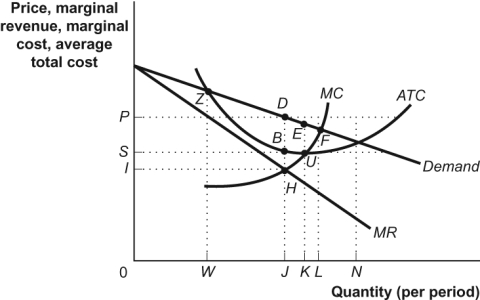 -(Figure: Monopoly Model) Look at the figure Monopoly Model. When the firm is in equilibrium (that is, maximizing its economic profit), its total cost is the area of rectangle _____ and its total revenue is the area of rectangle _____.
 (Multiple Choice)
5.0/5 (73)
(73) Use the following to answer questions:
Figure: PPV  -(Figure: PPV) Look at the figure PPV, which shows the demand and marginal revenue for a pay-per-view football game on cable TV. Assume that the marginal cost and average cost are a constant $40. If the cable company practices perfect price discrimination, then it will sell _____ subscriptions.
 (Multiple Choice)
4.7/5 (84)
(84) Use the following to answer questions:
Figure: A Rock Climbing Shoe Monopoly 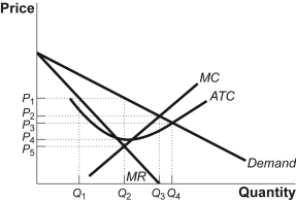 -(Figure: A Rock Climbing Shoe Monopoly) Look at the figure A Rock Climbing Shoe Monopoly. If the firm acts to maximize profit, the firm will sell _____ pairs of shoes at _____ per pair.
 (Multiple Choice)
4.9/5 (83)
(83) Use the following to answer questions:  -(Table: Prices and Demand) Look at the table Prices and Demand. The New Orleans Saints have a monopoly on Saints logo hats. The marginal cost of producing a hat is $18. How much is producer surplus at the Saint's profit-maximizing output?
 (Multiple Choice)
4.9/5 (77)
(77) Use the following to answer questions:
-(Table: Demand and Total Cost) Look at the table Demand and Total Cost. Lenoia runs a natural monopoly producing electricity for a small mountain village. The table shows Lenoia's demand and total cost of producing electricity. The profit-maximizing quantity of electricity for her to produce is _____ megawatts.
-(Table: Demand and Total Cost) Look at the table Demand and Total Cost. Lenoia runs a natural monopoly producing electricity for a small mountain village. The table shows Lenoia's demand and total cost of producing electricity. The profit-maximizing quantity of electricity for her to produce is _____ megawatts. (Multiple Choice)
4.8/5 (78)
(78) Use the following to answer questions:
Figure: PPV 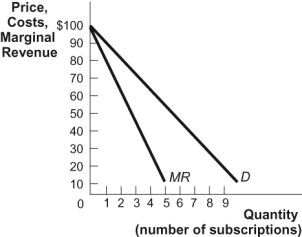 -(Figure: PPV) Look at the figure PPV, which shows the demand and marginal revenue for a pay-per-view football game on cable TV. Assume that the marginal cost and average cost are a constant $20. If the cable company is a monopoly, how much is deadweight loss when the monopolist maximizes profit?
 (Multiple Choice)
4.8/5 (76)
(76) When a monopolist practices price discrimination as opposed to setting a single price, the monopolist increases its profits by capturing consumer surplus.
(True/False)
4.8/5 (66)
(66) Lenoia runs a natural monopoly producing electricity for a small mountain village. The barrier preventing other firms from competing with her is:
(Multiple Choice)
5.0/5 (69)
(69) Use the following to answer questions:
Figure: PPV
-(Figure: PPV) Look at the figure PPV, which shows the demand and marginal revenue for a pay-per-view football game on cable TV. Assume that the marginal cost and average cost are a constant $20. If the cable company is a monopoly, how much is total surplus when the monopolist maximizes profit?
-(Figure: PPV) Look at the figure PPV, which shows the demand and marginal revenue for a pay-per-view football game on cable TV. Assume that the marginal cost and average cost are a constant $20. If the cable company is a monopoly, how much is total surplus when the monopolist maximizes profit? (Multiple Choice)
4.8/5 (72)
(72) An industry with a firm that is the only producer of a good or service for which there are no close substitutes and for which entry by potential rivals is prohibitively difficult is:
(Multiple Choice)
4.9/5 (67)
(67) Consumer surplus in monopoly is smaller than in perfect competition.
(True/False)
4.8/5 (75)
(75) Use the following to answer questions:
Figure: Computing Monopoly Profit 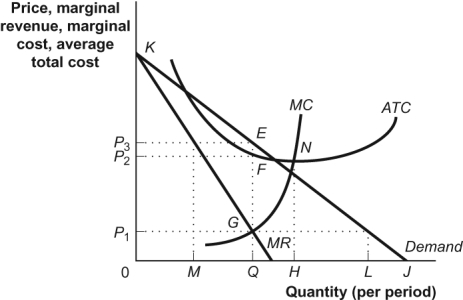 -(Figure: Computing Monopoly Profit) Look at the figure Computing Monopoly Profit. At the profit-maximizing output, total cost is:
 (Multiple Choice)
4.9/5 (73)
(73) Use the following to answer questions:
Figure: Demand, Revenue, and Cost Curves 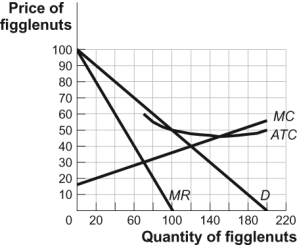 -(Figure: Demand, Revenue, and Cost Curves) Look at the figure Demand, Revenue, and Cost Curves. Figglenuts-R-Us is a monopolist in the figglenut market. Figglenuts-R-Us will sell _____ figglenuts and set a price of _____ to maximize profits.
 (Multiple Choice)
4.7/5 (84)
(84) A monopolist or an imperfectly competitive firm practices price discrimination primarily to:
(Multiple Choice)
4.8/5 (68)
(68) 
Filters
- Essay(0)
- Multiple Choice(0)
- Short Answer(0)
- True False(0)
- Matching(0)