



 Chat with AI
Exam 13: Monopoly

Exam 1: First Principles233 Questions
Exam 2: Economic Models: Trade-Offs and Trade 25382 Questions
Exam 3: Supply and Demand290 Questions
Exam 4: Consumer and Producer Surplus224 Questions
Exam 5: Price Controls and Quotas: Meddling With Markets227 Questions
Exam 6: Elasticity300 Questions
Exam 7: Taxes298 Questions
Exam 8: International Trade272 Questions
Exam 9: Decision Making by Individuals Firms201 Questions
Exam 10: The Rational Consumer372 Questions
Exam 11: Behind the Supply Curve: Inputs and Costs362 Questions
Exam 12: Perfect Competition and the Supply Curve355 Questions
Exam 13: Monopoly350 Questions
Exam 14: Oligopoly294 Questions
Exam 15: Monopolistic Competition and Product Differentiation262 Questions
Exam 16: Externalities199 Questions
Exam 17: Public Goods Common Resources224 Questions
Exam 18: The Economics of the Welfare140 Questions
Exam 19: Factor Markets and the Distribution of Income369 Questions
Exam 20: Uncertainty, Risk, and Private Information202 Questions
Select questions type


What are the fundamental differences between the perfect competition and monopoly market structures?
(Essay)
4.9/5  (78)
(78) The land you own has the only known source of aloe needed to make anti-itch lotion. In this case, your monopoly results from:
(Multiple Choice)
4.8/5 (86)
(86) Amtrak is a publicly owned company that provides rail service. This means that Amtrak's prices tend to be _____ than if it were a private company, and the quality of service tends to be _____ than if it were a private company.
(Multiple Choice)
4.9/5 (99)
(99) Use the following to answer questions:
Figure: The Profit-Maximizing Output and Price  -(Figure: The Profit-Maximizing Output and Price) Look at the figure The Profit-Maximizing Output and Price. Assume that there are no fixed costs and AC = MC = $200. At the profit-maximizing output and price for a monopolist, producer surplus is:
 (Multiple Choice)
4.8/5 (67)
(67) When a monopolist practices price discrimination, consumer surplus will be higher than the consumer surplus in a single-price monopoly.
(True/False)
4.8/5 (65)
(65) Use the following to answer questions:
Figure: PPV 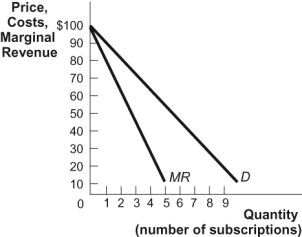 -(Figure: PPV) Look at the figure PPV, which shows the demand and marginal revenue for a pay-per-view football game on cable TV. Assume that the marginal cost and average cost are a constant $20. If the cable company is in a perfectly competitive industry, how much is deadweight loss?
 (Multiple Choice)
4.9/5 (84)
(84) If the government allowed only one airline to serve the entire U.S. market, there would be a _____ loss associated with _____ efficiency in the airline industry.
(Multiple Choice)
4.9/5 (84)
(84) Use the following to answer questions:
Figure: Water Works 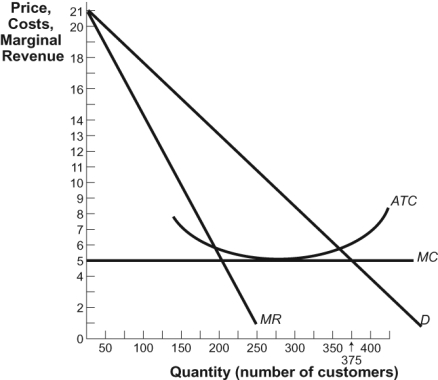 -(Figure: Water Works) Look at the figure Water Works, which describes a small town's water works, a natural monopoly. If the water works is unregulated and maximizes profit, consumer surplus will be:
 (Multiple Choice)
4.9/5 (78)
(78) Use the following to answer questions:
Figure: The Profit-Maximizing Output and Price
-(Figure: The Profit-Maximizing Output and Price) Look at the figure The Profit-Maximizing Output and Price. Assume that there are no fixed costs and AC = MC = $200. At the profit-maximizing output and price for competitor perfectly competitive industry, consumer surplus is:
-(Figure: The Profit-Maximizing Output and Price) Look at the figure The Profit-Maximizing Output and Price. Assume that there are no fixed costs and AC = MC = $200. At the profit-maximizing output and price for competitor perfectly competitive industry, consumer surplus is: (Multiple Choice)
4.7/5 (72)
(72) If the regulation of a monopoly results in a price equal to marginal cost but the price is below average total cost:
(Multiple Choice)
4.8/5 (59)
(59) The advantage of public ownership of a monopoly is that prices can be based on efficiency rather than profit maximization.
(True/False)
4.9/5 (73)
(73) Use the following to answer questions:
Figure: Water Works
-(Figure: Water Works) Look at the figure Water Works, which describes a small town's water works, a natural monopoly. If regulators require the water works to charge the price that eliminates deadweight loss, the water works will:
-(Figure: Water Works) Look at the figure Water Works, which describes a small town's water works, a natural monopoly. If regulators require the water works to charge the price that eliminates deadweight loss, the water works will: (Multiple Choice)
4.8/5 (76)
(76) Assume a monopoly is currently earning economic profits. If a change in fixed cost raises average total cost above the demand curve:
(Multiple Choice)
4.9/5 (77)
(77) A monopolist is likely to produce _____ and charge _____ than a comparable perfectly competitive firm.
(Multiple Choice)
4.8/5 (89)
(89) Use the following to answer question:
Figure: The Monopolist II 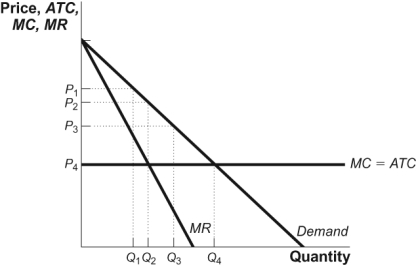 -(Figure: The Monopolist II) Look at the figure The Monopolist II. The deadweight loss associated with this monopoly can be measured as the area:
 (Multiple Choice)
4.7/5 (79)
(79) Suppose the GoSports pennant monopoly is broken up and the pennant industry becomes perfectly competitive. We would expect the _____ to increase and _____ to decrease after the breakup.
(Multiple Choice)
4.7/5 (70)
(70) 
Filters
- Essay(0)
- Multiple Choice(0)
- Short Answer(0)
- True False(0)
- Matching(0)