



 Chat with AI
Exam 13: Monopoly

Exam 1: First Principles233 Questions
Exam 2: Economic Models: Trade-Offs and Trade 25382 Questions
Exam 3: Supply and Demand290 Questions
Exam 4: Consumer and Producer Surplus224 Questions
Exam 5: Price Controls and Quotas: Meddling With Markets227 Questions
Exam 6: Elasticity300 Questions
Exam 7: Taxes298 Questions
Exam 8: International Trade272 Questions
Exam 9: Decision Making by Individuals Firms201 Questions
Exam 10: The Rational Consumer372 Questions
Exam 11: Behind the Supply Curve: Inputs and Costs362 Questions
Exam 12: Perfect Competition and the Supply Curve355 Questions
Exam 13: Monopoly350 Questions
Exam 14: Oligopoly294 Questions
Exam 15: Monopolistic Competition and Product Differentiation262 Questions
Exam 16: Externalities199 Questions
Exam 17: Public Goods Common Resources224 Questions
Exam 18: The Economics of the Welfare140 Questions
Exam 19: Factor Markets and the Distribution of Income369 Questions
Exam 20: Uncertainty, Risk, and Private Information202 Questions
Select questions type


If a monopolist is producing a quantity that generates MC = MR, then profit:
(Multiple Choice)
4.7/5  (83)
(83) Use the following to answer questions:
Figure: Water Works 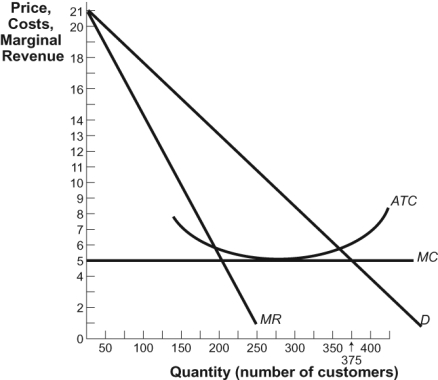 -(Figure: Water Works) Look at the figure Water Works, which describes a small town's water works, a natural monopoly. If regulators allow the water works to charge the price that covers average total costs, consumer surplus will be:
 (Multiple Choice)
4.8/5 (90)
(90) A monopoly increases price by limiting the quantity supplied to a market.
(True/False)
4.8/5 (83)
(83) Use the following to answer questions:
Figure: PPV 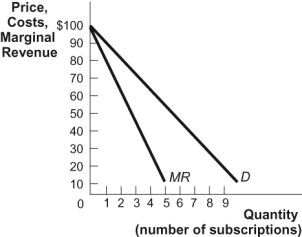 -(Figure: PPV) Look at the figure PPV, which shows the demand and marginal revenue for a pay-per-view football game on cable TV. Assume that the marginal cost and average cost are a constant $20. If the cable company is a monopoly, how much is consumer surplus when the monopolist maximizes profit?
 (Multiple Choice)
4.8/5 (76)
(76) Suppose the elasticity of demand for tickets to Broadway shows is 2.0 for men and 0.3 for women. To use price discrimination to increase profits, the producers should charge higher prices to _____ because their demand is _____.
(Multiple Choice)
4.8/5 (81)
(81) Suppose a monopolist reduces its price in an effort to expand output. If the price effect equals the quantity effect, then the marginal revenue will be zero.
(True/False)
4.8/5 (89)
(89) Consumer surplus is higher under a single-price monopoly than under a perfectly price-discriminating monopoly.
(True/False)
4.8/5 (84)
(84) 
Filters
- Essay(0)
- Multiple Choice(0)
- Short Answer(0)
- True False(0)
- Matching(0)