



 Chat with AI
Exam 13: Monopoly

Exam 1: First Principles233 Questions
Exam 2: Economic Models: Trade-Offs and Trade 25382 Questions
Exam 3: Supply and Demand290 Questions
Exam 4: Consumer and Producer Surplus224 Questions
Exam 5: Price Controls and Quotas: Meddling With Markets227 Questions
Exam 6: Elasticity300 Questions
Exam 7: Taxes298 Questions
Exam 8: International Trade272 Questions
Exam 9: Decision Making by Individuals Firms201 Questions
Exam 10: The Rational Consumer372 Questions
Exam 11: Behind the Supply Curve: Inputs and Costs362 Questions
Exam 12: Perfect Competition and the Supply Curve355 Questions
Exam 13: Monopoly350 Questions
Exam 14: Oligopoly294 Questions
Exam 15: Monopolistic Competition and Product Differentiation262 Questions
Exam 16: Externalities199 Questions
Exam 17: Public Goods Common Resources224 Questions
Exam 18: The Economics of the Welfare140 Questions
Exam 19: Factor Markets and the Distribution of Income369 Questions
Exam 20: Uncertainty, Risk, and Private Information202 Questions
Select questions type


Use the following to answer questions:
Figure: A Profit-Maximizing Monopoly Firm 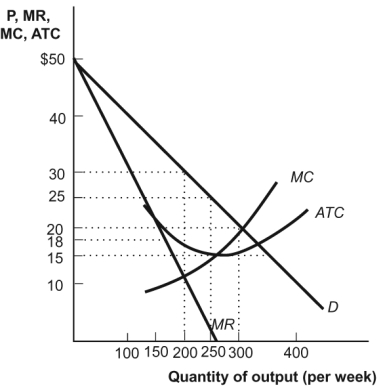 -(Figure: A Profit-Maximizing Monopoly Firm) Look at the figure A Profit-Maximizing Monopoly Firm. This firm's price per unit is:
 (Multiple Choice)
4.8/5  (83)
(83) Use the following to answer questions:
Figure: PPV  -(Figure: PPV) Look at the figure PPV, which shows the demand and marginal revenue for a pay-per-view football game on cable TV. Assume that the marginal cost and average cost are a constant $40. If the cable company practices perfect price discrimination, producer surplus will be:
 (Multiple Choice)
4.7/5 (87)
(87) Use the following to answer questions:  -(Table: Lunch) Look at the figure Lunch. Joe makes and sells picnic lunches to people taking all-day rafting trips on the river. The marginal cost and average cost of each lunch are a constant $4. If Joe is a monopolist, how many lunches will he produce in the long run?
 (Multiple Choice)
4.8/5 (71)
(71) The practice of charging different prices to different customers for the same good or service, even though the cost of supplying those customers is the same, is:
(Multiple Choice)
4.9/5 (74)
(74) If your farm had the only known source of a rare cocoa bean needed to make chocolate-covered peanuts, your monopoly would result from:
(Multiple Choice)
4.7/5 (74)
(74) Use the following to answer questions:
Figure: PPV 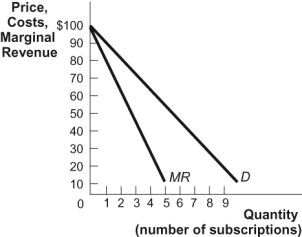 -(Figure: PPV) Look at the figure PPV, which shows the demand and marginal revenue for a pay-per-view football game on cable TV. Assume that the marginal cost and average cost are a constant $20. If the cable company is a monopoly, what price will it charge?
 (Multiple Choice)
4.9/5 (81)
(81) A monopoly is producing output so that average total cost is $30, marginal revenue is $40, and the price is $50. If ATC is at its minimum level and the ATC curve is U-shaped, to maximize profits this firm should:
(Multiple Choice)
4.8/5 (86)
(86) Use the following to answer questions:  -(Table: Prices and Demand) Look at the table Prices and Demand. The New Orleans Saints have a monopoly on Saints logo hats. The marginal cost of producing a hat is $18. How many hats should the Saints produce, and what price should the organization charge to maximize its profits?
 (Multiple Choice)
4.9/5 (64)
(64) Which of the following statements about the differences between monopoly and perfect competition is INCORRECT?
(Multiple Choice)
4.8/5 (73)
(73) Airlines that engage in price discrimination charge higher prices to business travelers because their _____ is more _____ than that of other travelers.
(Multiple Choice)
4.9/5 (81)
(81) Why is the demand curve for a monopolist downward-sloping, while the demand curve for the perfectly competitive firm is horizontal?
(Essay)
4.8/5 (71)
(71) Use the following to answer questions:
Figure: PPV
-(Figure: PPV) Look at the figure PPV, which shows the demand and marginal revenue for a pay-per-view football game on cable TV. Assume that the marginal cost and average cost are a constant $40. If the cable company is a single-price monopoly and maximizes profit, producer surplus will be:
-(Figure: PPV) Look at the figure PPV, which shows the demand and marginal revenue for a pay-per-view football game on cable TV. Assume that the marginal cost and average cost are a constant $40. If the cable company is a single-price monopoly and maximizes profit, producer surplus will be: (Multiple Choice)
4.9/5 (97)
(97) Use the following to answer questions:
-(Table: Prices and Demand) Look at the table Prices and Demand. The New Orleans Saints have a monopoly on Saints logo hats. The marginal cost of producing a hat is $18. How much is consumer surplus at the Saint's profit-maximizing output?
-(Table: Prices and Demand) Look at the table Prices and Demand. The New Orleans Saints have a monopoly on Saints logo hats. The marginal cost of producing a hat is $18. How much is consumer surplus at the Saint's profit-maximizing output? (Multiple Choice)
5.0/5 (73)
(73) Use the following to answer questions:
Figure: Computing Monopoly Profit 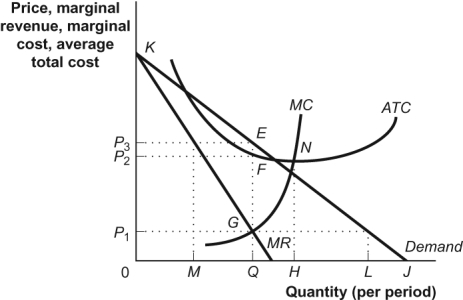 -(Figure: Computing Monopoly Profit) Look at the figure Computing Monopoly Profit. The profit-maximizing price is _____ and will generate total economic profit of _____.
 (Multiple Choice)
4.8/5 (75)
(75) Use the following to answer questions:
Figure: The Profit-Maximizing Output and Price  -(Figure: The Profit-Maximizing Output and Price) Look at the figure The Profit-Maximizing Output and Price. Assume there are no fixed costs and AC = MC. At the profit-maximizing quantity of production for the monopolist, total revenue is _____, total cost is _____, and profit is _____.
 (Multiple Choice)
4.9/5 (78)
(78) 
Filters
- Essay(0)
- Multiple Choice(0)
- Short Answer(0)
- True False(0)
- Matching(0)