



 Chat with AI
Exam 13: Monopoly

Exam 1: First Principles233 Questions
Exam 2: Economic Models: Trade-Offs and Trade 25382 Questions
Exam 3: Supply and Demand290 Questions
Exam 4: Consumer and Producer Surplus224 Questions
Exam 5: Price Controls and Quotas: Meddling With Markets227 Questions
Exam 6: Elasticity300 Questions
Exam 7: Taxes298 Questions
Exam 8: International Trade272 Questions
Exam 9: Decision Making by Individuals Firms201 Questions
Exam 10: The Rational Consumer372 Questions
Exam 11: Behind the Supply Curve: Inputs and Costs362 Questions
Exam 12: Perfect Competition and the Supply Curve355 Questions
Exam 13: Monopoly350 Questions
Exam 14: Oligopoly294 Questions
Exam 15: Monopolistic Competition and Product Differentiation262 Questions
Exam 16: Externalities199 Questions
Exam 17: Public Goods Common Resources224 Questions
Exam 18: The Economics of the Welfare140 Questions
Exam 19: Factor Markets and the Distribution of Income369 Questions
Exam 20: Uncertainty, Risk, and Private Information202 Questions
Select questions type


Use the following to answer questions:
Figure: Water Works 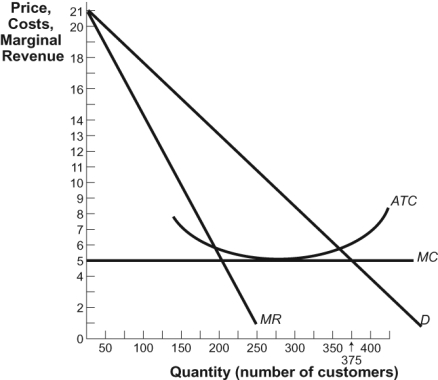 -(Figure: Water Works) Look at the figure Water Works, which describes a small town's water works, a natural monopoly. If regulators allow the monopolist to charge a price that just covers average total cost, the water works will serve _____ customers.
 (Multiple Choice)
4.9/5  (93)
(93) Use the following to answer questions: 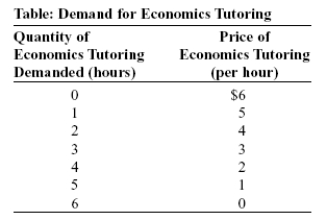 -(Table: Demand for Economics Tutoring) Look at the table Demand for Economics Tutoring. Suppose Eric is the only economics tutor in town and therefore holds a monopoly. Eric can offer additional hours of tutoring at a constant marginal cost of $2 per hour, and he has no fixed costs.
A) If Eric acts as a monopolist, how many hours will he offer and what price will he charge?
B) Calculate Eric's monopoly profit.
-(Table: Demand for Economics Tutoring) Look at the table Demand for Economics Tutoring. Suppose Eric is the only economics tutor in town and therefore holds a monopoly. Eric can offer additional hours of tutoring at a constant marginal cost of $2 per hour, and he has no fixed costs.
A) If Eric acts as a monopolist, how many hours will he offer and what price will he charge?
B) Calculate Eric's monopoly profit. (Essay)
4.9/5 (85)
(85) Use the following to answer questions:
Figure: The Profit-Maximizing Output and Price  -(Figure: The Profit-Maximizing Output and Price) Look at the figure The Profit-Maximizing Output and Price. Assume that there are no fixed costs and AC = MC = $200. At the profit-maximizing output and price for a perfectly competitive industry, total surplus is:
 (Multiple Choice)
4.9/5 (64)
(64) One government policy for dealing with natural monopoly is to:
(Multiple Choice)
4.8/5 (85)
(85) Use the following to answer questions:  -(Table: Lunch) Look at the figure Lunch. Joe makes and sells picnic lunches to people taking all-day rafting trips on the river. The marginal cost and average cost of each lunch are a constant $4. If Joe is a monopolist, what is producer surplus in the long run?
 (Multiple Choice)
4.9/5 (67)
(67) In perfect price discrimination, consumer surplus is larger than in a single-price monopoly.
(True/False)
4.9/5 (76)
(76) Control of a scarce resource or input, economies of scale, technological superiority, and government-set rules and regulations are forms of:
(Multiple Choice)
4.8/5 (82)
(82) It is often said that the monopolist will never set the price in the inelastic range of the demand curve. Why?
(Essay)
5.0/5 (78)
(78) When a monopolist practices price discrimination, compared to a single-price monopolist, monopoly profits will:
(Multiple Choice)
4.8/5 (82)
(82) Use the following to answer questions:  -(Table: Prices and Demand) Look at the table Prices and Demand. The New Orleans Saints have a monopoly on Saints logo hats. The marginal cost of producing a hat is $18. If the Saints were a perfectly competitive firm in a perfectly competitive industry, at their profit-maximizing price and output, consumer surplus would be:
 (Multiple Choice)
5.0/5 (82)
(82) Use the following to answer questions:
Figure: A Profit-Maximizing Monopoly Firm 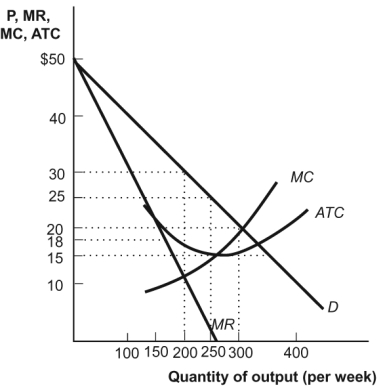 -(Figure: A Profit-Maximizing Monopoly Firm) Look at the figure A Profit-Maximizing Monopoly Firm. This firm's profit per unit is:
 (Multiple Choice)
4.9/5 (79)
(79) Monopolists are engaging in price discrimination when they charge all customers the same price.
(True/False)
4.7/5 (85)
(85) If a monopoly can engage in perfect price discrimination, then its marginal revenue is equal to price, in contrast to the usual situation for a monopoly, in which price is higher than marginal revenue.
(True/False)
4.9/5 (98)
(98) One of the major differences between a monopolist and a purely competitive firm is that the monopolist has a _____ demand curve, while the purely competitive firm has a _____ demand curve.
(Multiple Choice)
4.7/5 (74)
(74) Use the following to answer questions:
Figure: Short-Run Monopoly  -(Figure: Short-Run Monopoly) Look at the figure Short-Run Monopoly. The marginal cost of producing the profit-maximizing quantity is cost:
 (Multiple Choice)
4.9/5 (78)
(78) 
Filters
- Essay(0)
- Multiple Choice(0)
- Short Answer(0)
- True False(0)
- Matching(0)