



 Chat with AI
Exam 13: Monopoly

Exam 1: First Principles233 Questions
Exam 2: Economic Models: Trade-Offs and Trade 25382 Questions
Exam 3: Supply and Demand290 Questions
Exam 4: Consumer and Producer Surplus224 Questions
Exam 5: Price Controls and Quotas: Meddling With Markets227 Questions
Exam 6: Elasticity300 Questions
Exam 7: Taxes298 Questions
Exam 8: International Trade272 Questions
Exam 9: Decision Making by Individuals Firms201 Questions
Exam 10: The Rational Consumer372 Questions
Exam 11: Behind the Supply Curve: Inputs and Costs362 Questions
Exam 12: Perfect Competition and the Supply Curve355 Questions
Exam 13: Monopoly350 Questions
Exam 14: Oligopoly294 Questions
Exam 15: Monopolistic Competition and Product Differentiation262 Questions
Exam 16: Externalities199 Questions
Exam 17: Public Goods Common Resources224 Questions
Exam 18: The Economics of the Welfare140 Questions
Exam 19: Factor Markets and the Distribution of Income369 Questions
Exam 20: Uncertainty, Risk, and Private Information202 Questions
Select questions type


Temporary monopolies via the provision of sole ownership rights to profit from the production, use, or sale of a good are provided by:
(Multiple Choice)
5.0/5  (80)
(80) Of the four market structures, the only one that is characterized by product differentiation is oligopoly.
(True/False)
4.9/5 (73)
(73) An oligopoly that engages in price discrimination will charge higher prices to customers with the most elastic demand.
(True/False)
4.9/5 (54)
(54) For a monopolist to practice price discrimination successfully, its customers must all have the same willingness to pay for the good.
(True/False)
4.9/5 (89)
(89) The pricing in monopoly prevents some mutually beneficial trades. The value of these unrealized mutually beneficial trades is called:
(Multiple Choice)
4.8/5 (84)
(84) Suppose a perfectly competitive industry is suddenly transformed to a monopoly industry. What will happen to price, output, consumer and producer surplus, and deadweight loss?
(Essay)
5.0/5 (77)
(77) Use the following to answer questions:  -(Table: Demand for Lenny's Coffee) Look at the table Demand for Lenny's Coffee. Lenny's Café is the only source of coffee for hundreds of miles in any direction. If Lenny's marginal cost of selling coffee is a constant $2, his profit-maximizing level of output is _____ cups at _____ per cup.
 (Multiple Choice)
5.0/5 (80)
(80) Use the following to answer questions:  -(Table: Demand and Total Cost) Look at the table Demand and Total Cost. Lenoia runs a natural monopoly firm producing electricity for a small mountain village. The table shows Lenoia's demand and total cost of producing electricity. To maximize profits, Lenoia should charge a price of:
 (Multiple Choice)
4.9/5 (80)
(80) Use the following to answer questions:
Figure: Monopoly Model 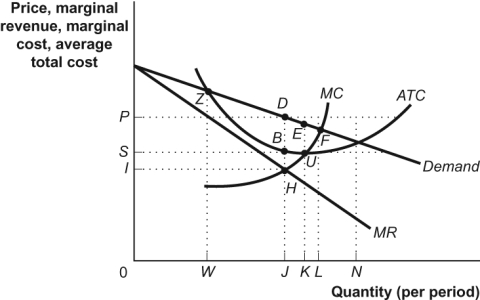 -(Figure: Monopoly Model) Look at the figure Monopoly Model. The profit-maximizing price is:
 (Multiple Choice)
4.9/5 (78)
(78) Use the following to answer questions:
Figure: The Profit-Maximizing Output and Price  -(Figure: The Profit-Maximizing Output and Price) Look at the figure The Profit-Maximizing Output and Price. Assume that there are no fixed costs and AC = MC = $200. At the profit-maximizing output and price for a perfectly competitive industry, deadweight loss is:
 (Multiple Choice)
4.8/5 (77)
(77) Because of monopoly, consumers experience _____ than with perfect competition.
(Multiple Choice)
4.9/5 (86)
(86) Use the following to answer questions:  -(Table: Lunch) Look at the figure Lunch. Joe makes and sells picnic lunches to people taking all-day rafting trips on the river. The marginal cost and average cost of each lunch are a constant $4. If Joe is one of many firms in a competitive industry, what is deadweight loss in the long run?
 (Multiple Choice)
4.8/5 (90)
(90) Use the following to answer questions:
Figure: A Profit-Maximizing Monopoly Firm 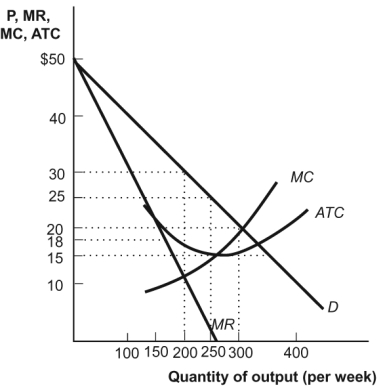 -(Figure: A Profit-Maximizing Monopoly Firm) Look at the figure A Profit-Maximizing Monopoly Firm. The firm in this figure will produce _____ units of output per week.
 (Multiple Choice)
4.9/5 (72)
(72) When price discrimination occurs, the producer's profit is _____ if the producer charges each customer the same profit-maximizing price where marginal revenue equals _____ cost.
(Multiple Choice)
4.8/5 (83)
(83) Natural monopolies are likely to include all of the following EXCEPT:
(Multiple Choice)
4.8/5 (72)
(72) For a monopolist with a downward-sloping demand curve, the quantity effect dominates the price effect at:
(Multiple Choice)
4.9/5 (70)
(70) 
Filters
- Essay(0)
- Multiple Choice(0)
- Short Answer(0)
- True False(0)
- Matching(0)