



 Chat with AI
Exam 13: Monopoly

Exam 1: First Principles233 Questions
Exam 2: Economic Models: Trade-Offs and Trade 25382 Questions
Exam 3: Supply and Demand290 Questions
Exam 4: Consumer and Producer Surplus224 Questions
Exam 5: Price Controls and Quotas: Meddling With Markets227 Questions
Exam 6: Elasticity300 Questions
Exam 7: Taxes298 Questions
Exam 8: International Trade272 Questions
Exam 9: Decision Making by Individuals Firms201 Questions
Exam 10: The Rational Consumer372 Questions
Exam 11: Behind the Supply Curve: Inputs and Costs362 Questions
Exam 12: Perfect Competition and the Supply Curve355 Questions
Exam 13: Monopoly350 Questions
Exam 14: Oligopoly294 Questions
Exam 15: Monopolistic Competition and Product Differentiation262 Questions
Exam 16: Externalities199 Questions
Exam 17: Public Goods Common Resources224 Questions
Exam 18: The Economics of the Welfare140 Questions
Exam 19: Factor Markets and the Distribution of Income369 Questions
Exam 20: Uncertainty, Risk, and Private Information202 Questions
Select questions type


Use the following to answer questions:
Figure: PPV 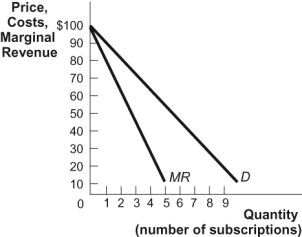 -(Figure: PPV) Look at the figure PPV, which shows the demand and marginal revenue for a pay-per-view football game on cable TV. Assume that the marginal cost and average cost are a constant $20. If the cable company is a monopoly, how much is producer surplus when the monopolist maximizes profit?
 (Multiple Choice)
4.9/5  (75)
(75) The GoSports Company is a profit-maximizing firm with a monopoly in the production of school team pennants. The firm sells its pennants for $10 each. We can conclude that GoSports is producing a level of output at which:
(Multiple Choice)
4.8/5 (78)
(78) Which of the following statements about monopoly equilibrium and perfectly competitive equilibrium is INCORRECT?
(Multiple Choice)
4.9/5 (68)
(68) Use the following to answer questions:
Figure: Computing Monopoly Profit 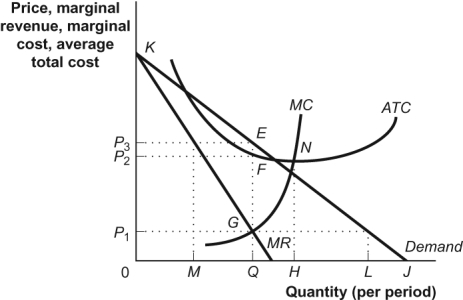 -(Figure: Computing Monopoly Profit) Look at the figure Computing Monopoly Profit. To obtain maximum profits, the monopoly should produce the output determined by point:
 (Multiple Choice)
4.7/5 (73)
(73) An increase in the fixed costs of a monopoly firm would _____ price and _____ quantity in the short run.
(Multiple Choice)
4.7/5 (74)
(74) Public policies toward monopoly in the United States often consist of:
(Multiple Choice)
4.8/5 (61)
(61) Use the following to answer questions:
Figure: Water Works 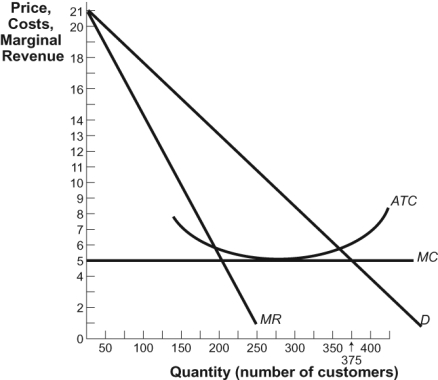 -(Figure: Water Works) Look at the figure Water Works, which describes a small town's water works, a natural monopoly. If regulators require the water works to charge the price that just covers average total cost, the water works will:
 (Multiple Choice)
4.9/5 (96)
(96) The main reason a monopoly engages in price discrimination is that:
(Multiple Choice)
4.7/5 (83)
(83) When a monopoly maximizes profit, the loss of surplus by consumers is _____ the monopolist's gain in profit.
(Multiple Choice)
4.8/5 (83)
(83) When regulating a natural monopoly, the government always sets a price ceiling where marginal cost intersects the demand curve.
(True/False)
4.9/5 (84)
(84) Use the following to answer questions:  -(Table: Lunch) Look at the figure Lunch. Joe makes and sells picnic lunches to people taking all-day rafting trips on the river. The marginal cost and average cost of each lunch are a constant $4. If Joe is a monopolist, what price will he charge for a lunch in the long run?
 (Multiple Choice)
4.7/5 (74)
(74) Use the following to answer questions:  -(Table: Prices and Demand) Look at the table Prices and Demand. The New Orleans Saints have a monopoly on Saints logo hats. The marginal cost of producing a hat is $18. If the Saints were a perfectly competitive firm in a perfectly competitive industry, at their profit-maximizing price and output producer surplus would be:
 (Multiple Choice)
4.8/5 (73)
(73) To practice price discrimination, the producer must have some control over the price of the product.
(True/False)
4.9/5 (76)
(76) Use the following to answer questions:
-(Table: Prices and Demand) Look at the table Prices and Demand. The New Orleans Saints have a monopoly on Saints logo hats. The marginal cost of producing a hat is $18. How much is deadweight loss at the Saint's profit-maximizing output?
-(Table: Prices and Demand) Look at the table Prices and Demand. The New Orleans Saints have a monopoly on Saints logo hats. The marginal cost of producing a hat is $18. How much is deadweight loss at the Saint's profit-maximizing output? (Multiple Choice)
4.9/5 (85)
(85) An industry with a single producer that sells a single product with no substitutes is a:
(Multiple Choice)
4.7/5 (78)
(78) In general, economists are critical of monopoly where there is (are):
(Multiple Choice)
4.9/5 (91)
(91) 
Filters
- Essay(0)
- Multiple Choice(0)
- Short Answer(0)
- True False(0)
- Matching(0)