



 Chat with AI
Exam 10: The Rational Consumer

Exam 1: First Principles233 Questions
Exam 2: Economic Models: Trade-Offs and Trade 25382 Questions
Exam 3: Supply and Demand290 Questions
Exam 4: Consumer and Producer Surplus224 Questions
Exam 5: Price Controls and Quotas: Meddling With Markets227 Questions
Exam 6: Elasticity300 Questions
Exam 7: Taxes298 Questions
Exam 8: International Trade272 Questions
Exam 9: Decision Making by Individuals Firms201 Questions
Exam 10: The Rational Consumer372 Questions
Exam 11: Behind the Supply Curve: Inputs and Costs362 Questions
Exam 12: Perfect Competition and the Supply Curve355 Questions
Exam 13: Monopoly350 Questions
Exam 14: Oligopoly294 Questions
Exam 15: Monopolistic Competition and Product Differentiation262 Questions
Exam 16: Externalities199 Questions
Exam 17: Public Goods Common Resources224 Questions
Exam 18: The Economics of the Welfare140 Questions
Exam 19: Factor Markets and the Distribution of Income369 Questions
Exam 20: Uncertainty, Risk, and Private Information202 Questions
Select questions type


The optimal consumption rule for all goods requires:

Free
(Multiple Choice)
4.9/5  (81)
(81) Correct Answer: Verified
C
Use the following to answer questions:
Figure: Indifference Curves and Consumption Bundles 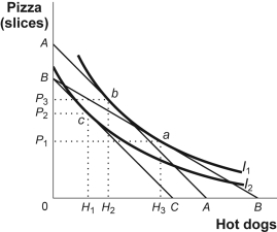 -(Figure: Indifference Curves and Consumption Bundles) Look at the figure Indifference Curves and Consumption Bundles. For this consumer pizza is a(n) _____ good and hot dogs are a(n) _____ good.
Free
(Multiple Choice)
4.9/5 (89)
(89) Correct Answer:Verified
VerifiedC
Jennifer has $10 to spend on tomatoes and cheese. The price of a pound of tomatoes is $2 and the price of a pound of cheese is $4. She has found her utility-maximizing bundle at 2 pounds of tomatoes and 1.5 pounds of cheese. Suppose Jennifer's income falls to $8 and the price of tomatoes falls to $1. The price of cheese remains the same. Jennifer is considering a bundle of no tomatoes and 2 units of cheese. What is your advice?
Free
(Essay)
4.9/5 (78)
(78) Correct Answer:Verified
VerifiedBefore the change to the budget constraint, Jennifer could afford 2 units of cheese and no tomatoes, but she did not choose this bundle. She can still afford her current bundle of 2 tomatoes and 4 pounds of cheese, so why would she choose something that she previously found inferior to the current bundle? Maybe she could even improve her utility with a bundle like 3 units of tomatoes and 1.25 pounds of cheese, but it is impossible to know.
Use the following to answer questions: 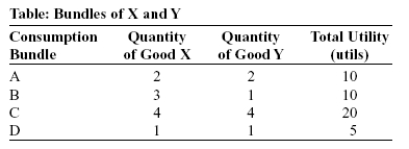 -(Table: Bundles of X and Y) Look at the table Bundles of X and Y. Bundle(s):
 (Multiple Choice)
4.7/5 (56)
(56) Use the following to answer questions:
Figure: Consumer Equilibrium I
The figure shows three of Owen's indifference curves for pizza and soda per week. Owen has $180 per month to spend on the two goods. The price of a pizza is $20, and the price of a soda is $1.50. 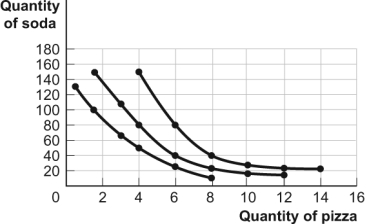 -(Figure: Consumer Equilibrium I) Look at the figure Consumer Equilibrium I. If Owen consumes 1.5 pizzas and 100 sodas, which of the following describes the relationship between his marginal rate of substitution of pizza for soda and the price of pizza in terms of soda?
 (Multiple Choice)
4.9/5 (83)
(83) Assume that Siri is consuming the utility-maximizing quantities of pork and chicken. We can conclude that:
(Multiple Choice)
5.0/5 (85)
(85) If a consumer derives more utility by spending an additional $1 on good X rather than on good Y:
(Multiple Choice)
4.8/5 (85)
(85) Use the following to answer questions:
Figure: Consumer Equilibrium I
The figure shows three of Owen's indifference curves for pizza and soda per week. Owen has $180 per month to spend on the two goods. The price of a pizza is $20, and the price of a soda is $1.50.
-(Figure: Consumer Equilibrium I) Look at the figure Consumer Equilibrium I. What is Owen's marginal rate of substitution of pizza for soda when he is consuming his optimal consumption bundle?
-(Figure: Consumer Equilibrium I) Look at the figure Consumer Equilibrium I. What is Owen's marginal rate of substitution of pizza for soda when he is consuming his optimal consumption bundle? (Multiple Choice)
4.8/5 (81)
(81) After learning about indifference curves, Sandy realizes that her marginal rate of substitution of grapes for cheese is 2. Since the price of cheese is $3 and the price of grapes is $1, Sandy:
(Multiple Choice)
4.8/5 (82)
(82) The income effect will play a greater role in a consumer's spending if the good:
(Multiple Choice)
4.8/5 (65)
(65) For economists, the satisfaction an individual derives from the consumption of goods and services is best described as:
(Multiple Choice)
4.7/5 (83)
(83) In economics, the ability of pumpkin pie to satisfy a want is referred to as its:
(Multiple Choice)
4.9/5 (68)
(68) Assume that two combinations of two goods yield the same level of satisfaction. We can conclude that these combinations are always on:
(Multiple Choice)
4.9/5 (75)
(75) Use the following to answer questions:  -(Table: Consumer Equilibrium) Look at the table Consumer Equilibrium. Assume that the price of both goods is $1 per unit, that you consume three units of good X and three units of good Y, and that you are spending all of your income. To maximize utility, assuming that the goods are divisible, you would consume _____ of X and _____ of Y.
 (Multiple Choice)
4.7/5 (70)
(70) Increases in the price of the good measured on the horizontal axis will make the horizontal intercept _____ and make the budget line _____.
(Multiple Choice)
4.8/5 (81)
(81) Suppose peanut butter is an inferior good for Ilya and the price of peanut butter rises. What will happen to Ilya's consumption of peanut butter?
(Multiple Choice)
4.8/5 (88)
(88) Use the following to answer questions:
Figure: The Optimal Consumption Bundle 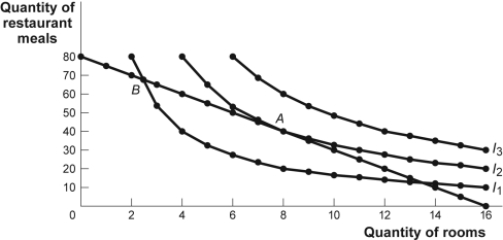 -(Figure: The Optimal Consumption Bundle) Look at the figure The Optimal Consumption Bundle. Which of the following could lead to an optimal consumption bundle on indifference curve I3?
 (Multiple Choice)
4.8/5 (73)
(73) Which of the following goods is MOST likely to display increasing marginal utility over some range?
(Multiple Choice)
4.8/5 (78)
(78) 
Filters
- Essay(0)
- Multiple Choice(0)
- Short Answer(0)
- True False(0)
- Matching(0)