



 Chat with AI
Exam 10: The Rational Consumer

Exam 1: First Principles233 Questions
Exam 2: Economic Models: Trade-Offs and Trade 25382 Questions
Exam 3: Supply and Demand290 Questions
Exam 4: Consumer and Producer Surplus224 Questions
Exam 5: Price Controls and Quotas: Meddling With Markets227 Questions
Exam 6: Elasticity300 Questions
Exam 7: Taxes298 Questions
Exam 8: International Trade272 Questions
Exam 9: Decision Making by Individuals Firms201 Questions
Exam 10: The Rational Consumer372 Questions
Exam 11: Behind the Supply Curve: Inputs and Costs362 Questions
Exam 12: Perfect Competition and the Supply Curve355 Questions
Exam 13: Monopoly350 Questions
Exam 14: Oligopoly294 Questions
Exam 15: Monopolistic Competition and Product Differentiation262 Questions
Exam 16: Externalities199 Questions
Exam 17: Public Goods Common Resources224 Questions
Exam 18: The Economics of the Welfare140 Questions
Exam 19: Factor Markets and the Distribution of Income369 Questions
Exam 20: Uncertainty, Risk, and Private Information202 Questions
Select questions type


Use the following to answer questions:
Figure: Consumer Equilibrium IV 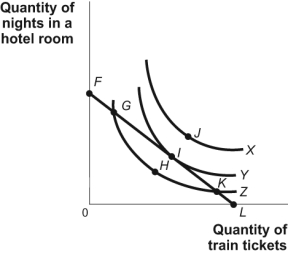 -(Figure: Consumer Equilibrium IV) Look at the figure Consumer Equilibrium IV. An unattainable level of utility, given budget constraint FL, is at point:
 (Multiple Choice)
4.7/5  (90)
(90) Tonya's budget constraint for gasoline (G) and clothes (C) each month can be expressed by the equation G = 100 - 2C. If the price of clothing is $10, the price of gasoline is _____ and the total amount of income spent on both clothing and gasoline each month is _____.
(Multiple Choice)
4.7/5 (75)
(75) Mr. Coiner is always willing to exchange two nickels for a dime, no matter how many nickels and dimes he has. This implies that nickels and dimes are ordinary goods for Mr. Coiner.
(True/False)
4.9/5 (77)
(77) George has a weekly income (I) of $50, which he uses to purchase doughnuts (D) and coffee (C). The price of a doughnut is $1 and the price of coffee is $2.50. Suppose George's income drops to $25 and the prices of doughnuts and coffee each fall to one-half their initial prices. One would expect George's budget line to:
(Multiple Choice)
4.9/5 (72)
(72) If two combinations of two goods yield the same level of satisfaction, then they are on:
(Multiple Choice)
4.8/5 (71)
(71) The utility of a good is determined by how much _____ a particular consumer obtains from it.
(Multiple Choice)
4.7/5 (71)
(71) When the price of Spam (an inferior good) decreased, Dale bought more Spam. For Dale, the income and substitution effects moved in the same direction.
(True/False)
4.9/5 (94)
(94) Joseph chooses a combination of apples and oranges along his budget line. The marginal rate of substitution of apples for oranges is 2, the price of an apple is $0.50, and the price of an orange is $0.50. Joseph:
(Multiple Choice)
4.8/5 (75)
(75) Ms. Sweettooth always consumes iced tea and sugar in fixed proportions: 8 ounces of iced tea to 3 teaspoons of sugar. This implies that for Ms. Sweettooth the marginal rate of substitution of iced tea for sugar is:
(Multiple Choice)
4.9/5 (90)
(90) When an individual's consumption of an additional unit of a good generates a smaller increase in total utility than the previous unit consumed, then this person's indifference curve will be:
(Multiple Choice)
4.8/5 (78)
(78) John consumes pizza and pasta, both normal goods. He is maximizing his utility in consumption of both goods. The price of pasta rises. Assuming that diminishing marginal utility applies to both goods, as he adjusts to this event, the marginal utility of pizza will _____, and the marginal utility of pasta will _____.
(Multiple Choice)
4.9/5 (81)
(81) If marginal utility is diminishing, the marginal utility curve is _____, since each additional unit of the good consumed yields _____ satisfaction.
(Multiple Choice)
4.7/5 (92)
(92) As an individual moves down his or her indifference curve, total utility remains constant.
(True/False)
4.8/5 (91)
(91) George has a weekly income (I) of $50, which he uses to purchase doughnuts (D) and coffee (C). The price of a doughnut is $1 and the price of coffee is $2.50. Suppose George's income increases to $100 and the prices of both doughnuts and coffee remain unchanged. Given this income change, one would expect George's budget line:
(Multiple Choice)
4.9/5 (92)
(92) Use the following to answer questions:
Figure: Oreos and Apples 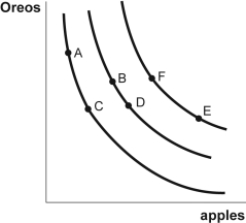 -(Figure: Oreos and Apples) Look at the figure Oreos and Apples, which provides an indifference curve map for Diego. Diego prefers:
 (Multiple Choice)
4.9/5 (82)
(82) Jaime enjoys both iced tea and hot dogs. Explain why Jaime's indifference curves for these two goods must slope downward.
(Essay)
4.8/5 (70)
(70) If the price of coffee cups falls and the consumer decides to buy more coffee cups solely because they are less expensive, this describes the:
(Multiple Choice)
4.9/5 (70)
(70) Jake considers fries and onion rings perfect substitutes. The indifference curve between fries and onion rings must be:
(Multiple Choice)
4.8/5 (80)
(80) According to the relative price rule, the optimal consumption bundle between hot dogs and beer takes place when the _____ rate of substitution is _____ their relative price.
(Multiple Choice)
4.8/5 (63)
(63) 
Filters
- Essay(0)
- Multiple Choice(0)
- Short Answer(0)
- True False(0)
- Matching(0)