



 Chat with AI
Exam 10: The Rational Consumer

Exam 1: First Principles233 Questions
Exam 2: Economic Models: Trade-Offs and Trade 25382 Questions
Exam 3: Supply and Demand290 Questions
Exam 4: Consumer and Producer Surplus224 Questions
Exam 5: Price Controls and Quotas: Meddling With Markets227 Questions
Exam 6: Elasticity300 Questions
Exam 7: Taxes298 Questions
Exam 8: International Trade272 Questions
Exam 9: Decision Making by Individuals Firms201 Questions
Exam 10: The Rational Consumer372 Questions
Exam 11: Behind the Supply Curve: Inputs and Costs362 Questions
Exam 12: Perfect Competition and the Supply Curve355 Questions
Exam 13: Monopoly350 Questions
Exam 14: Oligopoly294 Questions
Exam 15: Monopolistic Competition and Product Differentiation262 Questions
Exam 16: Externalities199 Questions
Exam 17: Public Goods Common Resources224 Questions
Exam 18: The Economics of the Welfare140 Questions
Exam 19: Factor Markets and the Distribution of Income369 Questions
Exam 20: Uncertainty, Risk, and Private Information202 Questions
Select questions type


Janella consumes only bananas and passion fruit. It is not possible for Janella's indifference curves to cross one another at any point.
(True/False)
4.9/5  (98)
(98) Two consumers, Eric and Eli, have the same preferences for good X, a normal good. The only difference is that for Eli there would be no income effect if the price of good X changed. For Eric, there are both income and substitution effects for a price change. What does this tell you about Eric's and Eli's demand for good X? Explain.
(Essay)
4.8/5 (89)
(89) For a Giffen good, the income effect works in the opposite direction from the substitution effect, and the income effect is larger than the substitution effect.
(True/False)
4.8/5 (82)
(82) To say that you can't have too much of a good thing means that for any good that you enjoy (for example, pizza):
(Multiple Choice)
4.8/5 (80)
(80) Use the following to answer question: 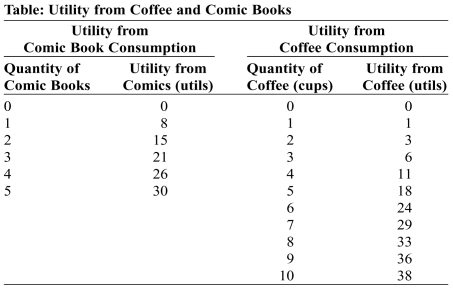 -(Table: Utility from Coffee and Comic Books) Look at the table Utility from Coffee and Comic Books. Your eccentric professor has a daily budget of $40, and he spends it entirely on coffee and comic books. Each comic book is priced at $8 and each cup of coffee is priced at $4. To maximize his utility, how many cups of coffee and how many comic books should he buy? How many total utils will he enjoy?
 (Essay)
4.7/5 (89)
(89) Mikaela is buying a new motorcycle. She has narrowed her choices to a BMW Classic Montauk or a Honda Valkyrie Rune. She likes the Honda exactly twice as much, but it costs about 40% more. If both bikes are in her budget, she should buy the Honda.
(True/False)
4.8/5 (75)
(75) As a consumer gives up some of good A, which is on the horizontal axis, to get more of good B, which is on the vertical axis, his or her marginal rate of substitution of good A for good B:
(Multiple Choice)
4.9/5 (81)
(81) Use the following to answer questions:
Figure: Consumer Equilibrium II 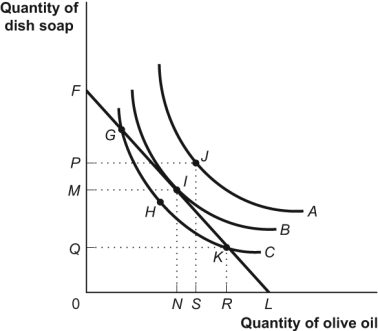 -(Figure: Consumer Equilibrium II) Look at the figure Consumer Equilibrium II. Ashyra consumes at point G. Ashyra would be able to realize more total utility by choosing point _____, all other things held equal.
 (Multiple Choice)
5.0/5 (85)
(85) Jie consumes three heads of broccoli and six bowls of rice each week. The price of a head of broccoli is $2 and the price of rice is $4 per bowl. Jie's marginal utility from the last head of broccoli consumed is 4 utils and her marginal utility from her last bowl of rice is 8 utils. If Jie wants to maximize her utility, she should:
(Multiple Choice)
4.9/5 (95)
(95) An indifference curve is a line showing all of the consumption bundles that:
(Multiple Choice)
5.0/5 (78)
(78) If, for Adam, the marginal utility of ties is greater than the marginal utility of shirts, to maximize utility, Adam should:
(Multiple Choice)
4.9/5 (62)
(62) If good A is a normal good and its price decreases, the _____ effect will cause a(n) _____ in consumption of it.
(Multiple Choice)
4.8/5 (80)
(80) An indifference curve shows combinations of two goods that yield:
(Multiple Choice)
4.8/5 (83)
(83) Calculating the marginal rate of substitution assumes that _____ remain(s) unchanged.
(Multiple Choice)
4.8/5 (82)
(82) Frank buys only milk and cereal, both of which are normal goods, and he always maximizes his utility. Frank's boss cuts Frank's pay by $200 per month. What happens to Frank's marginal rate of substitution between milk and cereal?
(Multiple Choice)
4.9/5 (79)
(79) The consumption bundles that Mei CAN afford but that do not use up her entire income lie _____ the budget line.
(Multiple Choice)
4.8/5 (81)
(81) Consumers buy both alcoholic and nonalcoholic beverages. If the government tries to discourage people from drinking alcoholic beverages by imposing an excise tax on them but gives consumers an income subsidy to keep the consumers on their original indifference curves:
(Multiple Choice)
4.9/5 (77)
(77) 
Filters
- Essay(0)
- Multiple Choice(0)
- Short Answer(0)
- True False(0)
- Matching(0)