



 Chat with AI
Exam 8: International Trade

Exam 1: First Principles233 Questions
Exam 2: Economic Models: Trade-Offs and Trade 25382 Questions
Exam 3: Supply and Demand290 Questions
Exam 4: Consumer and Producer Surplus224 Questions
Exam 5: Price Controls and Quotas: Meddling With Markets227 Questions
Exam 6: Elasticity300 Questions
Exam 7: Taxes298 Questions
Exam 8: International Trade272 Questions
Exam 9: Decision Making by Individuals Firms201 Questions
Exam 10: The Rational Consumer372 Questions
Exam 11: Behind the Supply Curve: Inputs and Costs362 Questions
Exam 12: Perfect Competition and the Supply Curve355 Questions
Exam 13: Monopoly350 Questions
Exam 14: Oligopoly294 Questions
Exam 15: Monopolistic Competition and Product Differentiation262 Questions
Exam 16: Externalities199 Questions
Exam 17: Public Goods Common Resources224 Questions
Exam 18: The Economics of the Welfare140 Questions
Exam 19: Factor Markets and the Distribution of Income369 Questions
Exam 20: Uncertainty, Risk, and Private Information202 Questions
Select questions type


Which of the following oversees international trade agreements?

Free
(Multiple Choice)
4.9/5  (83)
(83) Correct Answer: Verified
B
The infant industry argument for trade protection states that:
Free
(Multiple Choice)
4.8/5 (76)
(76) Correct Answer:Verified
VerifiedB
In a single year, Argentina can raise 100 tons of beef or produce 1,000 boxes of tulips. In the same growing season, Venezuela can raise 50 tons of beef or produce 750 boxes of tulips. When the two countries begin trading beef for tulips, we expect the price of beef in Venezuela:
Free
(Multiple Choice)
4.9/5 (91)
(91) Correct Answer:Verified
VerifiedA
In a single year, the Netherlands can raise 100 tons of beef or produce 1,000 boxes of tulips. In the same growing season, Belgium can raise 50 tons of beef or produce 750 boxes of tulips. In autarky, the opportunity cost of 1 ton of beef in the Netherlands is:
(Multiple Choice)
4.8/5 (71)
(71) Although U.S. exports and imports have grown substantially in absolute terms since the 1960s, the share of exports and imports in total output has fallen significantly over the past few decades.
(True/False)
4.7/5 (79)
(79) In autarky, the amount of a country's production and consumption of a good must be identical.
(True/False)
4.9/5 (89)
(89) Use the following to answer questions:
Scenario: The Production of Wheat and Toys 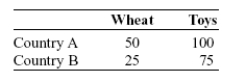 The table describes the production of two goods, wheat and toys, in country A and country B. Each country has a linear production possibility frontier with respect to its production of the two goods. The numbers in each column represent the total number of units each country could produce if it used all of its resources to produce the good.
-(Scenario: The Production of Wheat and Toys) Look at the scenario Production of Wheat and Toys. If each country specializes in the good for which it has the comparative advantage, then the price of wheat in terms of toys will be:
The table describes the production of two goods, wheat and toys, in country A and country B. Each country has a linear production possibility frontier with respect to its production of the two goods. The numbers in each column represent the total number of units each country could produce if it used all of its resources to produce the good.
-(Scenario: The Production of Wheat and Toys) Look at the scenario Production of Wheat and Toys. If each country specializes in the good for which it has the comparative advantage, then the price of wheat in terms of toys will be: (Multiple Choice)
4.9/5 (77)
(77) Over the past 50 years in the United States, as a percentage of gross domestic product:
(Multiple Choice)
4.8/5 (69)
(69) Use the following to answer questions:
Figure: The Market for Calculators 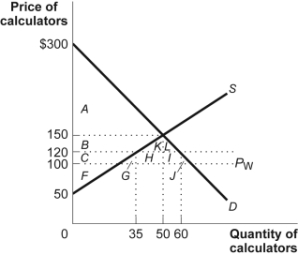 -(Figure: The Market for Calculators) Look at the figure The Market for Calculators. Assume that S and D represent the domestic demand and supply of calculators. The world price, PW, equals $100. The government imposes an import tariff of $20 per calculator. Compared with the free trade situation, the tariff leads to a deadweight loss equal to area:
 (Multiple Choice)
4.8/5 (89)
(89) An economy moves from autarky to free international trade. In the import sector consumer surplus _____, producer surplus _____, and the economy as a whole _____.
(Multiple Choice)
4.8/5 (77)
(77) If labor is scarce in Sri Lanka but capital is abundant, when Sri Lanka opens to trade, the price of labor will _____ and the price of capital will _____.
(Multiple Choice)
5.0/5 (61)
(61) Use the following to answer questions:  -(Table: Production Possibilities for Machinery and Petroleum) Look at the table Production Possibilities for Machinery and Petroleum. The opportunity cost in Mexico of producing 10 units of machinery is _____ units of petroleum.
 (Multiple Choice)
4.8/5 (72)
(72) Since the United States imports a large quantity of textiles from Asia, the overall wages of U.S. textile workers has _____, while the price of textiles in the United States has _____.
(Multiple Choice)
4.7/5 (82)
(82) Mexico produces lettuce but can also import it. If Mexico imports some lettuce:
(Multiple Choice)
4.9/5 (73)
(73) Assume an economy moves from autarky to free international trade. In the export sector, consumer surplus _____, producer surplus _____, and the economy as a whole _____.
(Multiple Choice)
4.8/5 (87)
(87) Taken collectively, people in nations that engage in international trade are not likely to:
(Multiple Choice)
4.9/5 (84)
(84) Use the following to answer questions:
Figure: The Market for Laptop Sleeves 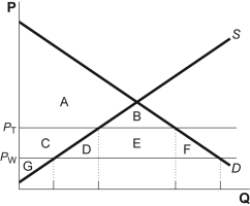 -(Figure: The Market for Laptop Sleeves) Look at the figure The Market for Laptop Sleeves. Assume that S and D are the domestic supply and demand curves and the world price is PW. Identify the area of consumer surplus when a tariff raises the domestic price from the world price to PT.
 (Multiple Choice)
4.9/5 (89)
(89) According to the Heckscher-Ohlin model, Brazil will have a comparative advantage in oranges if the factors _____ in the production of oranges are _____.
(Multiple Choice)
4.8/5 (81)
(81) Suppose the United States auctioned off all import quotas, the auctions were perfectly competitive, and the government received the revenues from the auction. In this case, the deadweight loss from a quota would be _____ the deadweight loss from an equivalent tariff.
(Multiple Choice)
4.9/5 (71)
(71) 
Filters
- Essay(0)
- Multiple Choice(0)
- Short Answer(0)
- True False(0)
- Matching(0)