



 Chat with AI
Exam 8: International Trade

Exam 1: First Principles233 Questions
Exam 2: Economic Models: Trade-Offs and Trade 25382 Questions
Exam 3: Supply and Demand290 Questions
Exam 4: Consumer and Producer Surplus224 Questions
Exam 5: Price Controls and Quotas: Meddling With Markets227 Questions
Exam 6: Elasticity300 Questions
Exam 7: Taxes298 Questions
Exam 8: International Trade272 Questions
Exam 9: Decision Making by Individuals Firms201 Questions
Exam 10: The Rational Consumer372 Questions
Exam 11: Behind the Supply Curve: Inputs and Costs362 Questions
Exam 12: Perfect Competition and the Supply Curve355 Questions
Exam 13: Monopoly350 Questions
Exam 14: Oligopoly294 Questions
Exam 15: Monopolistic Competition and Product Differentiation262 Questions
Exam 16: Externalities199 Questions
Exam 17: Public Goods Common Resources224 Questions
Exam 18: The Economics of the Welfare140 Questions
Exam 19: Factor Markets and the Distribution of Income369 Questions
Exam 20: Uncertainty, Risk, and Private Information202 Questions
Select questions type


Use the following to answer questions:  -(Table: The Production Possibilities for Tractors and Crude Oil) Look at the table The Production Possibilities for Tractors and Crude Oil. _____ has (have) an absolute advantage in producing tractors.
 (Multiple Choice)
4.8/5  (77)
(77) Use the following to answer questions:
Figure: The Domestic Supply and Demand for SUVs in the United States 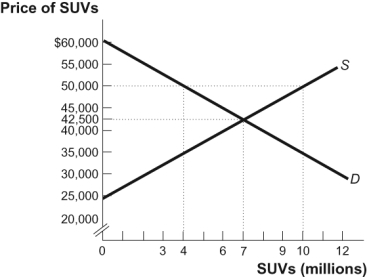 -(Figure: The Domestic Supply and Demand for SUVs in the United States) Look at the figure The Domestic Supply and Demand for SUVs in the United States. Suppose the world price equals $50,000 and there is free trade. In the United States, consumer surplus would _____ and producer surplus would _____.
 (Multiple Choice)
4.8/5 (90)
(90) The Ricardian model of international trade assumes that countries have the usual bowed-out (concave to the origin) production possibility frontiers.
(True/False)
4.8/5 (69)
(69) In the importing country, the most likely effect of a tariff is to:
(Multiple Choice)
4.7/5 (81)
(81) Use the following to answer questions:
-(Table: The Production Possibilities for Tractors and Crude Oil) Look at the table The Production Possibilities for Tractors and Crude Oil. Both the United States and Mexico will gain from trade if one tractor trades for _____ barrels of crude oil.
-(Table: The Production Possibilities for Tractors and Crude Oil) Look at the table The Production Possibilities for Tractors and Crude Oil. Both the United States and Mexico will gain from trade if one tractor trades for _____ barrels of crude oil. (Multiple Choice)
4.9/5 (81)
(81) Use the following to answer questions:
Figure: The Production Possibility Frontiers for Jackson and Tahoe  -(Figure: The Production Possibility Frontiers for Jackson and Tahoe) Look at the figure The Production Possibility Frontiers for Jackson and Tahoe. Jackson has an absolute advantage in producing:
 (Multiple Choice)
4.8/5 (71)
(71) Policies that limit imports, usually to insulate domestic producers from foreign competition, are known as:
(Multiple Choice)
5.0/5 (70)
(70) Use the following to answer questions:
Figure: The Production Possibilities for Two Countries  -(Figure: The Production Possibilities for Two Countries) Look at the figure The Production Possibilities for Two Countries. The opportunity cost of producing 1 tire in Indonesia is _____ radio(s), while the opportunity cost of producing 1 tire in Malaysia is _____ radio(s).
 (Multiple Choice)
4.8/5 (78)
(78) Use the following to answer questions:
Figure: The Market for Computers 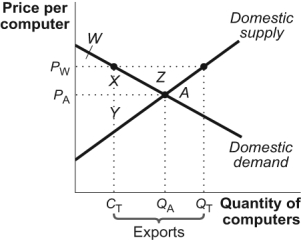 -(Figure: The Market for Computers) Look at the figure The Market for Computers. Assume that PA is the autarky price and PW is the world price. Producer surplus with international trade would be area:
 (Multiple Choice)
4.7/5 (86)
(86) Use the following to answer questions:
Figure: The Production Possibilities for Two Countries
-(Figure: The Production Possibilities for Two Countries) Look at the figure The Production Possibilities for Two Countries. If Indonesia and Malaysia trade 1 radio for 1 tire, the most that Indonesia can consume is _____ radios and _____ tires, while the most that Malaysia can consume is _____ radios and _____ tires.
-(Figure: The Production Possibilities for Two Countries) Look at the figure The Production Possibilities for Two Countries. If Indonesia and Malaysia trade 1 radio for 1 tire, the most that Indonesia can consume is _____ radios and _____ tires, while the most that Malaysia can consume is _____ radios and _____ tires. (Multiple Choice)
4.9/5 (87)
(87) If the _____ differ(s) between two countries, this suggests the possibility for mutually advantageous trade.
(Multiple Choice)
4.9/5 (81)
(81) Use the following to answer questions:
Figure: The Market for Melons in Russia II 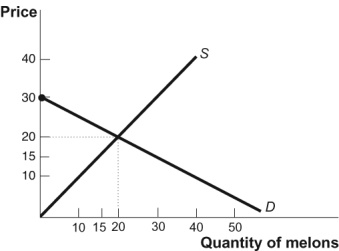 -(Figure: The Markets for Melons in Russia II) Look at the figure The Market for Melons in Russia II. Suppose producers lobby effectively for the imposition of a tariff that raises the world price from $10 to $15. Tariff revenue to the government will equal:
 (Multiple Choice)
5.0/5 (85)
(85) Use the following to answer questions:
Figure: The Market for Melons in Russia 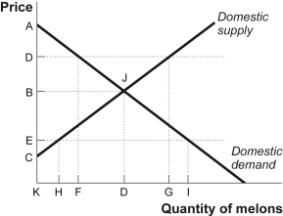 -(Figure: The Markets for Melons in Russia) Look at the figure The Market for Melons in Russia. Suppose the world price of melons is D. Russia will _____ of melons.
 (Multiple Choice)
4.9/5 (74)
(74) Use the following to answer questions:
-(Table: The Production Possibilities for Tractors and Crude Oil) Look at the table The Production Possibilities for Tractors and Crude Oil. In Mexico the opportunity cost of producing 40 tractors is _____ barrels of crude oil.
-(Table: The Production Possibilities for Tractors and Crude Oil) Look at the table The Production Possibilities for Tractors and Crude Oil. In Mexico the opportunity cost of producing 40 tractors is _____ barrels of crude oil. (Multiple Choice)
4.7/5 (80)
(80) Use the following to answer questions: 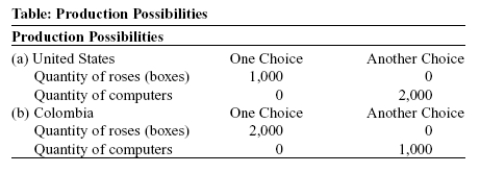 -(Table: Production Possibilities) Look at the table Production Possibilities. The opportunity cost of 1 computer for _____ is _____ box(es) of roses.
 (Multiple Choice)
4.9/5 (87)
(87) If labor is abundant in South Africa but capital is scarce, when South Africa opens to trade, the price of labor will _____ and the price of capital will _____.
(Multiple Choice)
4.9/5 (75)
(75) An urbanized country has 100 million workers living on 100 square miles of land. A country that is principally rural has 1 million workers living on 10 square miles of land. From this information we know that the urbanized country is _____ relative to the rural country.
(Multiple Choice)
4.7/5 (78)
(78) Import tariffs always benefit domestic producers more than they hurt domestic consumers.
(True/False)
4.9/5 (73)
(73) 
Filters
- Essay(0)
- Multiple Choice(0)
- Short Answer(0)
- True False(0)
- Matching(0)