



 Chat with AI
Exam 8: International Trade

Exam 1: First Principles233 Questions
Exam 2: Economic Models: Trade-Offs and Trade 25382 Questions
Exam 3: Supply and Demand290 Questions
Exam 4: Consumer and Producer Surplus224 Questions
Exam 5: Price Controls and Quotas: Meddling With Markets227 Questions
Exam 6: Elasticity300 Questions
Exam 7: Taxes298 Questions
Exam 8: International Trade272 Questions
Exam 9: Decision Making by Individuals Firms201 Questions
Exam 10: The Rational Consumer372 Questions
Exam 11: Behind the Supply Curve: Inputs and Costs362 Questions
Exam 12: Perfect Competition and the Supply Curve355 Questions
Exam 13: Monopoly350 Questions
Exam 14: Oligopoly294 Questions
Exam 15: Monopolistic Competition and Product Differentiation262 Questions
Exam 16: Externalities199 Questions
Exam 17: Public Goods Common Resources224 Questions
Exam 18: The Economics of the Welfare140 Questions
Exam 19: Factor Markets and the Distribution of Income369 Questions
Exam 20: Uncertainty, Risk, and Private Information202 Questions
Select questions type


Britain must give up the production of 75 hats to produce 25 additional sweaters. The opportunity cost of producing 3 hats is _____ sweater(s).
(Multiple Choice)
4.7/5  (79)
(79) Use the following to answer questions:
Figure: The Production Possibility Frontiers for Jackson and Tahoe  -(Figure: The Production Possibility Frontiers for Jackson and Tahoe) Look at the figure The Production Possibility Frontiers for Jackson and Tahoe. In autarky, Jackson produces and consumes 30 head of cattle and 80 bushels of wheat, while Tahoe produces and consumes 80 head of cattle and 60 bushels of wheat. Each nation specializes completely, based on comparative advantage, and the price of 1 head of cattle equals the price of 2 bushels of wheat. If Jackson exports 120 bushels of wheat to Tahoe, then the new consumption point for Tahoe after trade is _____ bushels of wheat and _____head of cattle.
 (Multiple Choice)
4.9/5 (77)
(77) Assume that a tariff is imposed on Chinese imports into the United States. This tariff is likely to _____ U.S. producers and _____ Chinese producers.
(Multiple Choice)
4.7/5 (76)
(76) Use the following to answer questions:  -(Table: The Production Possibilities for Tractors and Crude Oil) Look at the table The Production Possibilities for Tractors and Crude Oil. In the United States the opportunity cost of producing 40 tractors is _____ barrels of crude oil.
 (Multiple Choice)
4.8/5 (90)
(90) Use the following to answer questions:  -(Table: Production Possibilities for Machinery and Petroleum) Look at the table Production Possibilities for Machinery and Petroleum. The opportunity cost in Mexico of producing 105 units of petroleum is _____ units of machinery.
 (Multiple Choice)
4.7/5 (76)
(76) Use the following to answer questions:
Figure: The Market for Roses 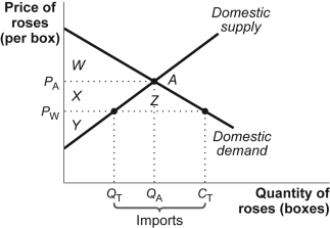 -(Figure: The Market for Roses) Look at the figure The Market for Roses. Assume that PA is the autarky price and PW is the world price. Producer surplus with international trade would be area:
 (Multiple Choice)
4.7/5 (77)
(77) Use the following to answer questions:
Figure: The Production Possibility Frontiers for Jackson and Tahoe
-(Figure: The Production Possibility Frontiers for Jackson and Tahoe) Look at the figure The Production Possibility Frontiers for Jackson and Tahoe. Tahoe has an absolute advantage in producing:
-(Figure: The Production Possibility Frontiers for Jackson and Tahoe) Look at the figure The Production Possibility Frontiers for Jackson and Tahoe. Tahoe has an absolute advantage in producing: (Multiple Choice)
4.9/5 (82)
(82) Some advocates of trade protection in the domestic market for steel argue that it is needed to protect domestic steelworkers' jobs. Why are economists usually unconvinced by this argument?
(Essay)
4.9/5 (80)
(80) When a country moves from autarky to free international trade, consumers and producers in the import and export sectors all gain (i.e., both consumer surplus and producer surplus increase in both sectors).
(True/False)
4.7/5 (77)
(77) The _____ analyzes trade under the assumption that opportunity costs are constant and therefore production possibility frontiers are straight lines.
(Multiple Choice)
4.7/5 (87)
(87) Use the following to answer questions:
-(Table: The Production Possibilities for Tractors and Crude Oil) Look at the table The Production Possibilities for Tractors and Crude Oil. In the United States the opportunity cost of producing 30,000 barrels of crude oil is _____ tractors.
-(Table: The Production Possibilities for Tractors and Crude Oil) Look at the table The Production Possibilities for Tractors and Crude Oil. In the United States the opportunity cost of producing 30,000 barrels of crude oil is _____ tractors. (Multiple Choice)
4.9/5 (89)
(89) Use the following to answer questions:
Figure: The Domestic Market for Rice 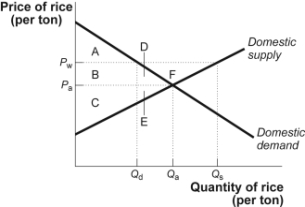 -(Figure: The Domestic Market for Rice) Look at the figure The Domestic Market for Rice. Assume that PA is the autarky price and PW is the world price. Before international trade, consumer surplus is equal to the area:
 (Multiple Choice)
4.8/5 (80)
(80) Use the following to answer question:
Figure: The Market for Digital Cameras with Tariff 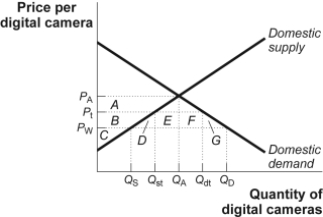 -(Figure: The Market for Digital Cameras with Tariff) Look at the figure The Market for Digital Cameras with Tariff. The domestic price is PA and the world price is PW. The government decides to impose a tariff on each imported digital camera, and the new price is Pt. Identify the area corresponding to the tax revenue collected by the government. Identify the area corresponding to the deadweight loss that results from the tariff.
 (Essay)
4.7/5 (77)
(77) Use the following to answer questions:  -(Table: Production Possibilities for the United States and Canada) Look at the table Production Possibilities for the United States and Canada. _____ has (have) an absolute advantage in producing lumber.
 (Multiple Choice)
4.8/5 (83)
(83) Use the following to answer questions:
Figure: The Market for Melons in Russia II 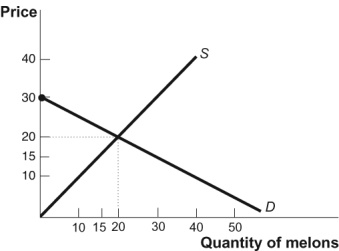 -(Figure: The Markets for Melons in Russia II) Look at the figure The Market for Melons in Russia II. If the world price is $10 and a tariff of $5 is imposed on this market, the burden of the tariff will be borne by:
 (Multiple Choice)
4.9/5 (95)
(95) When a country exchanges goods with another country, in the short run:
(Multiple Choice)
5.0/5 (87)
(87) Since the production of clothing is labor-intensive relative to the production of wheat and China is labor-abundant relative to most countries, we expect China to export clothing.
(True/False)
4.8/5 (89)
(89) Use the following to answer questions:
Figure: A Tariff on Oranges in South Africa 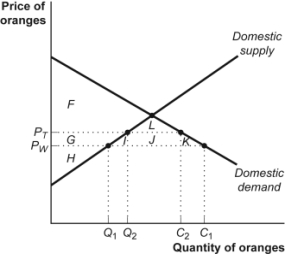 -(Figure: A Tariff on Oranges in South Africa) Look at the figure A Tariff on Oranges in South Africa. When the government imposes a tariff on imported oranges, the price of oranges in South Africa rises from PW to PT and there's a net _____ to total surplus of _____.
 (Multiple Choice)
4.9/5 (61)
(61) 
Filters
- Essay(0)
- Multiple Choice(0)
- Short Answer(0)
- True False(0)
- Matching(0)