



 Chat with AI
Exam 8: International Trade

Exam 1: First Principles233 Questions
Exam 2: Economic Models: Trade-Offs and Trade 25382 Questions
Exam 3: Supply and Demand290 Questions
Exam 4: Consumer and Producer Surplus224 Questions
Exam 5: Price Controls and Quotas: Meddling With Markets227 Questions
Exam 6: Elasticity300 Questions
Exam 7: Taxes298 Questions
Exam 8: International Trade272 Questions
Exam 9: Decision Making by Individuals Firms201 Questions
Exam 10: The Rational Consumer372 Questions
Exam 11: Behind the Supply Curve: Inputs and Costs362 Questions
Exam 12: Perfect Competition and the Supply Curve355 Questions
Exam 13: Monopoly350 Questions
Exam 14: Oligopoly294 Questions
Exam 15: Monopolistic Competition and Product Differentiation262 Questions
Exam 16: Externalities199 Questions
Exam 17: Public Goods Common Resources224 Questions
Exam 18: The Economics of the Welfare140 Questions
Exam 19: Factor Markets and the Distribution of Income369 Questions
Exam 20: Uncertainty, Risk, and Private Information202 Questions
Select questions type


Use the following to answer questions:
Figure: The Market for Tea in Sri Lanka 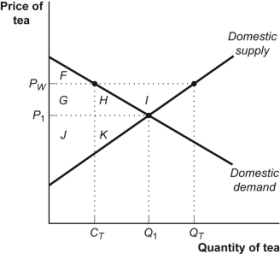 -(Figure: The Market for Tea in Sri Lanka) Look at the figure The Market for Tea in Sri Lanka. In autarky, the price is P1. When the economy is opened to trade, the price rises to PW. Sri Lanka will _____ tea and the volume of trade will equal _____.
 (Multiple Choice)
4.8/5  (78)
(78) Use the following to answer questions:  -(Table: The Production Possibilities for Tractors and Crude Oil) Look at the table The Production Possibilities for Tractors and Crude Oil. Which of the following is TRUE?
 (Multiple Choice)
4.8/5 (73)
(73) If quota rents do not accrue to the government, then the net loss to the government from an import quota is _____ the deadweight loss from an equivalent tariff.
(Multiple Choice)
4.9/5 (77)
(77) Use the following to answer questions:
Figure: The Market for Tea in Sri Lanka
-(Figure: The Market for Tea in Sri Lanka) Look at the figure The Market for Tea in Sri Lanka. In autarky, the price is P1. When the economy is opened to trade, the price rises to PW and consumer surplus _____ to _____.
-(Figure: The Market for Tea in Sri Lanka) Look at the figure The Market for Tea in Sri Lanka. In autarky, the price is P1. When the economy is opened to trade, the price rises to PW and consumer surplus _____ to _____. (Multiple Choice)
4.9/5 (66)
(66) The absolute value of the slope of the production possibility frontier at any point:
(Multiple Choice)
4.9/5 (80)
(80) Use the following to answer questions:
Figure: The Market for Thumb Drives 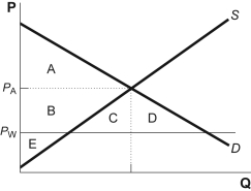 -(Figure: The Market for Thumb Drives) Look at the figure The Market for Thumb Drives. Assume that PA is the autarky price, PW is the world price, and D and S represent domestic demand and supply, respectively. The loss of producer surplus when the market moves from autarky to free trade equals the area:
 (Multiple Choice)
4.8/5 (91)
(91) Use the following to answer questions:
Figure: The Domestic Supply and Demand for SUVs in the United States 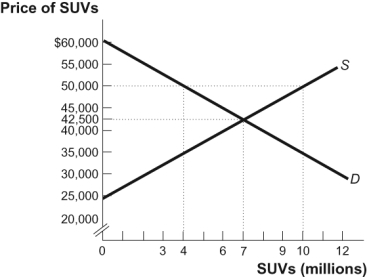 -(Figure: The Domestic Supply and Demand for SUVs in the United States) Look at the figure The Domestic Supply and Demand for SUVs in the United States. Suppose the world price equals $50,000 and there is free trade. The United States would _____ SUVs.
 (Multiple Choice)
4.8/5 (85)
(85) Use the following to answer questions:  -(Table: Production Possibilities for the United States and Canada) Look at the table Production Possibilities for the United States and Canada. Both nations can produce cars and lumber. In _____, the opportunity cost of _____ cars is _____ board feet of lumber.
 (Multiple Choice)
4.8/5 (86)
(86) Use the following to answer questions:
Figure: The Domestic Supply and Demand for SUVs in the United States
-(Figure: The Domestic Supply and Demand for SUVs in the United States) Look at the figure The Domestic Supply and Demand for SUVs in the United States. Suppose the world price equals $50,000 and there is free trade. Calculate the loss of consumer surplus.
-(Figure: The Domestic Supply and Demand for SUVs in the United States) Look at the figure The Domestic Supply and Demand for SUVs in the United States. Suppose the world price equals $50,000 and there is free trade. Calculate the loss of consumer surplus. (Multiple Choice)
4.9/5 (87)
(87) In a single year, Argentina can raise 100 tons of beef or produce 1,000 boxes of tulips. In the same growing season, Venezuela can raise 50 tons of beef or produce 750 boxes of tulips. When the two countries begin trading beef for tulips, we expect the price of beef in Argentina:
(Multiple Choice)
5.0/5 (78)
(78) Use the following to answer questions:
Figure: The Market for Melons in Russia 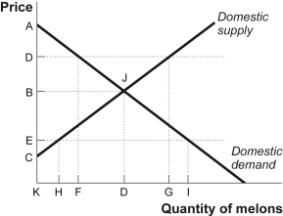 -The World Trade Organization:
 (Multiple Choice)
4.8/5 (85)
(85) Goods and services purchased from abroad are _____, while goods and services sold abroad are _____.
(Multiple Choice)
4.9/5 (77)
(77) If a country imposes a tariff on imported shoes, we expect the domestic price of shoes to _____ and the quantity of shoes consumed in the domestic market to _____ .
(Multiple Choice)
4.9/5 (61)
(61) If Canada imposes a tariff of $5 per bottle on French wine, the most likely effect will be to raise the price of wine in Canada by:
(Multiple Choice)
4.9/5 (81)
(81) If Japan must give up the production of 75 computers to produce 25 additional cellular telephones, the opportunity cost of producing 4 cellular telephones is _____ computers.
(Multiple Choice)
4.8/5 (91)
(91) Use the following to answer questions:
Figure: The Market for Tea in Sri Lanka
-(Figure: The Market for Tea in Sri Lanka) Look at the figure The Market for Tea in Sri Lanka. In autarky, the price is P1. When the economy is opened to trade, the price rises to PW, and producer surplus _____ to _____.
-(Figure: The Market for Tea in Sri Lanka) Look at the figure The Market for Tea in Sri Lanka. In autarky, the price is P1. When the economy is opened to trade, the price rises to PW, and producer surplus _____ to _____. (Multiple Choice)
4.8/5 (79)
(79) When a country joins the World Trade Organization, it gives up all of its ability to determine its trade policy.
(True/False)
4.8/5 (87)
(87) 
Filters
- Essay(0)
- Multiple Choice(0)
- Short Answer(0)
- True False(0)
- Matching(0)