



 Chat with AI
Exam 8: International Trade

Exam 1: First Principles233 Questions
Exam 2: Economic Models: Trade-Offs and Trade 25382 Questions
Exam 3: Supply and Demand290 Questions
Exam 4: Consumer and Producer Surplus224 Questions
Exam 5: Price Controls and Quotas: Meddling With Markets227 Questions
Exam 6: Elasticity300 Questions
Exam 7: Taxes298 Questions
Exam 8: International Trade272 Questions
Exam 9: Decision Making by Individuals Firms201 Questions
Exam 10: The Rational Consumer372 Questions
Exam 11: Behind the Supply Curve: Inputs and Costs362 Questions
Exam 12: Perfect Competition and the Supply Curve355 Questions
Exam 13: Monopoly350 Questions
Exam 14: Oligopoly294 Questions
Exam 15: Monopolistic Competition and Product Differentiation262 Questions
Exam 16: Externalities199 Questions
Exam 17: Public Goods Common Resources224 Questions
Exam 18: The Economics of the Welfare140 Questions
Exam 19: Factor Markets and the Distribution of Income369 Questions
Exam 20: Uncertainty, Risk, and Private Information202 Questions
Select questions type


Use the following to answer questions:
Figure: The Market for Computers 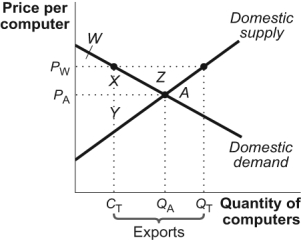 -(Figure: The Market for Computers) Look at the figure The Market for Computers. Assume that PA is the autarky price and PW is the world price. Consumer surplus without international trade would be area:
 (Multiple Choice)
4.8/5  (83)
(83) If a country's price for wood furniture in the absence of trade is lower than the price with trade, the country will likely:
(Multiple Choice)
4.7/5 (79)
(79) France and the United Kingdom both produce wine and cloth with constant opportunity costs. If opportunity costs in the two countries are different and France has a comparative advantage in wine production, then England MUST have a comparative advantage in cloth production.
(True/False)
4.9/5 (81)
(81) Many countries engage in trade protection by imposing import tariffs or quotas for at least some goods. This is because:
(Multiple Choice)
4.9/5 (61)
(61) Use the following to answer questions:
Figure: The Market for Melons in Russia 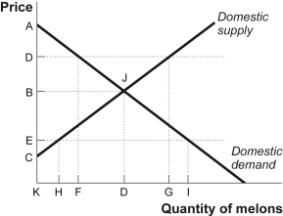 -(Figure: The Markets for Melons in Russia) Look at the figure The Market for Melons in Russia. Without trade, the country's producer surplus will equal area _____, and consumer surplus will equal area _____.
 (Multiple Choice)
4.8/5 (83)
(83) In 2002, the steel industry argued that higher tariffs on steel were necessary to help fight the war on terrorism. This is an example of the _____ argument.
(Multiple Choice)
4.7/5 (76)
(76) In a single year, the Netherlands can raise 100 tons of beef or produce 1,000 boxes of tulips. In the same growing season, Belgium can raise 50 tons of beef or produce 750 boxes of tulips. Trade will take place between these two countries if 1 ton of beef costs _____ boxes of tulips.
(Multiple Choice)
4.9/5 (72)
(72) A tariff is most likely to _____ prices and _____ domestic consumption of the good or service being protected.
(Multiple Choice)
4.9/5 (84)
(84) Use the following to answer questions:  -(Table: The Production Possibilities for Tractors and Crude Oil) Look at the table The Production Possibilities for Tractors and Crude Oil. Both the United States and Mexico will gain from trade if one tractor trades for _____ barrels of oil.
 (Multiple Choice)
5.0/5 (85)
(85) If a country has the comparative advantage in producing wooden furniture, then with free trade:
(Multiple Choice)
4.9/5 (86)
(86) Which statement is NOT true about the World Trade Organization (WTO)?
(Multiple Choice)
4.9/5 (89)
(89) Exports increase producer surplus but decrease consumer surplus and total surplus.
(True/False)
5.0/5 (89)
(89) A tariff imposed on U.S. imports into Japan tends to _____ U.S. producers and _____ Japanese producers.
(Multiple Choice)
4.9/5 (80)
(80) Use the following to answer questions:
Figure: The Domestic Market for Rice 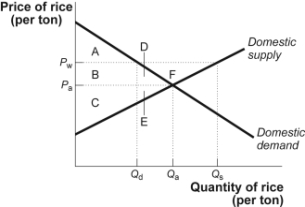 -(Figure: The Domestic Market for Rice) Look at the figure The Domestic Market for Rice. Assume that PA is the autarky price and PW is the world price. After international trade, this nation will _____ a quantity of rice equal to _____.
 (Multiple Choice)
4.8/5 (64)
(64) Workers in China earn low wages relative to world standards. A person who believes trade must be bad for workers in China because of this adheres to the:
(Multiple Choice)
4.8/5 (65)
(65) Use the following to answer questions:
Scenario: The Production of Wheat and Toys 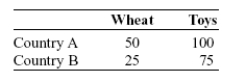 The table describes the production of two goods, wheat and toys, in country A and country B. Each country has a linear production possibility frontier with respect to its production of the two goods. The numbers in each column represent the total number of units each country could produce if it used all of its resources to produce the good.
-(Scenario: The Production of Wheat and Toys) Look at the scenario Production of Wheat and Toys. The opportunity cost of producing a unit of toys in country A is _____ unit(s) of wheat.
The table describes the production of two goods, wheat and toys, in country A and country B. Each country has a linear production possibility frontier with respect to its production of the two goods. The numbers in each column represent the total number of units each country could produce if it used all of its resources to produce the good.
-(Scenario: The Production of Wheat and Toys) Look at the scenario Production of Wheat and Toys. The opportunity cost of producing a unit of toys in country A is _____ unit(s) of wheat. (Multiple Choice)
4.8/5 (73)
(73) 
Filters
- Essay(0)
- Multiple Choice(0)
- Short Answer(0)
- True False(0)
- Matching(0)