



 Chat with AI
Exam 8: International Trade

Exam 1: First Principles233 Questions
Exam 2: Economic Models: Trade-Offs and Trade 25382 Questions
Exam 3: Supply and Demand290 Questions
Exam 4: Consumer and Producer Surplus224 Questions
Exam 5: Price Controls and Quotas: Meddling With Markets227 Questions
Exam 6: Elasticity300 Questions
Exam 7: Taxes298 Questions
Exam 8: International Trade272 Questions
Exam 9: Decision Making by Individuals Firms201 Questions
Exam 10: The Rational Consumer372 Questions
Exam 11: Behind the Supply Curve: Inputs and Costs362 Questions
Exam 12: Perfect Competition and the Supply Curve355 Questions
Exam 13: Monopoly350 Questions
Exam 14: Oligopoly294 Questions
Exam 15: Monopolistic Competition and Product Differentiation262 Questions
Exam 16: Externalities199 Questions
Exam 17: Public Goods Common Resources224 Questions
Exam 18: The Economics of the Welfare140 Questions
Exam 19: Factor Markets and the Distribution of Income369 Questions
Exam 20: Uncertainty, Risk, and Private Information202 Questions
Select questions type


Suppose a nation is considering two alternative policies to protect a domestic industry from world trade. The two policies are an import quota of X units and a per-unit tariff that would reduce imports to X units. Though either policy would result in only X imported units of this good, there is a fundamental difference in the outcome. Explain this difference.
(Essay)
4.9/5  (73)
(73) If Japan levies tariffs on U.S. goods entering Japan, this will tend to:
(Multiple Choice)
4.8/5 (65)
(65) The United States must give up the production of 300 motorcycles to produce 20 additional SUVs with the same resources. In this case, the opportunity cost of producing 5 SUVs is ________ motorcycles.
(Multiple Choice)
4.9/5 (78)
(78) Use the following to answer questions: 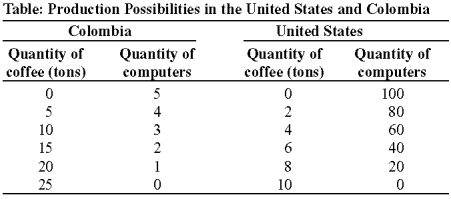 -(Table: Production Possibilities in the United States and Colombia) Look at the table Production Possibilities in the United States and Colombia. Which country should export coffee and which country should export computers? Justify your answer.
 (Essay)
4.9/5 (82)
(82) If Indonesia has lower wage rates than India, trade between these two nations will make India worse off.
(True/False)
4.8/5 (85)
(85) Britain must give up the production of 75 hats to produce 25 additional sweaters. The opportunity cost of producing 4 sweaters is _____ hats.
(Multiple Choice)
4.9/5 (86)
(86) Mexico is relatively labor-abundant when compared with the United States. Therefore, Mexico has a comparative advantage in _____ compared with the United States.
(Multiple Choice)
4.9/5 (69)
(69) If the opportunity cost of producing either of two goods in question is constant, the production possibility frontier is:
(Multiple Choice)
4.9/5 (76)
(76) Use the following to answer questions:
Figure: The Production Possibilities for Two Countries  -(Figure: The Production Possibilities for Two Countries) Look at the figure The Production Possibilities for Two Countries. If Indonesia and Malaysia specialize completely in the production of the good of their comparative advantage, the two nations together will produce _____ tires and _____ radios.
 (Multiple Choice)
5.0/5 (78)
(78) As measured by a percentage of the entire economic output of the United States, imports have been _____ and exports have been _____.
(Multiple Choice)
4.8/5 (79)
(79) In a single year, Argentina can raise 100 tons of beef or produce 1,000 boxes of tulips. In the same growing season, Venezuela can raise 50 tons of beef or produce 750 boxes of tulips. When the two countries begin trading beef for tulips, we expect the consumer surplus from beef consumption to:
(Multiple Choice)
4.8/5 (74)
(74) Which of the following trade patterns is best explained by increasing returns?
(Multiple Choice)
4.9/5 (72)
(72) A country that is relatively labor-abundant and relatively land-scarce opens to international trade. As a result, it finds that wages _____ and rents _____.
(Multiple Choice)
4.9/5 (84)
(84) Advocates of trade barriers suggest that the barriers are needed for national security, job creation, and to:
(Multiple Choice)
4.8/5 (62)
(62) Both the United States and Canada produce automobiles and their components; however, each particular model or component is produced in only one of the two countries. Which of the following explains this pattern of production and trade?
(Multiple Choice)
4.7/5 (79)
(79) Use the following to answer questions:
Figure: The Market for Computers 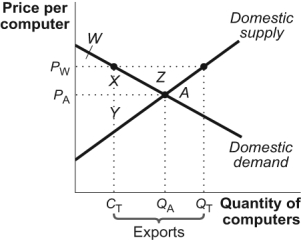 -(Figure: The Market for Computers) Look at the figure The Market for Computers. Assume that PA is the autarky price and PW is the world price. Producer surplus without international trade would be area:
 (Multiple Choice)
4.7/5 (93)
(93) A regulation that specifies the maximum amount of a good or service that may be imported during a specified period is a(n):
(Multiple Choice)
4.8/5 (75)
(75) If the United States can produce 30 computers for every car it produces and Japan can produce 15 computers for every car it produces, _____ has the _____ advantage in car production.
(Multiple Choice)
4.9/5 (75)
(75) Use the following to answer questions:
Figure: The Production Possibilities for Two Countries
-(Figure: The Production Possibilities for Two Countries) Look at the figure The Production Possibilities for Two Countries. If Indonesia and Malaysia trade 1 radio for 1.5 tires, the most that Indonesia can consume is _____ radios and _____ tires, while the most that Malaysia can consume is _____ radios and _____ tires.
-(Figure: The Production Possibilities for Two Countries) Look at the figure The Production Possibilities for Two Countries. If Indonesia and Malaysia trade 1 radio for 1.5 tires, the most that Indonesia can consume is _____ radios and _____ tires, while the most that Malaysia can consume is _____ radios and _____ tires. (Multiple Choice)
4.9/5 (79)
(79) 
Filters
- Essay(0)
- Multiple Choice(0)
- Short Answer(0)
- True False(0)
- Matching(0)