



 Chat with AI
Exam 13: Monopoly

Exam 1: First Principles233 Questions
Exam 2: Economic Models: Trade-Offs and Trade 25382 Questions
Exam 3: Supply and Demand290 Questions
Exam 4: Consumer and Producer Surplus224 Questions
Exam 5: Price Controls and Quotas: Meddling With Markets227 Questions
Exam 6: Elasticity300 Questions
Exam 7: Taxes298 Questions
Exam 8: International Trade272 Questions
Exam 9: Decision Making by Individuals Firms201 Questions
Exam 10: The Rational Consumer372 Questions
Exam 11: Behind the Supply Curve: Inputs and Costs362 Questions
Exam 12: Perfect Competition and the Supply Curve355 Questions
Exam 13: Monopoly350 Questions
Exam 14: Oligopoly294 Questions
Exam 15: Monopolistic Competition and Product Differentiation262 Questions
Exam 16: Externalities199 Questions
Exam 17: Public Goods Common Resources224 Questions
Exam 18: The Economics of the Welfare140 Questions
Exam 19: Factor Markets and the Distribution of Income369 Questions
Exam 20: Uncertainty, Risk, and Private Information202 Questions
Select questions type


Suppose that a monopoly computer chip maker increases production from 10 microchips to 11 microchips. If the market price declines from $30 per unit to $29 per unit, marginal revenue for the eleventh unit is:
(Multiple Choice)
5.0/5  (69)
(69) Use the following to answer questions:  -(Table: Prices and Demand) Look at the table Prices and Demand. The New Orleans Saints have a monopoly on Saints logo hats. The marginal cost of producing a hat is $18. If the Saints were a perfectly competitive firm in a perfectly competitive industry, their profit-maximizing price and output, respectively, would be:
 (Multiple Choice)
4.8/5 (90)
(90) Use the following to answer questions:
-(Table: Prices and Demand) Look at the table Prices and Demand. The New Orleans Saints have a monopoly on Saints logo hats. The marginal cost of producing a hat is $18. If the Saints were a perfectly competitive firm in a perfectly competitive industry, at their profit-maximizing price and output deadweight loss would be:
-(Table: Prices and Demand) Look at the table Prices and Demand. The New Orleans Saints have a monopoly on Saints logo hats. The marginal cost of producing a hat is $18. If the Saints were a perfectly competitive firm in a perfectly competitive industry, at their profit-maximizing price and output deadweight loss would be: (Multiple Choice)
4.8/5 (83)
(83) Use the following to answer questions:
Figure: The Profit-Maximizing Output and Price  -(Figure: The Profit-Maximizing Output and Price) Look at the figure The Profit-Maximizing Output and Price. Assume that there are no fixed costs and AC = MC = $200. At the profit-maximizing output and price for a monopolist, deadweight loss is:
 (Multiple Choice)
4.9/5 (77)
(77) A monopoly's short-run supply curve is its marginal cost curve above the minimum average variable cost.
(True/False)
4.7/5 (94)
(94) A monopolist responds to a decrease in demand by _____ price and _____ output.
(Multiple Choice)
4.8/5 (79)
(79) To practice effective price discrimination, a monopolist must be able to:
(Multiple Choice)
4.8/5 (71)
(71) Which of the following statements concerning monopoly is TRUE?
(Multiple Choice)
4.8/5 (93)
(93) Use the following to answer questions:
Figure: Water Works 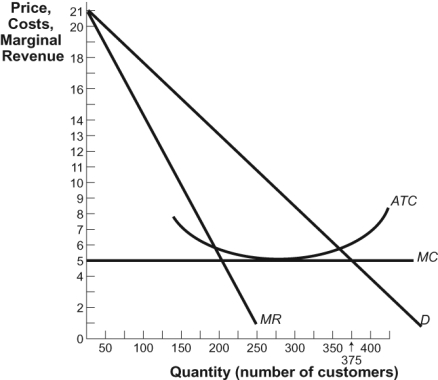 -(Figure: Water Works) Look at the figure Water Works, which describes a small town's water works, a natural monopoly. If the water works is unregulated and maximizes profit, how many customers will it serve?
 (Multiple Choice)
5.0/5 (77)
(77) When a monopolist practices price discrimination, producer surplus will be higher than in a single-price monopoly.
(True/False)
4.8/5 (76)
(76) When a monopolist practices price discrimination, compared to a single-price monopolist, producer surplus will:
(Multiple Choice)
4.9/5 (92)
(92) The De Beers company is described as a monopolist in the production of:
(Multiple Choice)
4.8/5 (76)
(76) Price-discriminating firms will impose a price structure that offers customers with a _____ demand a _____ price and offers customers with a(n) _____ demand a _____ price.
(Multiple Choice)
4.9/5 (76)
(76) Suppose the price elasticity of demand for coffee at the CoffeeBarn equals 1.71 for women and 0.55 for men. A successful price discrimination strategy would lead to _____ prices for men and _____ prices for women _____.
(Multiple Choice)
4.8/5 (76)
(76) Use the following to answer questions:  -(Table: Lunch) Look at the figure Lunch. Joe makes and sells picnic lunches to people taking all-day rafting trips on the river. The marginal cost and average cost of each lunch are a constant $4. If Joe is one of many firms in a competitive industry, what price will he charge for a lunch in the long run?
 (Multiple Choice)
4.9/5 (73)
(73) Use the following to answer questions:
Figure: Short-Run Monopoly  -(Figure: Short-Run Monopoly) Look at the figure Short-Run Monopoly. The profit-maximizing quantity of output is quantity:
 (Multiple Choice)
4.8/5 (85)
(85) Use the following to answer questions:
Figure: A Rock Climbing Shoe Monopoly 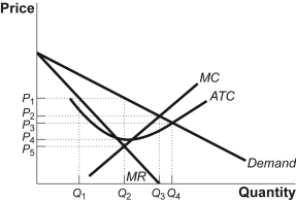 -(Figure: A Rock Climbing Shoe Monopoly) Look at the figure A Rock Climbing Shoe Monopoly. If the firm is regulated such that it earns zero economic profit, the firm will sell _____ pairs of shoes at a price of _____ per pair.
 (Multiple Choice)
4.9/5 (70)
(70) A monopolist who engages in perfect price discrimination charges each consumer a price equal to the consumer's willingness to pay.
(True/False)
4.8/5 (79)
(79) Use the following to answer questions:
Figure: The Profit-Maximizing Output and Price
-(Figure: The Profit-Maximizing Output and Price) Look at the figure The Profit-Maximizing Output and Price. Assume that there are no fixed costs and AC = MC = $200. The monopolist who can use price discrimination perfectly will produce an output of _____ diamonds.
-(Figure: The Profit-Maximizing Output and Price) Look at the figure The Profit-Maximizing Output and Price. Assume that there are no fixed costs and AC = MC = $200. The monopolist who can use price discrimination perfectly will produce an output of _____ diamonds. (Multiple Choice)
4.8/5 (78)
(78) Because tourist demand for airline flights is relatively _____, small _____ in ticket price will result in relatively _____ in additional tourists.
(Multiple Choice)
4.8/5 (66)
(66) 
Filters
- Essay(0)
- Multiple Choice(0)
- Short Answer(0)
- True False(0)
- Matching(0)