



 Chat with AI
Exam 13: Monopoly

Exam 1: First Principles233 Questions
Exam 2: Economic Models: Trade-Offs and Trade 25382 Questions
Exam 3: Supply and Demand290 Questions
Exam 4: Consumer and Producer Surplus224 Questions
Exam 5: Price Controls and Quotas: Meddling With Markets227 Questions
Exam 6: Elasticity300 Questions
Exam 7: Taxes298 Questions
Exam 8: International Trade272 Questions
Exam 9: Decision Making by Individuals Firms201 Questions
Exam 10: The Rational Consumer372 Questions
Exam 11: Behind the Supply Curve: Inputs and Costs362 Questions
Exam 12: Perfect Competition and the Supply Curve355 Questions
Exam 13: Monopoly350 Questions
Exam 14: Oligopoly294 Questions
Exam 15: Monopolistic Competition and Product Differentiation262 Questions
Exam 16: Externalities199 Questions
Exam 17: Public Goods Common Resources224 Questions
Exam 18: The Economics of the Welfare140 Questions
Exam 19: Factor Markets and the Distribution of Income369 Questions
Exam 20: Uncertainty, Risk, and Private Information202 Questions
Select questions type


Use the following to answer questions:  -(Table: Lunch) Look at the figure Lunch. Joe makes and sells picnic lunches to people taking all-day rafting trips on the river. The marginal cost and average cost of each lunch are a constant $4. If Joe is one of many firms in a competitive industry, how many lunches will he produce in the long run?
 (Multiple Choice)
4.9/5  (82)
(82) Goods that are subject to network externalities tend to be ones:
(Multiple Choice)
4.7/5 (77)
(77) Use the following to answer questions:
Figure: Water Works 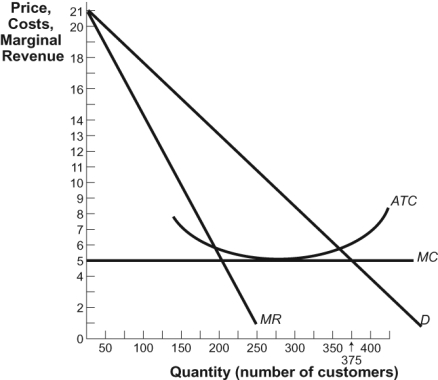 -(Figure: Water Works) Look at the figure Water Works, which describes a small town's water works, a natural monopoly. If the water works is unregulated and maximizes profit, how much profit will it earn?
 (Multiple Choice)
4.9/5 (77)
(77) A Japanese steel firm sells steel in the United States and in Japan. Since the United States buys steel from a number of sources, the U.S. demand for Japanese steel is more price-elastic than the Japanese demand for Japanese steel. If the Japanese steel firm wishes to maximize its profits, it should:
(Multiple Choice)
4.9/5 (75)
(75) If a firm wants to charge different customers different prices, it must be:
(Multiple Choice)
4.8/5 (84)
(84) The marginal revenue curve for a monopolist is always less than the price because of the price effect.
(True/False)
4.8/5 (81)
(81) Use the following to answer questions:
Scenario: Monopolist
The demand curve for a monopolist is P = 75 - 0.5Q, and the monopolist has the following MC expressed as P = 2Q. Assume also that ATC at the profit-maximizing level of production is equal to $12.50.
-(Scenario: Monopolist) Look at the scenario Monopolist. The MR curve is:
(Multiple Choice)
4.9/5 (98)
(98) Suppose that a profit-maximizing monopoly firm undergoes a substantial technological change that reduces its marginal and average total costs by $40. If in response to its reduction in cost the firm changes its price in a profit-maximizing way, then we can predict that its total output will:
(Multiple Choice)
4.8/5 (85)
(85) Use the following to answer questions:
Figure: The Profit-Maximizing Output and Price  -(Figure: The Profit-Maximizing Output and Price) Look at the figure The Profit-Maximizing Output and Price. A perfect competitor would produce at a price of _____ and output of _____ units.
 (Multiple Choice)
4.8/5 (78)
(78) Use the following to answer questions:
Figure: Demand, Revenue, and Cost Curves 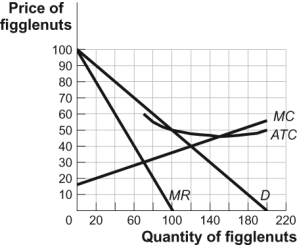 -(Figure: Demand, Revenue, and Cost Curves) Look at the figure Demand, Revenue, and Cost Curves. Figglenuts-R-Us is a monopolist in the figglenut market. If the government wanted to regulate Figglenuts-R-Us such that it would minimize the deadweight loss while allowing the firm to break even, it would impose a price ceiling of:
 (Multiple Choice)
4.7/5 (80)
(80) Years ago, Callaway Golf patented its signature Big Bertha line of drivers. Today the company spends a lot of money prosecuting individuals that try to sell knock-off Big Bertha drivers to the public. What is the purpose of the patent, and why do companies like Callaway Golf fight those that try to imitate their products?
(Essay)
4.8/5 (74)
(74) Critics of the National Collegiate Athletic Association (NCAA) argue that the NCAA monopolizes college athletics and prevents student-athletes from earning money while in college. If this is true, what type of entry barrier does the NCAA have?
(Multiple Choice)
4.9/5 (88)
(88) Use the following to answer questions:
Figure: Short-Run Monopoly  -(Figure: Short-Run Monopoly) Look at the figure Short-Run Monopoly. The profit-maximizing rule is satisfied by the intersection at point:
 (Multiple Choice)
4.8/5 (82)
(82) Use the following to answer questions: 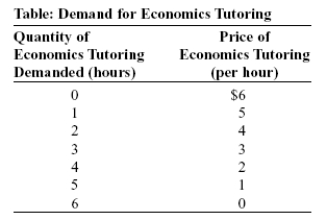 -(Table: Demand for Economics Tutoring) Look at the table Demand for Economics Tutoring. Suppose Eric is the only economics tutor in town. Eric can offer additional hours of tutoring at a constant marginal cost of $2 per hour, and he has no fixed costs. Suppose Eric can perfectly price-discriminate by charging his customers exactly their willingness to pay. How many hours will he offer, and how much profit will he earn by price-discriminating?
 (Essay)
4.7/5 (77)
(77) Use the following to answer questions:  -(Table: Prices and Demand) Look at the table Prices and Demand. The New Orleans Saints have a monopoly on Saints logo baseball hats. The Saints sell at most one hat to each customer, and the table shows each customer's willingness to pay. The marginal cost of producing a hat is $18, and there are no fixed costs. How much is the Saints' profit at the profit-maximizing output?
 (Multiple Choice)
4.8/5 (77)
(77) When a monopolist practices price discrimination as opposed to setting a single price, the monopolist sells more and increases profits.
(True/False)
4.9/5 (96)
(96) When a monopolist practices price discrimination, the monopolist's profits will be lower than in a single-price monopoly.
(True/False)
4.9/5 (72)
(72) When a natural monopoly is regulated to charge a price equal to average total cost, consumer surplus increases, but total surplus decreases.
(True/False)
4.8/5 (74)
(74) A monopolist's marginal cost curve shifts up, but the firm's demand curve remains the same and the firm does not shut down. Compared to the condition before the increase in marginal costs, the monopolist will _____ its price and _____ its level of production.
(Multiple Choice)
4.9/5 (90)
(90) Microsoft and its operating system are often cited as an example of a company that grew into a monopolist through:
(Multiple Choice)
4.8/5 (72)
(72) 
Filters
- Essay(0)
- Multiple Choice(0)
- Short Answer(0)
- True False(0)
- Matching(0)