



 Chat with AI
Exam 13: Monopoly

Exam 1: First Principles233 Questions
Exam 2: Economic Models: Trade-Offs and Trade 25382 Questions
Exam 3: Supply and Demand290 Questions
Exam 4: Consumer and Producer Surplus224 Questions
Exam 5: Price Controls and Quotas: Meddling With Markets227 Questions
Exam 6: Elasticity300 Questions
Exam 7: Taxes298 Questions
Exam 8: International Trade272 Questions
Exam 9: Decision Making by Individuals Firms201 Questions
Exam 10: The Rational Consumer372 Questions
Exam 11: Behind the Supply Curve: Inputs and Costs362 Questions
Exam 12: Perfect Competition and the Supply Curve355 Questions
Exam 13: Monopoly350 Questions
Exam 14: Oligopoly294 Questions
Exam 15: Monopolistic Competition and Product Differentiation262 Questions
Exam 16: Externalities199 Questions
Exam 17: Public Goods Common Resources224 Questions
Exam 18: The Economics of the Welfare140 Questions
Exam 19: Factor Markets and the Distribution of Income369 Questions
Exam 20: Uncertainty, Risk, and Private Information202 Questions
Select questions type


If a monopolist is producing a quantity that generates MC > MR, then profit:
(Multiple Choice)
4.8/5  (78)
(78) Use the following to answer questions:
Figure: PPV  -(Figure: PPV) Look at the figure PPV, which shows the demand and marginal revenue for a pay-per-view football game on cable TV. Assume that the marginal cost and average cost are a constant $40. If the cable company is a single-price monopoly and maximizes profit, deadweight loss will be:
 (Multiple Choice)
4.8/5 (67)
(67) Use the following to answer questions:
Figure: A Rock Climbing Shoe Monopoly 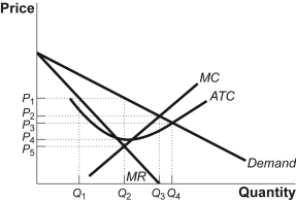 -(Figure: A Rock Climbing Shoe Monopoly) Look at the figure A Rock Climbing Shoe Monopoly. If the firm acts to maximize profit, the firm will earn profit equal to:
 (Multiple Choice)
4.9/5 (82)
(82) Use the following to answer questions:  -(Table: Prices and Demand) The New Orleans Saints have a monopoly on Saints logo hats. The marginal cost of producing a hat is $18. If the Saints increase the number of hats they sell from four to five, their total revenue changes from _____ to _____.
 (Multiple Choice)
4.8/5 (78)
(78) To increase profits with price discrimination, different groups of an oligopolist's customers must respond differently to prices of the good.
(True/False)
4.8/5 (93)
(93) After the first unit sold, the marginal revenue a monopolist receives from selling one more unit of a good is less than the price of that unit because of:
(Multiple Choice)
4.9/5 (85)
(85) Use the following to answer questions:
Figure: Demand, Revenue, and Cost Curves 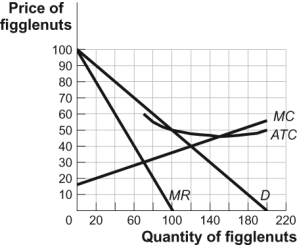 -(Figure: Demand, Revenue, and Cost Curves) Look at the figure Demand, Revenue, and Cost Curves. Figglenuts-R-Us is a monopolist in the figglenut market. If the government regulated the figglenut market by setting a price ceiling of $40, Figglenuts-R-Us might:
 (Multiple Choice)
4.7/5 (70)
(70) When a monopolist practices price discrimination, compared to a single-price monopolist, deadweight loss will:
(Multiple Choice)
4.8/5 (77)
(77) Monopoly is inefficient because some consumer surplus is transferred to producer surplus.
(True/False)
4.8/5 (77)
(77) Wendy has a monopoly in the retailing of motor homes. She can sell five per week at $21,000 each. If she wants to sell six, she can only charge $20,000 each. The price effect of selling the sixth motor home is:
(Multiple Choice)
4.8/5 (78)
(78) Use the following to answer questions:
Figure: Monopoly Model 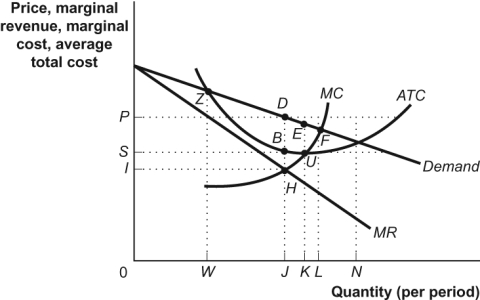 -(Figure: Monopoly Model) Look at the figure Monopoly Model. When the firm is in equilibrium (that is, maximizing its economic profit), its profit is the area of rectangle:
 (Multiple Choice)
4.8/5 (75)
(75) Use the following to answer questions:
Scenario: Monopolist
The demand curve for a monopolist is P = 75 - 0.5Q, and the monopolist has the following MC expressed as P = 2Q. Assume also that ATC at the profit-maximizing level of production is equal to $12.50.
-(Scenario: Monopolist) Look at the scenario Monopolist. The profit-maximizing output is _____ units and the profit-maximizing price is _____.
(Multiple Choice)
4.8/5 (72)
(72) Use the following to answer questions:
Figure: The Monopolist 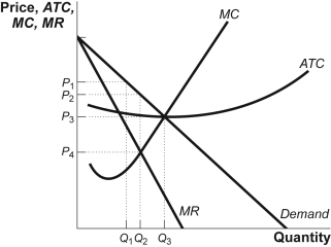 -(Figure: The Monopolist) Look at the figure The Monopolist. If this monopolist attempts to profit-maximize, it will produce _____ units and sell them at _____.
 (Multiple Choice)
4.7/5 (82)
(82) Suppose that a profit-maximizing monopoly firm undergoes a substantial technological change that reduces its marginal and average total costs by $40. If in response to its reduction in cost the firm changes its price in a profit-maximizing way, then we can predict that its total economic profit will:
(Multiple Choice)
5.0/5 (82)
(82) In 1999, a judge declared that Microsoft was a monopolist. Assuming that Microsoft has a linear demand curve and that it is maximizing its profits at its current level of output, we may conclude that if Microsoft were to increase its price, its total revenue would:
(Multiple Choice)
4.8/5 (80)
(80) Usually when a monopoly that isn't a natural monopoly is broken up, the losses to the producer outweigh the gains to consumers.
(True/False)
4.7/5 (90)
(90) 
Filters
- Essay(0)
- Multiple Choice(0)
- Short Answer(0)
- True False(0)
- Matching(0)