



 Chat with AI
Exam 13: Monopoly

Exam 1: First Principles233 Questions
Exam 2: Economic Models: Trade-Offs and Trade 25382 Questions
Exam 3: Supply and Demand290 Questions
Exam 4: Consumer and Producer Surplus224 Questions
Exam 5: Price Controls and Quotas: Meddling With Markets227 Questions
Exam 6: Elasticity300 Questions
Exam 7: Taxes298 Questions
Exam 8: International Trade272 Questions
Exam 9: Decision Making by Individuals Firms201 Questions
Exam 10: The Rational Consumer372 Questions
Exam 11: Behind the Supply Curve: Inputs and Costs362 Questions
Exam 12: Perfect Competition and the Supply Curve355 Questions
Exam 13: Monopoly350 Questions
Exam 14: Oligopoly294 Questions
Exam 15: Monopolistic Competition and Product Differentiation262 Questions
Exam 16: Externalities199 Questions
Exam 17: Public Goods Common Resources224 Questions
Exam 18: The Economics of the Welfare140 Questions
Exam 19: Factor Markets and the Distribution of Income369 Questions
Exam 20: Uncertainty, Risk, and Private Information202 Questions
Select questions type


Use the following to answer questions:
Figure: Monopoly Model 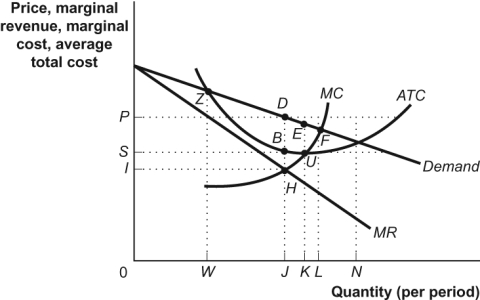 -(Figure: Monopoly Model) Look at the figure Monopoly Model. When the firm is in equilibrium (that is, maximizing its economic profit), its total cost is the area of rectangle:
 (Multiple Choice)
4.9/5  (97)
(97) Use the following to answer questions:
Figure: The Monopolist 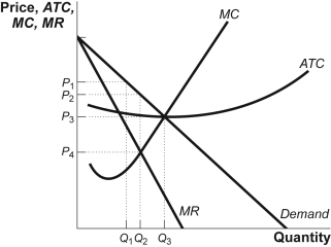 -(Figure: The Monopolist) Look at the figure The Monopolist. At the profit-maximizing level, this monopolist will:
 (Multiple Choice)
4.8/5 (75)
(75) Suppose that a monopoly firm is required to pay a new annual license fee to do business in its city and that the fee is somewhat less than the economic profit the firm is now earning. In response to the increase in fees, the firm will:
(Multiple Choice)
4.8/5 (93)
(93) Use the following to answer questions:
Figure: Water Works 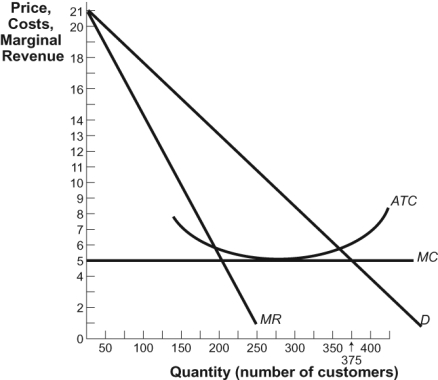 -(Figure: Water Works) Look at the figure Water Works, which describes a small town's water works, a natural monopoly. If regulators require the water works to charge the price that eliminates deadweight loss, the water works will serve _____ customers.
 (Multiple Choice)
4.7/5 (82)
(82) Use the following to answer questions:
Figure: Water Works
-(Figure: Water Works) Look at the figure Water Works, which describes a small town's water works, a natural monopoly. If regulators want the monopolist to cover average total cost, the monopolist will be allowed to charge a price of:
-(Figure: Water Works) Look at the figure Water Works, which describes a small town's water works, a natural monopoly. If regulators want the monopolist to cover average total cost, the monopolist will be allowed to charge a price of: (Multiple Choice)
4.9/5 (84)
(84) A monopoly's short-run marginal cost is constant at $10. This implies that its average variable cost is also constant and equal to $10.
(True/False)
4.9/5 (86)
(86) Use the following to answer questions:
Figure: PPV  -(Figure: PPV) Look at the figure PPV, which shows the demand and marginal revenue for a pay-per-view football game on cable TV. Assume that the marginal cost and average cost are a constant $40. If the cable company is a single-price monopoly and maximizes profit, consumer surplus will be:
 (Multiple Choice)
4.8/5 (74)
(74) Use the following to answer questions:  -(Table: Prices and Demand) Look at the table Prices and Demand. The New Orleans Saints have a monopoly on Saints logo hats. The marginal cost of producing a hat is $18. The Saints sell at most one hat to each customer, and the table shows each customer's willingness to pay. If the Saints were a perfectly competitive firm in a perfectly competitive industry, at their profit-maximizing price and output total surplus would be _____. If the Saints were a profit-maximizing monopoly, at their profit-maximizing price and output total surplus would be _____.
 (Multiple Choice)
4.8/5 (83)
(83) Suppose a monopoly is producing output so that marginal revenue equals marginal cost. If the monopolist reduces output, it:
(Multiple Choice)
4.8/5 (79)
(79) When firms price-discriminate, people with _____ price elasticity of demand will pay _____ prices relative to those purchasing the same product who have a _____ price elasticity of demand.
(Multiple Choice)
4.8/5 (92)
(92) All of the following are examples of price discrimination EXCEPT:
(Multiple Choice)
4.9/5 (78)
(78) If a product's usefulness increases with the number of users, it:
(Multiple Choice)
4.8/5 (89)
(89) Many hotel chains offer discounts to senior citizens. This is an example of _____ that is _____ in the United States.
(Multiple Choice)
4.7/5 (70)
(70) Suppose the government is considering how to regulate a monopolist. An economist argues that the price should be regulated to maximize total welfare. The monopolist argues that the price should be regulated so that it can just cover all of its opportunity costs. Are they basically arguing the same point? How do they differ?
(Essay)
4.8/5 (80)
(80) When a firm finds that its ATC of production decreases as it increases production, this firm is said to be experiencing:
(Multiple Choice)
4.8/5 (73)
(73) If a monopolist can engage in perfect price discrimination:
(Multiple Choice)
4.9/5 (72)
(72) Suppose that the Yankee Cap Company is a profit-maximizing firm with a monopoly in the production of baseball caps. The firm sells its baseball caps for $25 each. For this information, we can assume that the Yankee Cap Company is producing a level of output at which:
(Multiple Choice)
4.9/5 (81)
(81) Use the following to answer questions:
Scenario: A Small-Town Monopolist
A monopolist sells cable subscriptions in a small town and finds that it can sell 100 subscriptions when the price is $15 a week and an additional 75 subscriptions when the price is $10 a week. The MC for the provision of the cable is $5 a week. There are no fixed costs.
-(Scenario: A Small-Town Monopolist) Look at the scenario A Small-Town Monopolist. If this monopolist chooses to sell subscriptions at one price, it will sell _____ units at a price of _____ and earn economic profits equal to _____.
(Multiple Choice)
4.9/5 (86)
(86) Compared to perfect competition, monopoly produces a net welfare gain for society.
(True/False)
4.7/5 (65)
(65) 
Filters
- Essay(0)
- Multiple Choice(0)
- Short Answer(0)
- True False(0)
- Matching(0)