



 Chat with AI
Exam 13: Monopoly

Exam 1: First Principles233 Questions
Exam 2: Economic Models: Trade-Offs and Trade 25382 Questions
Exam 3: Supply and Demand290 Questions
Exam 4: Consumer and Producer Surplus224 Questions
Exam 5: Price Controls and Quotas: Meddling With Markets227 Questions
Exam 6: Elasticity300 Questions
Exam 7: Taxes298 Questions
Exam 8: International Trade272 Questions
Exam 9: Decision Making by Individuals Firms201 Questions
Exam 10: The Rational Consumer372 Questions
Exam 11: Behind the Supply Curve: Inputs and Costs362 Questions
Exam 12: Perfect Competition and the Supply Curve355 Questions
Exam 13: Monopoly350 Questions
Exam 14: Oligopoly294 Questions
Exam 15: Monopolistic Competition and Product Differentiation262 Questions
Exam 16: Externalities199 Questions
Exam 17: Public Goods Common Resources224 Questions
Exam 18: The Economics of the Welfare140 Questions
Exam 19: Factor Markets and the Distribution of Income369 Questions
Exam 20: Uncertainty, Risk, and Private Information202 Questions
Select questions type


In an industry characterized by extensive economies of scale:
(Multiple Choice)
4.7/5  (74)
(74) A price-discriminating firm will adjust prices so that customers with more _____ demand pay _____ than (as) customers with _____ elastic demand.
(Multiple Choice)
4.9/5 (84)
(84) Use the following to answer questions:
Scenario: Monopolist
The demand curve for a monopolist is P = 75 - 0.5Q, and the monopolist has the following MC expressed as P = 2Q. Assume also that ATC at the profit-maximizing level of production is equal to $12.50.
-(Scenario: Monopolist) Look at the scenario Monopolist. The deadweight loss from this monopolist's production is:
(Multiple Choice)
4.8/5 (84)
(84) Use the following to answer questions:
Figure: PPV 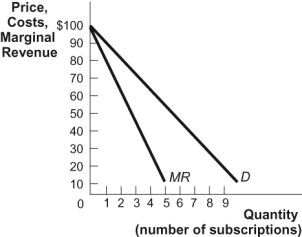 -(Figure: PPV) Look at the figure PPV, which shows the demand and marginal revenue for a pay-per-view football game on cable TV. Assume that the marginal cost and average cost are a constant $20. If the cable company is a monopoly, how much will it produce?
 (Multiple Choice)
4.9/5 (77)
(77) When a monopolist practices price discrimination as opposed to setting a single price, the monopolist increases its profits by decreasing producer surplus.
(True/False)
4.9/5 (91)
(91) _____ is the practice of selling _____ product(s) at different prices to different consumers, without corresponding differences in costs.
(Multiple Choice)
5.0/5 (75)
(75) Use the following to answer questions:
Figure: A Profit-Maximizing Monopoly Firm 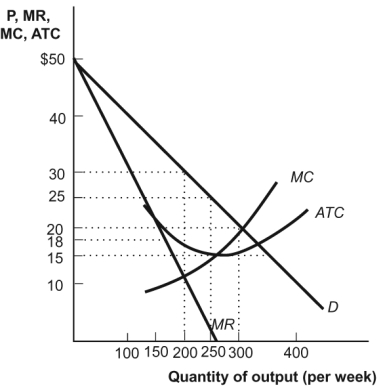 -(Figure: A Profit-Maximizing Monopoly Firm) Look at the figure A Profit-Maximizing Monopoly Firm. This firm's cost per unit at its profit-maximizing quantity is:
 (Multiple Choice)
4.8/5 (84)
(84) Conditions that keep new firms out of a monopoly market are:
(Multiple Choice)
4.8/5 (92)
(92) Use the following to answer questions:
Figure: The Profit-Maximizing Output and Price  -(Figure: The Profit-Maximizing Output and Price) Look at the figure The Profit-Maximizing Output and Price. Assume that there are no fixed costs and AC = MC = $200. At the profit-maximizing output and price for a monopolist, total surplus is:
 (Multiple Choice)
4.9/5 (71)
(71) A profit-maximizing monopoly will never set price in the inelastic region of the demand curve.
(True/False)
4.8/5 (61)
(61) To maintain profits in the long run, a monopoly must be protected by barriers to the entry of other firms into the industry.
(True/False)
4.7/5 (89)
(89) When a monopolist practices price discrimination, compared to a single-price monopolist, consumer surplus will:
(Multiple Choice)
4.7/5 (72)
(72) A monopoly's short-run supply curve is upward-sloping because of diminishing marginal returns.
(True/False)
4.9/5 (68)
(68) A monopoly may continue to make economic profits in the long run because of the barriers to entry.
(True/False)
4.9/5 (86)
(86) What makes a natural monopoly a distinct form of monopoly? Use an example of a natural monopoly in your explanation.
(Essay)
4.8/5 (73)
(73) A monopolist that charges each customer a different price based on the customer's individual willingness to pay is called a single-price monopolist.
(True/False)
4.8/5 (78)
(78) 
Filters
- Essay(0)
- Multiple Choice(0)
- Short Answer(0)
- True False(0)
- Matching(0)