



 Chat with AI
Exam 13: Monopoly

Exam 1: First Principles233 Questions
Exam 2: Economic Models: Trade-Offs and Trade 25382 Questions
Exam 3: Supply and Demand290 Questions
Exam 4: Consumer and Producer Surplus224 Questions
Exam 5: Price Controls and Quotas: Meddling With Markets227 Questions
Exam 6: Elasticity300 Questions
Exam 7: Taxes298 Questions
Exam 8: International Trade272 Questions
Exam 9: Decision Making by Individuals Firms201 Questions
Exam 10: The Rational Consumer372 Questions
Exam 11: Behind the Supply Curve: Inputs and Costs362 Questions
Exam 12: Perfect Competition and the Supply Curve355 Questions
Exam 13: Monopoly350 Questions
Exam 14: Oligopoly294 Questions
Exam 15: Monopolistic Competition and Product Differentiation262 Questions
Exam 16: Externalities199 Questions
Exam 17: Public Goods Common Resources224 Questions
Exam 18: The Economics of the Welfare140 Questions
Exam 19: Factor Markets and the Distribution of Income369 Questions
Exam 20: Uncertainty, Risk, and Private Information202 Questions
Select questions type


A firm that can price-discriminate should adjust prices so that customers with _____ demand pay _____ prices than (as) those with _____ demand.
(Multiple Choice)
4.8/5  (87)
(87) Sadia wants to practice price discrimination in her bakery. Which of the following techniques should Sadia NOT use?
(Multiple Choice)
4.9/5 (80)
(80) Use the following to answer questions:
Figure: Short-Run Monopoly  -(Figure: Short-Run Monopoly) Look at the figure Short-Run Monopoly. The profit-maximizing price is price:
 (Multiple Choice)
4.8/5 (76)
(76) When a monopolist practices price discrimination as opposed to setting a single price, the monopolist sells less but increases profits.
(True/False)
4.7/5 (82)
(82) Use the following to answer questions:
Figure: PPV  -(Figure: PPV) Look at the figure PPV, which shows the demand and marginal revenue for a pay-per-view football game on cable TV. Assume that the marginal cost and average cost are a constant $40. If the cable company practices perfect price discrimination, consumer surplus will be:
 (Multiple Choice)
4.8/5 (87)
(87) A producer is a monopoly if it is the sole supplier of a good that has no close substitutes.
(True/False)
4.8/5 (85)
(85) A natural monopolist that is price-regulated at the marginal cost output level will:
(Multiple Choice)
4.8/5 (81)
(81) If the state government gave you the exclusive right to sell cement to municipalities, your monopoly would result from:
(Multiple Choice)
4.8/5 (75)
(75) The municipal swimming pool charges lower entrance fees to local residents than to nonresidents. Assuming that this pricing strategy increases the profits of the pool, we can conclude that nonresidents must have a _____ demand for swimming at the pool than residents.
(Multiple Choice)
5.0/5 (84)
(84) In perfect competition, the firm produces the output such that _____, and in monopoly, the firm produces the output such that _____.
(Multiple Choice)
4.8/5 (84)
(84) Use the following to answer questions:
Figure: PPV
-(Figure: PPV) Look at the figure PPV, which shows the demand and marginal revenue for a pay-per-view football game on cable TV. Assume that the marginal cost and average cost are a constant $40. If the cable company is a single-price monopoly, to maximize profit it will sell _____ subscriptions and charge _____ per subscription.
-(Figure: PPV) Look at the figure PPV, which shows the demand and marginal revenue for a pay-per-view football game on cable TV. Assume that the marginal cost and average cost are a constant $40. If the cable company is a single-price monopoly, to maximize profit it will sell _____ subscriptions and charge _____ per subscription. (Multiple Choice)
4.9/5 (80)
(80) A disadvantage of public ownership of a monopoly is that publicly owned firms have relatively little incentive to keep costs low or offer high-quality products.
(True/False)
4.8/5 (90)
(90) Price discrimination leads to a _____ price for consumers with a _____ demand.
(Multiple Choice)
4.7/5 (92)
(92) If you had a license for the exclusive right to sell breakfast bagels in your community, your monopoly would result from:
(Multiple Choice)
5.0/5 (83)
(83) A monopolist who practices price discrimination can increase sales but can never increase profits above the level that would pertain if the single price was set so that marginal revenue and marginal cost are equal.
(True/False)
4.9/5 (92)
(92) If a monopoly has a linear demand curve and is producing at the profit-maximizing level of output, at that level of output, demand is:
(Multiple Choice)
4.9/5 (85)
(85) Use the following to answer questions:
Figure: PPV 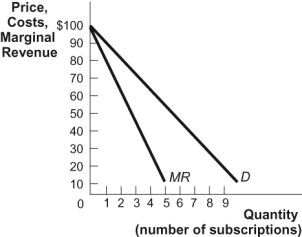 -(Figure: PPV) Look at the figure PPV, which shows the demand and marginal revenue for a pay-per-view football game on cable TV. Assume that the marginal cost and average cost are a constant $20. If the cable company is in a perfectly competitive industry, what price will it charge?
 (Multiple Choice)
4.8/5 (73)
(73) Although price discrimination never occurs in perfect competition, it may occur in monopolistic competition.
(True/False)
4.8/5 (67)
(67) Network externalities exist when a good's value to the consumer rises as:
(Multiple Choice)
4.7/5 (74)
(74) 
Filters
- Essay(0)
- Multiple Choice(0)
- Short Answer(0)
- True False(0)
- Matching(0)