



 Chat with AI
Exam 13: Monopoly

Exam 1: First Principles233 Questions
Exam 2: Economic Models: Trade-Offs and Trade 25382 Questions
Exam 3: Supply and Demand290 Questions
Exam 4: Consumer and Producer Surplus224 Questions
Exam 5: Price Controls and Quotas: Meddling With Markets227 Questions
Exam 6: Elasticity300 Questions
Exam 7: Taxes298 Questions
Exam 8: International Trade272 Questions
Exam 9: Decision Making by Individuals Firms201 Questions
Exam 10: The Rational Consumer372 Questions
Exam 11: Behind the Supply Curve: Inputs and Costs362 Questions
Exam 12: Perfect Competition and the Supply Curve355 Questions
Exam 13: Monopoly350 Questions
Exam 14: Oligopoly294 Questions
Exam 15: Monopolistic Competition and Product Differentiation262 Questions
Exam 16: Externalities199 Questions
Exam 17: Public Goods Common Resources224 Questions
Exam 18: The Economics of the Welfare140 Questions
Exam 19: Factor Markets and the Distribution of Income369 Questions
Exam 20: Uncertainty, Risk, and Private Information202 Questions
Select questions type


The city bus system charges lower fares to senior citizens than to other passengers. Assuming that this pricing strategy increases the profits of the bus system, we can conclude that senior citizens must have a _____ demand for bus service than other passengers.
(Multiple Choice)
4.8/5  (75)
(75) If a monopoly market structure is transformed to a perfectly competitive one, price will _____ and output will _____.
(Multiple Choice)
5.0/5 (73)
(73) A natural monopoly has increasing returns to scale, so that a large producer has a relatively low average total cost.
(True/False)
4.9/5 (85)
(85) A monopoly is most likely to be temporary if the monopoly power is derived from:
(Multiple Choice)
4.8/5 (83)
(83) If a monopolist is producing a quantity that generates MC > MR, then profit:
(Multiple Choice)
4.9/5 (74)
(74) Use the following to answer questions:
Figure: Demand, Revenue, and Cost Curves 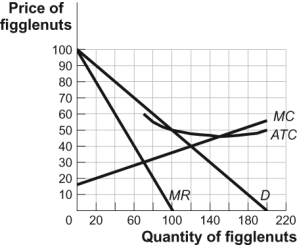 -(Figure: Demand, Revenue, and Cost Curves) Look at the figure Demand, Revenue, and Cost Curves. Figglenuts-R-Us is a monopolist in the figglenut market. If the government wanted to regulate Figglenuts-R-Us such that the entire deadweight loss would be eliminated in the short run, it would impose a price ceiling of:
 (Multiple Choice)
4.7/5 (83)
(83) When a monopolist practices price discrimination as opposed to setting a single price, efficiency decreases.
(True/False)
4.8/5 (89)
(89) Use the following to answer questions:
Figure: Monopoly Model 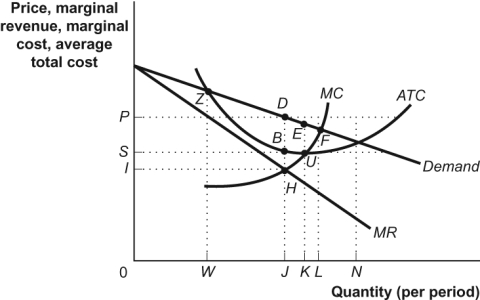 -(Figure: Monopoly Model) Look at the figure Monopoly Model. When the firm is in equilibrium (that is, maximizing its economic profit), its total revenue is the area of rectangle:
 (Multiple Choice)
4.8/5 (79)
(79) Use the following to answer questions:  -(Table: Demand and Total Cost) Look at the table Demand and Total Cost. Lenoia runs a natural monopoly producing electricity for a small mountain village. The accompanying table shows Lenoia's demand and total cost of producing electricity. The maximum profit Lenoia can make is:
 (Multiple Choice)
4.7/5 (72)
(72) The government can reduce the inefficiency associated with a monopoly through a system of patents and copyrights.
(True/False)
5.0/5 (78)
(78) If large fixed costs result in ATC falling as output increases and this occurs over the relevant range of output, this industry is a:
(Multiple Choice)
4.8/5 (69)
(69) Which of the following is NOT an example of price discrimination?
(Multiple Choice)
4.8/5 (81)
(81) Use the following to answer question:
Figure: The Monopolist III 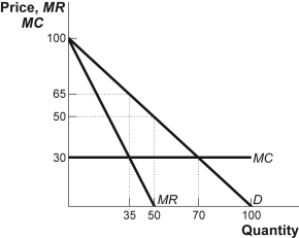 -(Figure: The Monopolist III) Look at the figure The Monopolist III. If this monopolist profit-maximizes, it will produce _____ units and charge a price equal to _____. Its producer surplus will be _____, its consumer surplus will be _____, and the deadweight loss is _____.
 (Multiple Choice)
4.8/5 (73)
(73) A monopoly responds to a decrease in marginal cost by _____ price and _____ output.
(Multiple Choice)
4.8/5 (90)
(90) A monopoly can choose the price or it can choose the quantity, but it cannot choose price and quantity independent of each other.
(True/False)
4.8/5 (80)
(80) Use the following to answer questions:
Figure: PPV 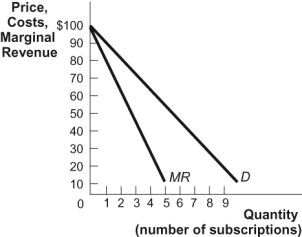 -(Figure: PPV) Look at the figure PPV, which shows the demand and marginal revenue for a pay-per-view football game on cable TV. Assume that the marginal cost and average cost are a constant $20. If the cable company is in a perfectly competitive industry, how many subscriptions will it sell?
 (Multiple Choice)
4.9/5 (89)
(89) Use the following to answer questions:
Figure: Water Works 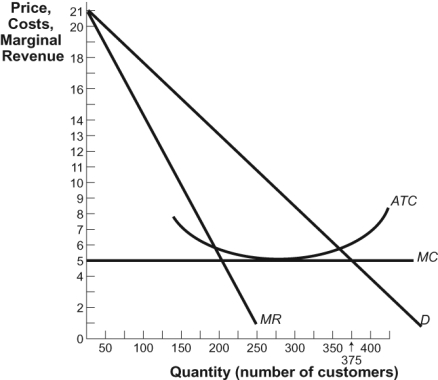 -(Figure: Water Works) Look at the figure Water Works, which describes a small town's water works, a natural monopoly. If regulators require the water works to charge the price that eliminates deadweight loss, consumer surplus will be:
 (Multiple Choice)
4.9/5 (67)
(67) 
Filters
- Essay(0)
- Multiple Choice(0)
- Short Answer(0)
- True False(0)
- Matching(0)