



 Chat with AI
Exam 28: Clinical Microbiology and Epidemiology

Exam 1: Microbial Life: Origin and Discovery70 Questions
Exam 2: Observing the Microbial Cell69 Questions
Exam 3: Cell Structure and Function72 Questions
Exam 4: Bacterial Culture, Growth, and Development70 Questions
Exam 5: Environmental Influences and Control of Microbial Growth70 Questions
Exam 6: Viruses70 Questions
Exam 7: Genomes and Chromosomes70 Questions
Exam 8: Transcription, Translation, and Bioinformatics76 Questions
Exam 9: Gene Transfer, Mutations, and Genome Evolution72 Questions
Exam 10: Molecular Regulation73 Questions
Exam 11: Viral Molecular Biology70 Questions
Exam 12: Biotechniques and Synthetic Biology72 Questions
Exam 13: Energetics and Catabolism77 Questions
Exam 14: Electron Flow in Organotrophy, Lithotrophy, and Phototrophy73 Questions
Exam 15: Biosynthesis73 Questions
Exam 16: Food and Industrial Microbiology73 Questions
Exam 17: Origins and Evolution70 Questions
Exam 18: Bacterial Diversity71 Questions
Exam 19: Archaeal Diversity70 Questions
Exam 20: Eukaryotic Diversity69 Questions
Exam 21: Microbial Ecology70 Questions
Exam 22: Microbes in Global Elemental Cycles70 Questions
Exam 23: Human Microbiota and Innate Immunity70 Questions
Exam 24: The Adaptive Immune Response70 Questions
Exam 25: Microbial Pathogenesis70 Questions
Exam 26: Microbial Diseases69 Questions
Exam 27: Antimicrobial Therapy72 Questions
Exam 28: Clinical Microbiology and Epidemiology75 Questions
Select questions type


How were Koch's postulates modified in the discovery of Tropheryma whipplei, the causative agent of Whipple's disease?
(Essay)
4.9/5  (75)
(75) A serum antibody ELISA would be looking for which of the following in a person who is presumed to have a necrotizing fasciitis infection?
(Multiple Choice)
4.9/5 (73)
(73) Tuberculosis has become a reemerging pathogen today in large part due to
(Multiple Choice)
4.9/5 (86)
(86) Fluorescent antibody staining works well for clinical diagnosis on what types of antigens?
(Multiple Choice)
4.9/5 (77)
(77) A person who begins to exhibit symptoms of bronchitis and bacterial pneumonia after recovering from the flu would be exhibiting
(Multiple Choice)
4.8/5 (77)
(77) John Snow, the "father of epidemiology," is known for deducing the source of which etiologic agent in the 1854 London outbreak?
(Multiple Choice)
4.7/5 (69)
(69) Describe the chain of command that is followed when a patient sees his or her doctor and is diagnosed with a reportable disease such as listeriosis.
(Essay)
4.8/5 (84)
(84) How can reverse transcriptase PCR (RT-PCR) be used to determine the presence and viral load of HIV infection?
(Essay)
4.8/5 (76)
(76) RNA sensors can be used to detect pathogens such as ZIKA virus. The steps below are steps used in testing for ZIKA virus. Which has the required steps in the correct order? 1- LacZ gene product is detected via a color change.
2- DNA is added to an RNA switch that has a hairpin to block transcription of lacZ.
3- Multiple copies of DNA matching ZIKA are produced.
4- In the presence of the ZIKA-trigger RNA, the "toehold" switch is bound and releases the lacZ rbs and start codon so transcription can occur.
5- Reverse transcriptase is used to produce cDNA from the ZIKA RNA.
(Multiple Choice)
4.8/5 (73)
(73) The diagram shown below shows information relative to Gram-negative rods. We CANNOT consider this diagram to be a(n)
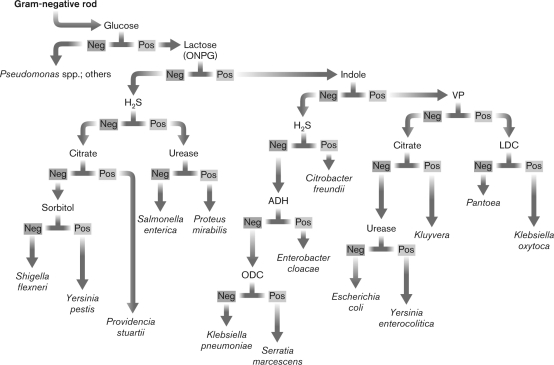
(Multiple Choice)
4.8/5 (90)
(90) PCR-based detection of a person thought to have HIV would require all of the following EXCEPT
(Multiple Choice)
5.0/5 (85)
(85) A proper course of action for a patient presenting with Ebola would be
(Multiple Choice)
4.8/5 (87)
(87) A Gram-negative diplococcus result on a laboratory test would rule out all of the following bacteria EXCEPT
(Multiple Choice)
4.7/5 (95)
(95) The figure shown below is a picture of a gel with multiplex PCR products from Clostridium botulinum isolates. Lane 1 contains DNA molecular weight markers and lanes 2-5 are positive strains as controls for toxins type A, type B, type E, and type F, respectively. Based on the bands shown, what can we say about the isolate results in lane 6? 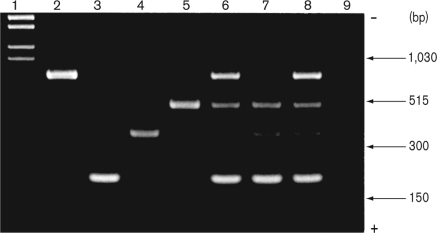
(Multiple Choice)
5.0/5 (70)
(70) Compare and contrast the dichotomous key approach to bacterial determination with the seven-digit-number approach when using the API strip system.
(Essay)
4.8/5 (81)
(81) Catalase-positive organisms such as ________ produce ________ as end products when exposed to hydrogen peroxide.
(Multiple Choice)
4.8/5 (79)
(79) Compare and contrast the handling of rabies (a category III organism) with Lassa fever (a category IV organism).
(Essay)
4.9/5 (66)
(66) A person exhibiting glomerular nephritis and rheumatic fever must have had what type of previous infection?
(Multiple Choice)
4.8/5 (76)
(76) Which infectious disease is on the CDC bioterrorism list due to the general population NOT being vaccinated for this disease since the 1970s?
(Multiple Choice)
4.9/5 (86)
(86) Which of the following organisms falls within biosafety group category II?
(Multiple Choice)
4.8/5 (77)
(77) 
Filters
- Essay(0)
- Multiple Choice(0)
- Short Answer(0)
- True False(0)
- Matching(0)