



 Chat with AI
Exam 7: Genomes and Chromosomes

Exam 1: Microbial Life: Origin and Discovery70 Questions
Exam 2: Observing the Microbial Cell69 Questions
Exam 3: Cell Structure and Function72 Questions
Exam 4: Bacterial Culture, Growth, and Development70 Questions
Exam 5: Environmental Influences and Control of Microbial Growth70 Questions
Exam 6: Viruses70 Questions
Exam 7: Genomes and Chromosomes70 Questions
Exam 8: Transcription, Translation, and Bioinformatics76 Questions
Exam 9: Gene Transfer, Mutations, and Genome Evolution72 Questions
Exam 10: Molecular Regulation73 Questions
Exam 11: Viral Molecular Biology70 Questions
Exam 12: Biotechniques and Synthetic Biology72 Questions
Exam 13: Energetics and Catabolism77 Questions
Exam 14: Electron Flow in Organotrophy, Lithotrophy, and Phototrophy73 Questions
Exam 15: Biosynthesis73 Questions
Exam 16: Food and Industrial Microbiology73 Questions
Exam 17: Origins and Evolution70 Questions
Exam 18: Bacterial Diversity71 Questions
Exam 19: Archaeal Diversity70 Questions
Exam 20: Eukaryotic Diversity69 Questions
Exam 21: Microbial Ecology70 Questions
Exam 22: Microbes in Global Elemental Cycles70 Questions
Exam 23: Human Microbiota and Innate Immunity70 Questions
Exam 24: The Adaptive Immune Response70 Questions
Exam 25: Microbial Pathogenesis70 Questions
Exam 26: Microbial Diseases69 Questions
Exam 27: Antimicrobial Therapy72 Questions
Exam 28: Clinical Microbiology and Epidemiology75 Questions
Select questions type


The genome of the bacterium ________, the agent of Lyme disease, is not contained in a circular DNA molecule but rather in a linear chromosome and more than twenty plasmids.

Free
(Multiple Choice)
4.9/5  (76)
(76) Correct Answer: Verified
D
How are archaeal genomes and gene expression mechanisms similar to both bacterial and eukaryotic genomes?
Free
(Essay)
4.9/5 (70)
(70) Correct Answer:Verified
VerifiedLike bacteria, reproduction in archaea is primarily asexual. Archaea are true prokaryotes because their cells lack a nuclear membrane, but the structure of DNA-packing proteins, RNA polymerase, and ribosomal components more closely resemble those of eukaryotes.
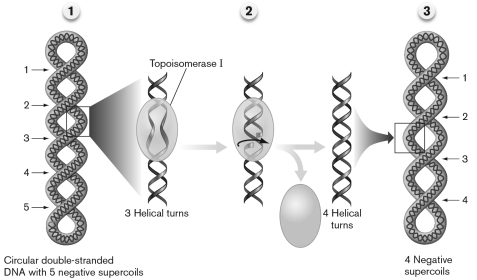
Refer to the figure below and describe the mechanism of action for type I topoisomerases.
Free
(Essay)
4.8/5 (85)
(85) Correct Answer:Verified
VerifiedAnswers may vary, but basically should reflect the following: (1) A type I topoisomerase (e.g., E. coli topo I) cleaves one strand of a DNA double helix and grasps both ends of the break. (2) Using the intrinsic energy released by the break, the enzyme passes the intact strand through the break and relegates the cleaved strand. (3) As the double helix winds in the modified region, a negative supercoil is lost, thus relaxing a negative supercoiled DNA molecule.
In the figure below, which models DNA semiconservative replication, the numeral I points to ________, II points to ________, and III points to _______. 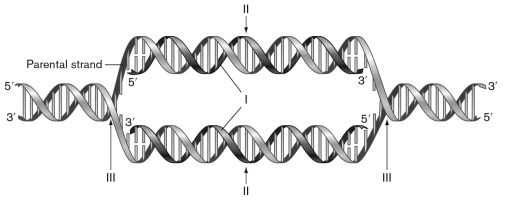
(Multiple Choice)
4.9/5 (71)
(71) Which of the following is NOT a mechanism by which plasmids increase the possibility of being present in the new generation of cells?
(Multiple Choice)
4.7/5 (77)
(77) Cite three examples of the use of metagenomics in the advancement of our knowledge of microbiomes.
(Essay)
4.9/5 (83)
(83) A nucleoid gently released from Escherichia coli appears as 30-100 tightly wound loops, each defined by anchoring
(Multiple Choice)
4.9/5 (71)
(71) The ability of cohesive ends of DNA from different organisms to ________ constitutes the basis of recombinant DNA technology.
(Multiple Choice)
4.9/5 (70)
(70) Pieces of DNA that have been cut with restriction enzymes can anneal and then be covalently bonded using the enzyme
(Multiple Choice)
4.7/5 (70)
(70) The first steps in bacterial DNA replication are represented in the figure below, in which the letters T and U point to ________, respectively. 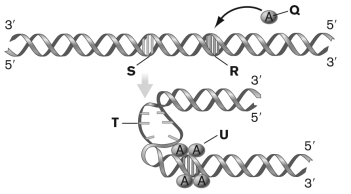
(Multiple Choice)
4.7/5 (90)
(90) Use the figure below to describe the process of RNA primer elimination in the synthesis of the lagging strand. What are the names of the enzymes indicated by the numbers?
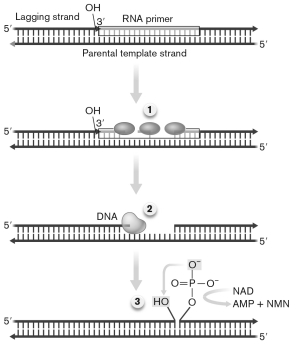
(Essay)
4.8/5 (73)
(73) The main replication DNA polymerase in E. coli is Pol III. What type of bonds do DNA polymerases form?
(Multiple Choice)
4.9/5 (78)
(78) What is the approximate size of Okazaki fragments in E. coli?
(Multiple Choice)
4.8/5 (76)
(76) The natural function of ________ is to cut the DNA of invading plasmids and phages at specific sequences.
(Multiple Choice)
4.8/5 (85)
(85) The entire genetic complement of DNA in a cell of a particular organism is called
(Multiple Choice)
4.9/5 (80)
(80) The backbone of the DNA double helix allows the formation of major and minor ________ through which DNA-binding proteins interact with the bases without separating the strands.
(Multiple Choice)
4.8/5 (81)
(81) Agarose gel electrophoresis separates pieces of linear DNA based on
(Multiple Choice)
5.0/5 (85)
(85) Errors during replication are corrected by the DNA proofreading activity intrinsic to DNA Pol
(Multiple Choice)
4.8/5 (68)
(68) Which of the following is a process that involves cell-to-cell contact to move a plasmid from a donor cell to a recipient cell?
(Multiple Choice)
4.8/5 (77)
(77) 
Filters
- Essay(0)
- Multiple Choice(0)
- Short Answer(0)
- True False(0)
- Matching(0)