



 Chat with AI
Exam 28: Clinical Microbiology and Epidemiology

Exam 1: Microbial Life: Origin and Discovery70 Questions
Exam 2: Observing the Microbial Cell69 Questions
Exam 3: Cell Structure and Function72 Questions
Exam 4: Bacterial Culture, Growth, and Development70 Questions
Exam 5: Environmental Influences and Control of Microbial Growth70 Questions
Exam 6: Viruses70 Questions
Exam 7: Genomes and Chromosomes70 Questions
Exam 8: Transcription, Translation, and Bioinformatics76 Questions
Exam 9: Gene Transfer, Mutations, and Genome Evolution72 Questions
Exam 10: Molecular Regulation73 Questions
Exam 11: Viral Molecular Biology70 Questions
Exam 12: Biotechniques and Synthetic Biology72 Questions
Exam 13: Energetics and Catabolism77 Questions
Exam 14: Electron Flow in Organotrophy, Lithotrophy, and Phototrophy73 Questions
Exam 15: Biosynthesis73 Questions
Exam 16: Food and Industrial Microbiology73 Questions
Exam 17: Origins and Evolution70 Questions
Exam 18: Bacterial Diversity71 Questions
Exam 19: Archaeal Diversity70 Questions
Exam 20: Eukaryotic Diversity69 Questions
Exam 21: Microbial Ecology70 Questions
Exam 22: Microbes in Global Elemental Cycles70 Questions
Exam 23: Human Microbiota and Innate Immunity70 Questions
Exam 24: The Adaptive Immune Response70 Questions
Exam 25: Microbial Pathogenesis70 Questions
Exam 26: Microbial Diseases69 Questions
Exam 27: Antimicrobial Therapy72 Questions
Exam 28: Clinical Microbiology and Epidemiology75 Questions
Select questions type


Eukaryotic parasites, such as Giardia lamblia, are usually diagnosed by

Free
(Multiple Choice)
4.9/5  (76)
(76) Correct Answer: Verified
E
The graph shown below diagrams the number of cases of a disease versus time. The high peak near the right-hand side would be considered a(n) 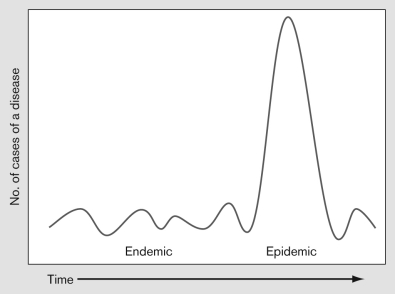
Free
(Multiple Choice)
4.7/5 (86)
(86) Correct Answer:Verified
VerifiedD
The Lancefield groupings are for ________ bacteria and are based on ________.
Free
(Multiple Choice)
4.9/5 (88)
(88) Correct Answer:Verified
VerifiedA
The use of a laminar flow hood when studying the organism Francisella tularensis is an example of level ________ biological safety.
(Multiple Choice)
4.8/5 (83)
(83) The clinical microbiology laboratory just received a sputum (deep-lung) sample that so far has been very slow-growing in nonselective agar, as well as not Gram stainable. What tests should be performed next, and why?
(Essay)
4.9/5 (92)
(92) The figure below shows cells stained bright fuchsia. This stain is called a(an) ________ and is used to stain ________. 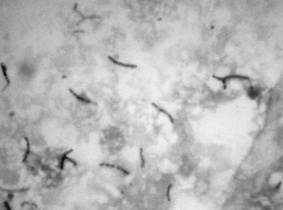
(Multiple Choice)
4.9/5 (86)
(86) When sampling clinical specimens to determine the cause of a disease, samples are often plated on selective media. The reason for this is to
(Multiple Choice)
4.9/5 (70)
(70) Chocolate agar is considered ________ in comparison to blood agar.
(Multiple Choice)
4.7/5 (78)
(78) Looking at the laboratory results presented here, what three interpretations can be made?
Colony 1 Colony 2 Colony 3 Growth on blood agar No growth Growth Growth Growth on Hektoen agar No growth No growth Growth Growth of chocolate agar Growth Growth Growth
(Essay)
4.9/5 (89)
(89) Which of the following clinical specimens would be expected to be sterile in a healthy individual?
(Multiple Choice)
4.9/5 (78)
(78) The following are all concerns of the influence of global climate change on infectious diseases EXCEPT that
(Multiple Choice)
4.8/5 (80)
(80) Humans are an incidental (dead-end) host in which clinical disease?
(Multiple Choice)
4.8/5 (78)
(78) How would a serum antibody ELISA work in the detection of Lyme disease?
(Essay)
4.9/5 (83)
(83) Which of the following criteria is NOT required in order for a mosquito-borne virus to become endemic in a new location?
(Multiple Choice)
4.9/5 (96)
(96) Gaëtan Dugas is frequently referred to as the individual who began the spread of HIV within the gay male community in North America in the 1970s. In epidemiology, he is known as
(Multiple Choice)
4.8/5 (89)
(89) Compare and contrast the use of the serum antibody ELISA with the antigen-capture ELISA in the detection of Ebola.
(Essay)
4.7/5 (82)
(82) In the figure shown below, we see someone wearing a specific biosafety suit. This suit would NOT be required for studying a(n) 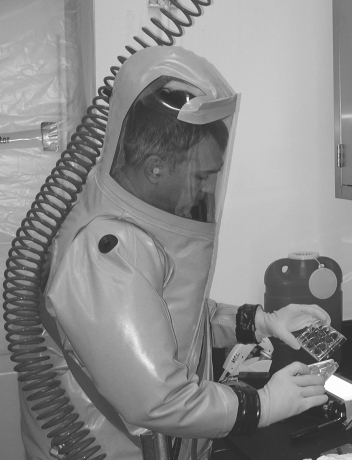
(Multiple Choice)
4.7/5 (89)
(89) Hektoen agar will grow all of the following microorganisms EXCEPT
(Multiple Choice)
4.8/5 (83)
(83) Haemophilius influenzae requires ________ and ________ for confirmatory growth of an organism in vitro.
(Multiple Choice)
4.9/5 (95)
(95) 
Filters
- Essay(0)
- Multiple Choice(0)
- Short Answer(0)
- True False(0)
- Matching(0)