



 Chat with AI
Exam 15: Biosynthesis


Briefly describe the reductive acetyl-CoA pathway. What is its relevance for methanogens?

 (72)
 Verified
The reductive acetyl-CoA pathway seems to be the most ancient CO₂ fixation and biomass assimilation; for example, in methanogens, up to 5% of the CO₂ they absorb is used in biosynthesis. It consists in the formation of an acetyl group using two CO₂ molecules converging from two different pathways. Formate is produced by reduction of CO₂ and transfer to tetrahydrofolate (THF), thus forming a C1 unit. The C1 unit is reduced to a methyl group, -CH₃. In methanogens, methane is formed from this C1 unit for energy gain. The methyl group can be fixed into biomass after being transferred to a tetrapyrrole (called TB and related to vitamin B₁₂). The second CO₂ molecule becomes via carbon dioxide dehydrogenase . is condensed with coenzyme A and the methyl group carried by TB to form acetyl-CoA.
Which of the following statements concerning glyceraldehyde-3-phosphate is FALSE?
(78) VerifiedE
What is the health risk of having nitrates in drinking water? What conditions favor the accumulation of nitrates and nitrites in bodies of water?
(76) VerifiedIn natural environments most nitrogen sources are subject to competition from dissimilatory metabolism. Fertilizers contain nitrogen as NH₄⁺, which can leach from agricultural soils to bodies of water where it can be oxidized to nitrate and nitrite by lithotrophs, a process known as nitrification. Nitrites can combine with hemoglobin, rendering it incapable of taking up oxygen. When infants drink water with high nitrate content, they become ill with "blue baby" syndrome, as nitrate becomes nitrite in the digestive system.
The cell diagrammed below provides an overview of some regulation of the Calvin cycle. Which of the following is NOT involved in this regulation? 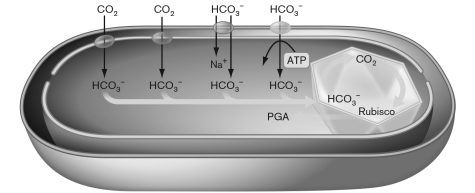 a. Several different transport mechanisms are used for and .
b. and are sequestered inside a carboxysome.
c. Rubisco is sequestered inside a carboxysome.
d. Carbonic anhydrase is used to convert to and thus trap it.
e. Proteins are used to block light and thus the light reactions.
a. Several different transport mechanisms are used for and .
b. and are sequestered inside a carboxysome.
c. Rubisco is sequestered inside a carboxysome.
d. Carbonic anhydrase is used to convert to and thus trap it.
e. Proteins are used to block light and thus the light reactions. (88) Which of the following molecules CANNOT freely cross biological membranes?
(95) All microorganisms require all of the following for biosynthetic purposes EXCEPT
(89) Describe the 3-hydroxypropionate cycle; give examples of microorganisms that use this CO₂ fixation mechanism.
(83) Which of the following are unique in that they fix CO₂ as their sole carbon source?
(77) Cyanobacteria are believed to generate the majority of oxygen gas in Earth's atmosphere. What allows them to produce oxygen?
(79) Based on the number of enzymes involved in its biosynthesis, which of the following is the most complex amino acid specified by the genetic code?
(83) Certain amino acids are more energetically expensive than others (tryptophan versus glutamate). Thus, when proteins are moved to the cell surface, extended outside the surface, or secreted out of the cell, there is a potential harm. Why is this potentially harmful, and what adaptations do bacteria have for this potential loss? Give an example.
(91) Which molecules use 5-phosphoribosyl-1-pyrophosphate (PRPP) in their biosynthesis?
(78) How do ammonium and oxygen regulate the expression of nitrogen fixation genes?
(72) It is thought that the Calvin cycle appeared after the divergence of the three domains of life. What supports this hypothesis?
(87) Gene expression of nitrogenase through NtrC is downregulated in high concentrations of
(84) Which of the following is the reducing agent in the saturation step of polyketide biosynthesis?
(85) 
Filters
- Essay(0)
- Multiple Choice(0)
- Short Answer(0)
- True False(0)
- Matching(0)