



 Chat with AI
Exam 15: Biosynthesis

Exam 1: Microbial Life: Origin and Discovery70 Questions
Exam 2: Observing the Microbial Cell69 Questions
Exam 3: Cell Structure and Function72 Questions
Exam 4: Bacterial Culture, Growth, and Development70 Questions
Exam 5: Environmental Influences and Control of Microbial Growth70 Questions
Exam 6: Viruses70 Questions
Exam 7: Genomes and Chromosomes70 Questions
Exam 8: Transcription, Translation, and Bioinformatics76 Questions
Exam 9: Gene Transfer, Mutations, and Genome Evolution72 Questions
Exam 10: Molecular Regulation73 Questions
Exam 11: Viral Molecular Biology70 Questions
Exam 12: Biotechniques and Synthetic Biology72 Questions
Exam 13: Energetics and Catabolism77 Questions
Exam 14: Electron Flow in Organotrophy, Lithotrophy, and Phototrophy73 Questions
Exam 15: Biosynthesis73 Questions
Exam 16: Food and Industrial Microbiology73 Questions
Exam 17: Origins and Evolution70 Questions
Exam 18: Bacterial Diversity71 Questions
Exam 19: Archaeal Diversity70 Questions
Exam 20: Eukaryotic Diversity69 Questions
Exam 21: Microbial Ecology70 Questions
Exam 22: Microbes in Global Elemental Cycles70 Questions
Exam 23: Human Microbiota and Innate Immunity70 Questions
Exam 24: The Adaptive Immune Response70 Questions
Exam 25: Microbial Pathogenesis70 Questions
Exam 26: Microbial Diseases69 Questions
Exam 27: Antimicrobial Therapy72 Questions
Exam 28: Clinical Microbiology and Epidemiology75 Questions
Select questions type


Tryptophan is among the so-called essential amino acids for humans, as we cannot produce it ourselves. Briefly describe tryptophan biosynthesis in bacteria. Why is it so energetically expensive to synthesize this aromatic amino acid?
(Essay)
4.7/5  (76)
(76) Which of the following is NOT correct regarding nitrogen assimilation into biomass?
(Multiple Choice)
5.0/5 (97)
(97) Which of the following pathways is NOT a route for CO₂ assimilation?
(Multiple Choice)
4.8/5 (83)
(83) How does the reductive (reverse) TCA cycle participate in carbon fixation?
(Multiple Choice)
4.9/5 (79)
(79) An association between two Antarctic microorganisms is pictured below. It provides an interaction that supplies ________, made by the ________, to the ________. 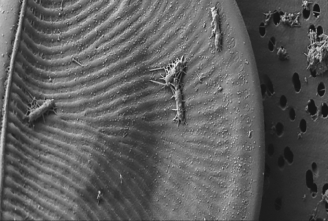
(Multiple Choice)
4.8/5 (70)
(70) The amino acid biosynthetic pathways are designated as families. The ________ family generates only one amino acid.
(Multiple Choice)
4.8/5 (91)
(91) Many of the antibiotics and other pharmaceutical agents isolated from Streptomyces species are
(Multiple Choice)
4.9/5 (73)
(73) What are polyalkanoates, and what are bacterially produced polyalkanoates used for? Why are they of ecological and medical interest?
(Essay)
4.7/5 (79)
(79) Which of the following is NOT correct regarding unsaturation in certain fatty acids?
(Multiple Choice)
4.9/5 (82)
(82) Two strains of E. coli were developed, each of which overproduced an amino acid, either histidine or tryptophan. When grown together in medium with adequate amino acids, they grew but did not associate with each other. When these strains were grown together in medium without histidine and tryptophan, they grew and formed ________ in order to ________.
(Multiple Choice)
4.8/5 (83)
(83) Nitrogenase is diagrammed below. This particular enzyme is shown in the format just before it begins a cycle of nitrogen reduction. This goal is accomplished in four steps. What is the first step? 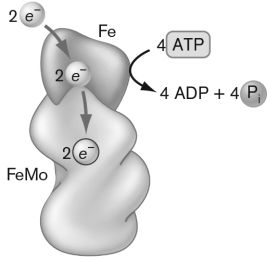
(Multiple Choice)
4.9/5 (90)
(90) 
Filters
- Essay(0)
- Multiple Choice(0)
- Short Answer(0)
- True False(0)
- Matching(0)