



 Chat with AI
Exam 3: Cell Structure and Function

Exam 1: Microbial Life: Origin and Discovery70 Questions
Exam 2: Observing the Microbial Cell69 Questions
Exam 3: Cell Structure and Function72 Questions
Exam 4: Bacterial Culture, Growth, and Development70 Questions
Exam 5: Environmental Influences and Control of Microbial Growth70 Questions
Exam 6: Viruses70 Questions
Exam 7: Genomes and Chromosomes70 Questions
Exam 8: Transcription, Translation, and Bioinformatics76 Questions
Exam 9: Gene Transfer, Mutations, and Genome Evolution72 Questions
Exam 10: Molecular Regulation73 Questions
Exam 11: Viral Molecular Biology70 Questions
Exam 12: Biotechniques and Synthetic Biology72 Questions
Exam 13: Energetics and Catabolism77 Questions
Exam 14: Electron Flow in Organotrophy, Lithotrophy, and Phototrophy73 Questions
Exam 15: Biosynthesis73 Questions
Exam 16: Food and Industrial Microbiology73 Questions
Exam 17: Origins and Evolution70 Questions
Exam 18: Bacterial Diversity71 Questions
Exam 19: Archaeal Diversity70 Questions
Exam 20: Eukaryotic Diversity69 Questions
Exam 21: Microbial Ecology70 Questions
Exam 22: Microbes in Global Elemental Cycles70 Questions
Exam 23: Human Microbiota and Innate Immunity70 Questions
Exam 24: The Adaptive Immune Response70 Questions
Exam 25: Microbial Pathogenesis70 Questions
Exam 26: Microbial Diseases69 Questions
Exam 27: Antimicrobial Therapy72 Questions
Exam 28: Clinical Microbiology and Epidemiology75 Questions
Select questions type


The bacterial cell wall of mycobacteria is highly hydrophobic due to presence of

Free
(Multiple Choice)
4.9/5  (88)
(88) Correct Answer: Verified
B
Mary Jane Osborn discovered that inner and outer membranes are different in density by using
Free
(Multiple Choice)
4.7/5 (88)
(88) Correct Answer:Verified
VerifiedC
Explain the movement of a bacterium possessing flagella away from a toxic chemical.
Free
(Essay)
4.9/5 (83)
(83) Correct Answer:Verified
VerifiedCounterclockwise spinning of the flagella causes the cell to swim a long distance in one direction. Clockwise spinning causes the cell to tumble randomly. These motions are used together to result in a biased random walk that moves the cell in the overall direction away from the toxic chemical.
E. coli and Sinorhizobium cell-surface proteins enable colonization of ________ and ________, respectively.
(Multiple Choice)
4.9/5 (88)
(88) We cannot see the molecules within a cell, but ________ and ________ analysis generate a remarkably detailed view.
(Multiple Choice)
5.0/5 (78)
(78) Describe how vancomycin affects the cell wall of Gram-positive bacteria. How have some cells developed resistance?
(Essay)
4.8/5 (87)
(87) Water can move across a membrane via passive diffusion but that movement is aided by
(Multiple Choice)
5.0/5 (94)
(94) A medically important example of active transport is that of drug ________ proteins powered by the hydrogen ion gradient.
(Multiple Choice)
4.9/5 (81)
(81) Directed movements toward or away from a chemical or physical signal are known as
(Multiple Choice)
4.9/5 (78)
(78) Explain how any two specialized structures are involved in bacterial photosynthesis.
(Essay)
4.9/5 (81)
(81) All of the following are components of peptidoglycan EXCEPT
(Multiple Choice)
4.9/5 (75)
(75) The proteins embedded in a membrane require that region to be
(Multiple Choice)
4.8/5 (81)
(81) Cell wall growth patterns of a variety of bacteria have been studied using fluorescently labeled D-amino acids. This approach has worked because
(Multiple Choice)
4.8/5 (79)
(79) What unusual lipids are found in mycobacteria, and of what benefit are they to these bacteria?
(Essay)
4.9/5 (76)
(76) The molecule shown below is ________ and may play a role in ________. 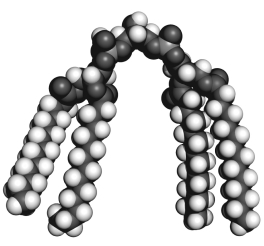
(Multiple Choice)
4.8/5 (84)
(84) The capsule polysaccharides form a slippery mucous layer that inhibits
(Multiple Choice)
4.9/5 (80)
(80) Cells must be broken open in order to then fractionate the components. Each of the following can be used in bacterial cell breakage EXCEPT
(Multiple Choice)
4.9/5 (78)
(78) 
Filters
- Essay(0)
- Multiple Choice(0)
- Short Answer(0)
- True False(0)
- Matching(0)