



 Chat with AI
Exam 18: Bacterial Diversity

Exam 1: Microbial Life: Origin and Discovery70 Questions
Exam 2: Observing the Microbial Cell69 Questions
Exam 3: Cell Structure and Function72 Questions
Exam 4: Bacterial Culture, Growth, and Development70 Questions
Exam 5: Environmental Influences and Control of Microbial Growth70 Questions
Exam 6: Viruses70 Questions
Exam 7: Genomes and Chromosomes70 Questions
Exam 8: Transcription, Translation, and Bioinformatics76 Questions
Exam 9: Gene Transfer, Mutations, and Genome Evolution72 Questions
Exam 10: Molecular Regulation73 Questions
Exam 11: Viral Molecular Biology70 Questions
Exam 12: Biotechniques and Synthetic Biology72 Questions
Exam 13: Energetics and Catabolism77 Questions
Exam 14: Electron Flow in Organotrophy, Lithotrophy, and Phototrophy73 Questions
Exam 15: Biosynthesis73 Questions
Exam 16: Food and Industrial Microbiology73 Questions
Exam 17: Origins and Evolution70 Questions
Exam 18: Bacterial Diversity71 Questions
Exam 19: Archaeal Diversity70 Questions
Exam 20: Eukaryotic Diversity69 Questions
Exam 21: Microbial Ecology70 Questions
Exam 22: Microbes in Global Elemental Cycles70 Questions
Exam 23: Human Microbiota and Innate Immunity70 Questions
Exam 24: The Adaptive Immune Response70 Questions
Exam 25: Microbial Pathogenesis70 Questions
Exam 26: Microbial Diseases69 Questions
Exam 27: Antimicrobial Therapy72 Questions
Exam 28: Clinical Microbiology and Epidemiology75 Questions
Select questions type


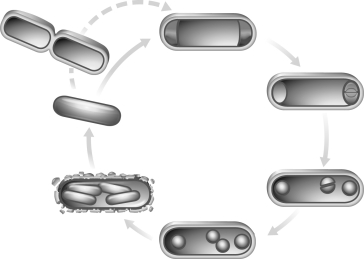
Outline the process illustrated in the following figure.

Free
(Essay)
4.8/5  (72)
(72) Correct Answer: Verified
Some clostridiales, such as members of the genera Metabacterium (shown in the figure) and Epulopiscium, have eliminated binary fission and duplicate through a form of "live birth." Endospores ingested from feces germinate in the upper intestine but rarely undergo binary fission. Instead, the growing cell forms forespores at both poles. The forespores multiply within the mother cell to form several endospores, which ultimately emerge in "live birth" from the mother cell, which then disintegrates.
Which is NOT a typical characteristic of Verrucomicrobia?
Free
(Multiple Choice)
4.9/5 (77)
(77) Correct Answer:Verified
VerifiedE
Pseudomonas aeruginosa may form ________ in the lungs of cystic fibrosis patients.
Free
(Multiple Choice)
4.9/5 (83)
(83) Correct Answer:Verified
VerifiedC
Methylobacterium species are methylotrophs, which means that they
(Multiple Choice)
4.9/5 (72)
(72) Which of the following is NOT a common feature in many spirochetes?
(Multiple Choice)
4.7/5 (89)
(89) Photoheterotrophs absorb light for energy, but do NOT typically
(Multiple Choice)
4.9/5 (73)
(73) Which of the following is NOT a common cyanobacterial morphology?
(Multiple Choice)
4.9/5 (84)
(84) Which of the following is NOT correct with respect to the species of Frankia?
(Multiple Choice)
4.9/5 (83)
(83) The following bacterial genera belong to the Enterobacteriaceae. In particular, the heavily flagellated ________ display swarming behavior prior to forming ________.
(Multiple Choice)
4.9/5 (87)
(87) The firmicutes ________ are the only known phototrophs that produce endospores.
(Multiple Choice)
4.8/5 (77)
(77) Describe three mechanisms cyanobacteria use to provide an anoxic environment for the oxygen-sensitive, nitrogen-fixation enzyme nitrogenase.
(Essay)
4.9/5 (87)
(87) Dehalobacter restrictus could be used in bioremediation because it
(Multiple Choice)
4.8/5 (88)
(88) What bacterial groups use actin as a means to leave their host cells? What advantage does this type of cellular invasion provide to intracellular pathogens?
(Essay)
4.9/5 (86)
(86) Which of the following is NOT correct about the non-spore-forming firmicutes?
(Multiple Choice)
4.8/5 (92)
(92) Cyanobacteria are the only prokaryotes that use ________ to photolyze water to produce oxygen.
(Multiple Choice)
4.8/5 (75)
(75) Which of the following species of Bacillus produces a biological insecticide?
(Multiple Choice)
4.9/5 (97)
(97) The following figure represents the life cycle of which bacteria? 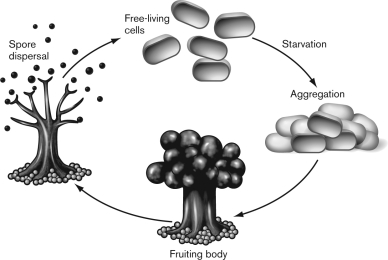
(Multiple Choice)
4.8/5 (94)
(94) 
Filters
- Essay(0)
- Multiple Choice(0)
- Short Answer(0)
- True False(0)
- Matching(0)