



 Chat with AI
Exam 18: Bacterial Diversity

Exam 1: Microbial Life: Origin and Discovery70 Questions
Exam 2: Observing the Microbial Cell69 Questions
Exam 3: Cell Structure and Function72 Questions
Exam 4: Bacterial Culture, Growth, and Development70 Questions
Exam 5: Environmental Influences and Control of Microbial Growth70 Questions
Exam 6: Viruses70 Questions
Exam 7: Genomes and Chromosomes70 Questions
Exam 8: Transcription, Translation, and Bioinformatics76 Questions
Exam 9: Gene Transfer, Mutations, and Genome Evolution72 Questions
Exam 10: Molecular Regulation73 Questions
Exam 11: Viral Molecular Biology70 Questions
Exam 12: Biotechniques and Synthetic Biology72 Questions
Exam 13: Energetics and Catabolism77 Questions
Exam 14: Electron Flow in Organotrophy, Lithotrophy, and Phototrophy73 Questions
Exam 15: Biosynthesis73 Questions
Exam 16: Food and Industrial Microbiology73 Questions
Exam 17: Origins and Evolution70 Questions
Exam 18: Bacterial Diversity71 Questions
Exam 19: Archaeal Diversity70 Questions
Exam 20: Eukaryotic Diversity69 Questions
Exam 21: Microbial Ecology70 Questions
Exam 22: Microbes in Global Elemental Cycles70 Questions
Exam 23: Human Microbiota and Innate Immunity70 Questions
Exam 24: The Adaptive Immune Response70 Questions
Exam 25: Microbial Pathogenesis70 Questions
Exam 26: Microbial Diseases69 Questions
Exam 27: Antimicrobial Therapy72 Questions
Exam 28: Clinical Microbiology and Epidemiology75 Questions
Select questions type


In order to learn what makes proteins stable in thermophilic bacteria, how should the amino acids or motifs that are involved in conferring thermostability to proteins be explored?
(Essay)
4.8/5  (71)
(71) Describe the cell wall of Verrucomicrobia. How could these organisms have acquired this trait?
(Essay)
4.9/5 (83)
(83) Discuss the chemical nature of mycolic acids and some of the traits they confer to organisms that possess them.
(Essay)
4.7/5 (78)
(78) The ________ lack cell walls and have a double membrane around the nucleoid; their tolerance for low concentrations of nutrients is called ________.
(Multiple Choice)
4.7/5 (93)
(93) Clades of microbes that are recently defined or characterized are referred to as
(Multiple Choice)
4.9/5 (86)
(86) Bacteria are widely diverse in their cell structure, metabolism, and ecological adaptations, but share some major common traits. Which of the following statements is NOT true?
(Multiple Choice)
5.0/5 (74)
(74) How do Bacteroides fragilis and B. thetaiotaomicron contribute to 15% of human caloric intake? Are there other benefits provided by these microbes to human health? Are they potentially pathogenic?
(Essay)
4.9/5 (76)
(76) Which of the following is NOT correct with respect to the mycoplasmas?
(Multiple Choice)
4.8/5 (72)
(72) Which of the following statements is NOT correct regarding the life cycle of Chlamydia? 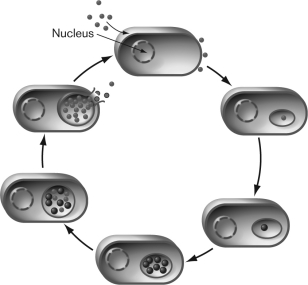
(Multiple Choice)
4.7/5 (73)
(73) Corynebacterium species have a particular type of cell division that can be described as
(Multiple Choice)
4.8/5 (85)
(85) The epsilonproteobacterium Helicobacter pylori is the cause of gastritis and stomach ulcers. What mechanism allows it to survive the acidic conditions of the mammalian stomach?
(Essay)
4.8/5 (84)
(84) All of the following are mechanisms that provide an anoxic environment for nitrogen fixation in cyanobacteria EXCEPT
(Multiple Choice)
4.8/5 (75)
(75) What distinguishes bacterial cell walls from those in archaea and eukarya?
(Essay)
4.9/5 (82)
(82) Which genus within the spirochetes includes the causative agent of Lyme disease?
(Multiple Choice)
4.8/5 (73)
(73) Which of the following is NOT correct about the outer membrane of Gram-negative proteobacterial cell wall?
(Multiple Choice)
4.9/5 (78)
(78) Which gammaproteobacteria genera include species that oxidize H₂S to S⁰?
(Multiple Choice)
4.8/5 (78)
(78) 
Filters
- Essay(0)
- Multiple Choice(0)
- Short Answer(0)
- True False(0)
- Matching(0)