



 Chat with AI
Exam 20: Eukaryotic Diversity

Exam 1: Microbial Life: Origin and Discovery70 Questions
Exam 2: Observing the Microbial Cell69 Questions
Exam 3: Cell Structure and Function72 Questions
Exam 4: Bacterial Culture, Growth, and Development70 Questions
Exam 5: Environmental Influences and Control of Microbial Growth70 Questions
Exam 6: Viruses70 Questions
Exam 7: Genomes and Chromosomes70 Questions
Exam 8: Transcription, Translation, and Bioinformatics76 Questions
Exam 9: Gene Transfer, Mutations, and Genome Evolution72 Questions
Exam 10: Molecular Regulation73 Questions
Exam 11: Viral Molecular Biology70 Questions
Exam 12: Biotechniques and Synthetic Biology72 Questions
Exam 13: Energetics and Catabolism77 Questions
Exam 14: Electron Flow in Organotrophy, Lithotrophy, and Phototrophy73 Questions
Exam 15: Biosynthesis73 Questions
Exam 16: Food and Industrial Microbiology73 Questions
Exam 17: Origins and Evolution70 Questions
Exam 18: Bacterial Diversity71 Questions
Exam 19: Archaeal Diversity70 Questions
Exam 20: Eukaryotic Diversity69 Questions
Exam 21: Microbial Ecology70 Questions
Exam 22: Microbes in Global Elemental Cycles70 Questions
Exam 23: Human Microbiota and Innate Immunity70 Questions
Exam 24: The Adaptive Immune Response70 Questions
Exam 25: Microbial Pathogenesis70 Questions
Exam 26: Microbial Diseases69 Questions
Exam 27: Antimicrobial Therapy72 Questions
Exam 28: Clinical Microbiology and Epidemiology75 Questions
Select questions type


Which of the following algae reproduce by opposite mating filaments forming a cytoplasmic conjugate bridge to fuse cellular material?

Free
(Multiple Choice)
4.8/5  (81)
(81) Correct Answer: Verified
A
Leishmania major causes a skin infection that can then disseminate to internal organs and is transmitted to a human host by
Free
(Multiple Choice)
4.8/5 (89)
(89) Correct Answer:Verified
VerifiedD
The apicomplexans have gone through extensive evolutionary reduction, in which the apicoplast has retained some genetic capabilities from an ancestral chloroplast in order to
Free
(Multiple Choice)
4.8/5 (89)
(89) Correct Answer:Verified
VerifiedE
A major group of marine phytoplankton that is essential to the marine food chain includes
(Multiple Choice)
4.8/5 (75)
(75) Which group has the widest range of form but the least diversity in terms of metabolism?
(Multiple Choice)
4.8/5 (70)
(70) Physarum polycephalum is a type of plasmodial slime mold that can be seen as a yellow mass growing on decaying wood. This organism produces
(Multiple Choice)
4.9/5 (73)
(73) What distinguishes the Opisthokonta from other eukaryotic clades?
(Multiple Choice)
4.9/5 (63)
(63) One of the smallest eukaryotes recently discovered, the green alga Ostreococcus tauri, measures less than ________ across and its genome (8 Mb) is ________ the size of that of Escherichia coli.
(Multiple Choice)
4.8/5 (76)
(76) Briefly describe the life cycle of Ascomyta and describe three ascomycetes that have been used in science or in the culinary arts.
(Essay)
4.8/5 (78)
(78) Use the figure below as a guide to describe the cycle of Plasmodium falciparum transmission between mosquito and human in malaria.
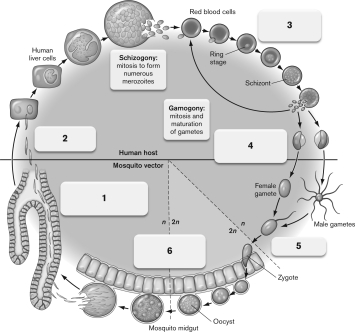
(Essay)
4.8/5 (82)
(82) The brewer's yeast Saccharomyces cerevisiae has been called a "single-celled" human because its genome of about 6,000 genes has many human homologs. Briefly describe three human cell processes that can be modeled using yeast.
(Essay)
4.9/5 (72)
(72) Plasmodium falciparum is a(n) ________ and is transmitted to the human host by the bite of a ________.
(Multiple Choice)
4.9/5 (91)
(91) Use the figure below to describe the mechanism of pseudopod motility in Amoebozoa.
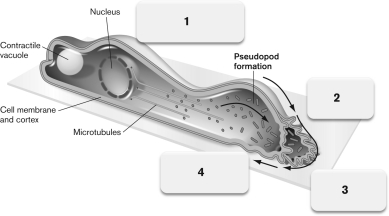
(Essay)
4.8/5 (87)
(87) The following are examples of challenges for classification of eukaryotes, EXCEPT
(Multiple Choice)
4.8/5 (79)
(79) Free living amebas are common soil predators that feed on bacteria, algae, rotifers, and so on. However, some species may harbor bacterial pathogens such as ________, which contaminates water supplies and air ducts.
(Multiple Choice)
4.7/5 (98)
(98) In the organism Saccharomyces cerevisiae, which of the following induces alternation of generations from a haploid to a diploid cell?
(Multiple Choice)
4.9/5 (76)
(76) The figure below is a schematic representation of Chlamydomonas life cycle. What is INCORRECTLY labeled? 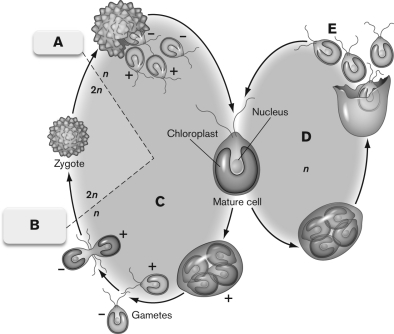
(Multiple Choice)
4.9/5 (85)
(85) 
Filters
- Essay(0)
- Multiple Choice(0)
- Short Answer(0)
- True False(0)
- Matching(0)