



 Chat with AI
Exam 9: Gene Transfer, Mutations, and Genome Evolution

Exam 1: Microbial Life: Origin and Discovery70 Questions
Exam 2: Observing the Microbial Cell69 Questions
Exam 3: Cell Structure and Function72 Questions
Exam 4: Bacterial Culture, Growth, and Development70 Questions
Exam 5: Environmental Influences and Control of Microbial Growth70 Questions
Exam 6: Viruses70 Questions
Exam 7: Genomes and Chromosomes70 Questions
Exam 8: Transcription, Translation, and Bioinformatics76 Questions
Exam 9: Gene Transfer, Mutations, and Genome Evolution72 Questions
Exam 10: Molecular Regulation73 Questions
Exam 11: Viral Molecular Biology70 Questions
Exam 12: Biotechniques and Synthetic Biology72 Questions
Exam 13: Energetics and Catabolism77 Questions
Exam 14: Electron Flow in Organotrophy, Lithotrophy, and Phototrophy73 Questions
Exam 15: Biosynthesis73 Questions
Exam 16: Food and Industrial Microbiology73 Questions
Exam 17: Origins and Evolution70 Questions
Exam 18: Bacterial Diversity71 Questions
Exam 19: Archaeal Diversity70 Questions
Exam 20: Eukaryotic Diversity69 Questions
Exam 21: Microbial Ecology70 Questions
Exam 22: Microbes in Global Elemental Cycles70 Questions
Exam 23: Human Microbiota and Innate Immunity70 Questions
Exam 24: The Adaptive Immune Response70 Questions
Exam 25: Microbial Pathogenesis70 Questions
Exam 26: Microbial Diseases69 Questions
Exam 27: Antimicrobial Therapy72 Questions
Exam 28: Clinical Microbiology and Epidemiology75 Questions
Select questions type


Approximately what percentage of the 4,288 open reading frames of E. coli have no known or annotated function?

Free
(Multiple Choice)
4.8/5  (82)
(82) Correct Answer: Verified
C
What is transcription-coupled repair and why is it important for the cell?
Free
(Essay)
4.9/5 (83)
(83) Correct Answer:Verified
VerifiedTranscriptionally active genes that are damaged need to be repaired. A cell unable to transcribe a gene due to recent DNA damage will be at an extreme disadvantage. The nucleotide excision repair mechanism is used. A protein recognizes a stalled RNA pol and UvrAB is hijacked to begin the repair process.
Why does a genetic experiment using recombination generally involve screening hundreds of millions of cells to find a few recombinants that form visible colonies?
Free
(Essay)
4.8/5 (88)
(88) Correct Answer:Verified
VerifiedThe whole process of recombination is very random and typically of low efficiency. A bacterium first has to receive the appropriate piece of DNA, and then it must recombine the right portion of it to reap any benefit.
Which of the following is the activator of the SOS response?
(Multiple Choice)
4.9/5 (67)
(67) The experiment outlined below is a/an ________ test. The role of the rat liver homogenate is to ________. 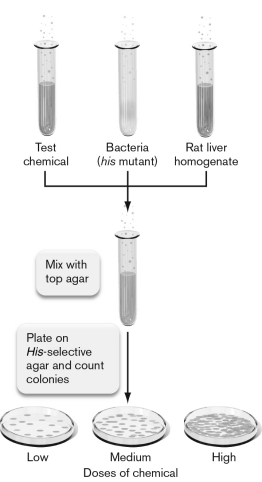
(Multiple Choice)
4.9/5 (76)
(76) Numerous human genetic diseases are caused by mutations in homologs of bacterial
(Multiple Choice)
4.8/5 (77)
(77) The figure shown below diagrams a variety of genomic islands. What characteristics do these islands in the diagram share? 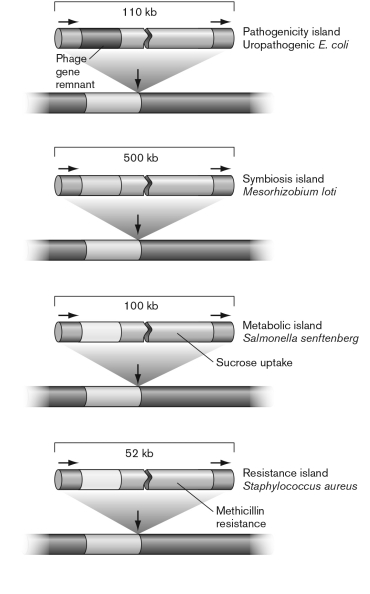
(Multiple Choice)
4.8/5 (79)
(79) Ames used his reversion test with Salmonella to screen compounds for
(Multiple Choice)
4.9/5 (81)
(81) The process of moving a genetic element within or between DNA molecules is
(Multiple Choice)
4.9/5 (81)
(81) Agrobacterium can transfer DNA to ________ using its ________.
(Multiple Choice)
4.8/5 (77)
(77) Approximately what percentage of the genome of E. coli O157:H7, which has been responsible for several outbreaks of food-borne disease, has been acquired from other species?
(Multiple Choice)
4.8/5 (91)
(91) Consider a culture of 10,000 cells that double to 20,000 cells. If measuring 100 mutations in the population, the mutation frequency would be
(Multiple Choice)
4.8/5 (77)
(77) What are the differences between replicative and nonreplicative transposition?
(Essay)
4.8/5 (76)
(76) The reaction of cytosine, shown below, happens ________ and causes ________. 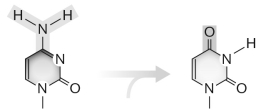
(Multiple Choice)
4.9/5 (78)
(78) In order to transfer, an F factor must have which of the following?
(Multiple Choice)
4.9/5 (76)
(76) Why did Ames modify the test to incorporate treatment of the potential mutagen with rat liver extract?
(Essay)
4.9/5 (67)
(67) 
Filters
- Essay(0)
- Multiple Choice(0)
- Short Answer(0)
- True False(0)
- Matching(0)