



 Chat with AI
Exam 9: Gene Transfer, Mutations, and Genome Evolution

Exam 1: Microbial Life: Origin and Discovery70 Questions
Exam 2: Observing the Microbial Cell69 Questions
Exam 3: Cell Structure and Function72 Questions
Exam 4: Bacterial Culture, Growth, and Development70 Questions
Exam 5: Environmental Influences and Control of Microbial Growth70 Questions
Exam 6: Viruses70 Questions
Exam 7: Genomes and Chromosomes70 Questions
Exam 8: Transcription, Translation, and Bioinformatics76 Questions
Exam 9: Gene Transfer, Mutations, and Genome Evolution72 Questions
Exam 10: Molecular Regulation73 Questions
Exam 11: Viral Molecular Biology70 Questions
Exam 12: Biotechniques and Synthetic Biology72 Questions
Exam 13: Energetics and Catabolism77 Questions
Exam 14: Electron Flow in Organotrophy, Lithotrophy, and Phototrophy73 Questions
Exam 15: Biosynthesis73 Questions
Exam 16: Food and Industrial Microbiology73 Questions
Exam 17: Origins and Evolution70 Questions
Exam 18: Bacterial Diversity71 Questions
Exam 19: Archaeal Diversity70 Questions
Exam 20: Eukaryotic Diversity69 Questions
Exam 21: Microbial Ecology70 Questions
Exam 22: Microbes in Global Elemental Cycles70 Questions
Exam 23: Human Microbiota and Innate Immunity70 Questions
Exam 24: The Adaptive Immune Response70 Questions
Exam 25: Microbial Pathogenesis70 Questions
Exam 26: Microbial Diseases69 Questions
Exam 27: Antimicrobial Therapy72 Questions
Exam 28: Clinical Microbiology and Epidemiology75 Questions
Select questions type


In the figure shown below, the role of the -Me groups on the second sequence is that the methyl groups 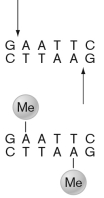
(Multiple Choice)
4.9/5  (81)
(81) In the figure shown below, the cause of the appearance of these bacterial colonies is ________ and is caused by ________. 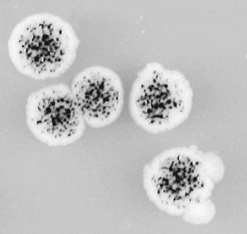
(Multiple Choice)
4.8/5 (92)
(92) Which of the following bacteria requires artificial assistance to become competent to take up DNA?
(Multiple Choice)
4.9/5 (85)
(85) Mutations that occur even in the absence of an added mutagen are known as ________ mutations.
(Multiple Choice)
4.7/5 (98)
(98) Describe the differences in the transformation process in Gram-positive and Gram-negative organisms.
(Essay)
5.0/5 (69)
(69) After extensive DNA damage, special DNA polymerases are expressed that sacrifice replication ________ to rescue the damaged genome.
(Multiple Choice)
4.7/5 (78)
(78) Many infectious bacteria have regions of DNA coding for virulence factors. These regions are called
(Multiple Choice)
4.7/5 (64)
(64) Describe the process whereby DNA is transferred from Agrobacterium to plants.
(Essay)
4.9/5 (77)
(77) Site-specific recombination is RecA independent and requires very short regions of homology between donor and target DNA. Describe an example in either E. coli or Salmonella.
(Essay)
4.9/5 (92)
(92) Which of the following is NOT an example of a genomic island?
(Multiple Choice)
4.8/5 (80)
(80) 
Filters
- Essay(0)
- Multiple Choice(0)
- Short Answer(0)
- True False(0)
- Matching(0)