



 Chat with AI
Exam 9: Gene Transfer, Mutations, and Genome Evolution

Exam 1: Microbial Life: Origin and Discovery70 Questions
Exam 2: Observing the Microbial Cell69 Questions
Exam 3: Cell Structure and Function72 Questions
Exam 4: Bacterial Culture, Growth, and Development70 Questions
Exam 5: Environmental Influences and Control of Microbial Growth70 Questions
Exam 6: Viruses70 Questions
Exam 7: Genomes and Chromosomes70 Questions
Exam 8: Transcription, Translation, and Bioinformatics76 Questions
Exam 9: Gene Transfer, Mutations, and Genome Evolution72 Questions
Exam 10: Molecular Regulation73 Questions
Exam 11: Viral Molecular Biology70 Questions
Exam 12: Biotechniques and Synthetic Biology72 Questions
Exam 13: Energetics and Catabolism77 Questions
Exam 14: Electron Flow in Organotrophy, Lithotrophy, and Phototrophy73 Questions
Exam 15: Biosynthesis73 Questions
Exam 16: Food and Industrial Microbiology73 Questions
Exam 17: Origins and Evolution70 Questions
Exam 18: Bacterial Diversity71 Questions
Exam 19: Archaeal Diversity70 Questions
Exam 20: Eukaryotic Diversity69 Questions
Exam 21: Microbial Ecology70 Questions
Exam 22: Microbes in Global Elemental Cycles70 Questions
Exam 23: Human Microbiota and Innate Immunity70 Questions
Exam 24: The Adaptive Immune Response70 Questions
Exam 25: Microbial Pathogenesis70 Questions
Exam 26: Microbial Diseases69 Questions
Exam 27: Antimicrobial Therapy72 Questions
Exam 28: Clinical Microbiology and Epidemiology75 Questions
Select questions type


Newly replicated, and consequently ________, DNA sequences are invisible to a restriction enzyme.
(Multiple Choice)
4.7/5  (84)
(84) Which of the following mutagens does NOT cause point mutations?
(Multiple Choice)
4.7/5 (83)
(83) In the figure below, which type(s) of mutation(s) is/are introducing frameshifts? A.
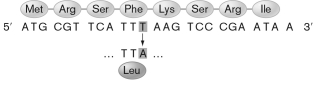 B.
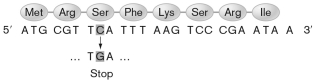 C.
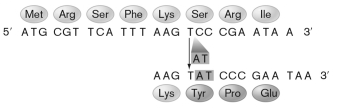 D.
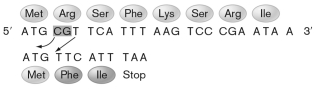 E.
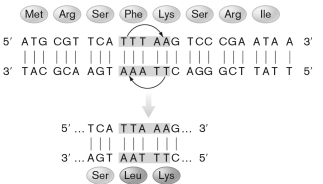
B.
C.
D.
E.
(Multiple Choice)
4.8/5 (79)
(79) In the figure shown below, product A is the result of ________ and product B is the result of ________. 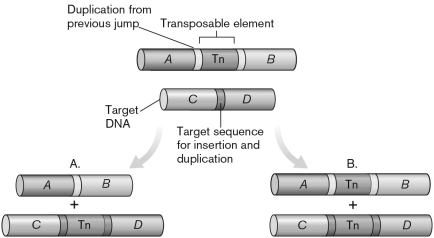
(Multiple Choice)
4.9/5 (80)
(80) During conjugation, DNA pol ________ is used for replication beginning at ________.
(Multiple Choice)
4.9/5 (80)
(80) Describe the purpose of an Ames revision test and how it is performed.
(Essay)
4.8/5 (74)
(74) A difference between type II restriction enzyme and type I or type III restriction enzymes is that
(Multiple Choice)
5.0/5 (74)
(74) Phages that carry host DNA are called transducing particles. Describe how the Salmonella P22 phage accidentally packages host DNA.
(Essay)
4.8/5 (64)
(64) Consider a culture of 1,000 cells. Each cell divides once to yield a total of 2,000 cells. A measurement of the mutation rate in this culture would be based on the total number of
(Multiple Choice)
4.8/5 (86)
(86) Describe a frameshift mutation in terms of insertions and deletions. Does an insertion always result in a frameshift mutation? Will an insertion always render the gene product nonfunctional?
(Essay)
4.8/5 (69)
(69) During conjugation, the DNA passes through the ________, NOT the ________.
(Multiple Choice)
4.9/5 (79)
(79) The transformasome necessary for cell competency in Gram-positive bacteria is regulated using which of the following methods?
(Multiple Choice)
4.9/5 (79)
(79) Outline any three characteristics of the human gastrointestinal tract that makes it an ideal environment for genetic exchange.
(Essay)
4.8/5 (81)
(81) Knockout mutations can include ________ mutations and ________ mutations.
(Multiple Choice)
4.9/5 (76)
(76) Genomes are considered to be mosaic. Which of the following statements provides the LEAST support for this idea?
(Multiple Choice)
4.9/5 (85)
(85) Consider a semipermeable membrane that allows molecules such as DNA and proteins to pass through to the other side. This membrane is not permeable to structures such as ribosomes, viruses, and cells. The following tubes are set up with membrane in between the two compartments in each tube. Tube 1. Cells, both donors and recipients, on both sides of the membrane
Tube 2. Bacteriophage on one side of the membrane and recipient cells on the other
Tube 3. DNA on one side and recipient cells on the other side
In which of these tubes would you see a genetic process, and what is the name of that process?
(Multiple Choice)
4.7/5 (76)
(76) Bacteria have developed a "Halt! Who goes there?" approach to gene exchange to prevent unrestricted incorporation of DNA into the cell. It is called ________ and ________.
(Multiple Choice)
4.7/5 (93)
(93) 
Filters
- Essay(0)
- Multiple Choice(0)
- Short Answer(0)
- True False(0)
- Matching(0)