



 Chat with AI
Exam 13: Energetics and Catabolism


The enzyme pyruvate kinase catalyzes the conversion of phosphoenolpyruvate to pyruvate; the phosphate group is transferred to ADP to form ATP. This reaction is an example of

 (78)
 Verified
A
Define the human metagenome. Describe an example to demonstrate the importance of the metagenome.
(67) VerifiedThe human metagenome is composed of the human genome and the genomes of all the organisms in human gut microbiota. This is important because there are organisms present in our microbiota that we depend on to carry out reactions we cannot perform. Humans obtain some amino acids and vitamins from gut microorganisms. As such, to get a more complete picture of all the metabolic activities present in a human, the metagenome must be considered. Also, genes could be found in gut microbes that code for proteins that utilize the N-acetyl glucosamine, sialic acid and fucose found in breast milk (and not metabolized by humans). Studies with Bacteroides and Ruminococcus sp. serve as examples. Examples may vary but can include studies examining the genes involved in digesting a variety of xyloglucan from sources such as tomatoes versus lettuce.
In their work with soil bacteria, McInerney and colleagues have found microorganisms that display metabolic pathways with net G values as small as -20 kJ/mol. This is an example of
(74) VerifiedC
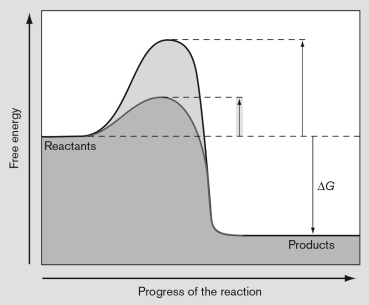
Oxidative catabolism of benzoate and other aromatic compounds is catalyzed by
(75) Which of the following is NOT an end product of fermentation?
(83) Hydrolysis of ATP with the release of pyrophosphate is the driving force of which of the following reactions?
(75) Disparate animal groups, such as ruminants and humans, can digest a variety of plant fibers because they harbor cellulase-producing bacteria such as
(90) What metabolic pathway does Mycobacterium tuberculosis use that allows it to grow slowly inside macrophages? What led to this discovery, and what practical application can further analysis of this pathway have?
(90) Which of the following is evidence that the Entner-Doudoroff (ED) route might have evolved earlier than the Embden-Meyerhof-Parnas pathway (EMP)?
(80) Glycolytic reactions with a near-zero G°' can participate in the overall pathway of gluconeogenesis because they
(91) When studying an enzymatic reaction, should one consider G, G?, or G?' when considering the thermodynamics of the reaction, and why?
(77) Hans Krebs's strategy to determine the biochemical intermediates involved in aerobic respiration was to use substrate molecules of varying lengths. What led Krebs to take this approach?
(77) Hydrogen-generating reactions in Syntrophus and Syntrophomonas have G°' > 0. Can these organisms obtain energy from hydrogen formation?
(76) What technique can be used to determine entropy and enthalpy changes associated with biochemical reactions?
(85) Some bacteria in the human gut microbiota primarily feed on glucose derivatives from mucus secretions. Which of the following is NOT correct with respect to "mucus farming" by bacteria?
(83) The dye ________ turns ________ in the presence of acid products and is included in fermentation broth for some diagnostic tests.
(78) Some intestinal bacteria, such as Escherichia coli, feed on ________ from mucus secretions using the Entner-Doudoroff pathway.
(76) The figure shown below diagrams three pathways for the metabolism of glucose. Pathway ________ is most likely to be used for biosynthesis because it can be used to ________. 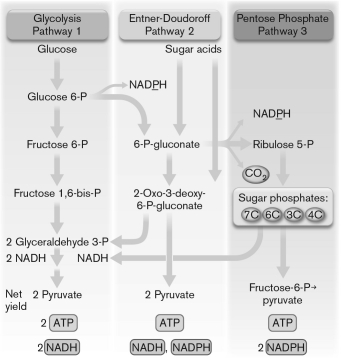
(76) 
Filters
- Essay(0)
- Multiple Choice(0)
- Short Answer(0)
- True False(0)
- Matching(0)