



 Chat with AI
Exam 13: Energetics and Catabolism

Exam 1: Microbial Life: Origin and Discovery70 Questions
Exam 2: Observing the Microbial Cell69 Questions
Exam 3: Cell Structure and Function72 Questions
Exam 4: Bacterial Culture, Growth, and Development70 Questions
Exam 5: Environmental Influences and Control of Microbial Growth70 Questions
Exam 6: Viruses70 Questions
Exam 7: Genomes and Chromosomes70 Questions
Exam 8: Transcription, Translation, and Bioinformatics76 Questions
Exam 9: Gene Transfer, Mutations, and Genome Evolution72 Questions
Exam 10: Molecular Regulation73 Questions
Exam 11: Viral Molecular Biology70 Questions
Exam 12: Biotechniques and Synthetic Biology72 Questions
Exam 13: Energetics and Catabolism77 Questions
Exam 14: Electron Flow in Organotrophy, Lithotrophy, and Phototrophy73 Questions
Exam 15: Biosynthesis73 Questions
Exam 16: Food and Industrial Microbiology73 Questions
Exam 17: Origins and Evolution70 Questions
Exam 18: Bacterial Diversity71 Questions
Exam 19: Archaeal Diversity70 Questions
Exam 20: Eukaryotic Diversity69 Questions
Exam 21: Microbial Ecology70 Questions
Exam 22: Microbes in Global Elemental Cycles70 Questions
Exam 23: Human Microbiota and Innate Immunity70 Questions
Exam 24: The Adaptive Immune Response70 Questions
Exam 25: Microbial Pathogenesis70 Questions
Exam 26: Microbial Diseases69 Questions
Exam 27: Antimicrobial Therapy72 Questions
Exam 28: Clinical Microbiology and Epidemiology75 Questions
Select questions type


Although ATP is the main energy carrier in living organisms, other molecules may also serve as energy carriers in metabolic reactions. Which of the following molecules does NOT carry energy?
(Multiple Choice)
4.9/5  (76)
(76) Which of the following phenomena is sufficient to transport nutrients to cells that lack chemotactic motility?
(Multiple Choice)
4.9/5 (79)
(79) The activity of the enzyme below is controlled in various ways using several of the binding sites shown. The two sites are the ________ site and the ________ site. 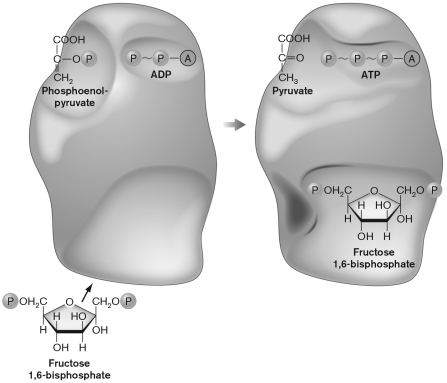
(Multiple Choice)
4.9/5 (81)
(81) Pyruvate dehydrogenase complex connects glycolysis to respiration. Which is a correct mechanism for how the activity of this enzyme complex is regulated?
(Multiple Choice)
4.8/5 (75)
(75) All oxidative catabolism of toluene and other benzene derivatives proceeds through
(Multiple Choice)
4.8/5 (76)
(76) The base adenine forms from ________ in experiments simulating the origin of life on Earth.
(Multiple Choice)
4.9/5 (69)
(69) How does the efficiency of energy capture by ATP formation in bacterial tricarboxylic acid cycle compare with that of mitochondria?
(Essay)
4.8/5 (91)
(91) The process of prioritized consumption of substrates is known as catabolite
(Multiple Choice)
4.9/5 (79)
(79) In the pentose phosphate shunt, glucose 6-phosphate is oxidized to 6-phosphogluconate, which is then decarboxylated to ribulose 5-phosphate. What is the main metabolic role of this pathway?
(Multiple Choice)
4.7/5 (87)
(87) All of the following are reasons to oxidize glucose in a series of steps EXCEPT to
(Multiple Choice)
4.8/5 (80)
(80) What is substrate-level phosphorylation? Provide two examples from bacterial metabolism.
(Essay)
5.0/5 (83)
(83) Amino acids can be synthesized using which one of the molecules from the diagram below? 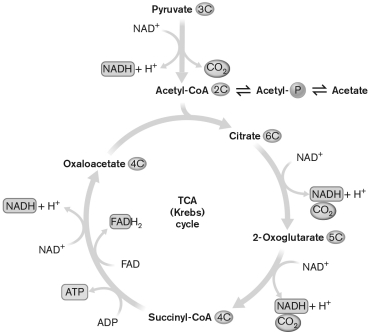
(Multiple Choice)
4.9/5 (86)
(86) In the pentose phosphate shunt (PPS), sugars exchange short carbohydrate moieties to form carbohydrates with varying chain lengths. What metabolic mechanisms allow these exchanges to occur? What are the metabolic advantages of the PPS pathway?
(Essay)
4.9/5 (87)
(87) Treponema pallidum, the causative agent of syphilis, was shown to be lacking a TCA cycle. Explain the significance of this finding.
(Essay)
4.8/5 (67)
(67) In glycolysis, dihydroxyacetone phosphate is isomerized to ________, which reenters the pathway.
(Multiple Choice)
5.0/5 (78)
(78) Clostridium acetobutylicum has been used to produce which solvents?
(Multiple Choice)
4.7/5 (80)
(80) 
Filters
- Essay(0)
- Multiple Choice(0)
- Short Answer(0)
- True False(0)
- Matching(0)