



 Chat with AI
Exam 7: Genomes and Chromosomes

Exam 1: Microbial Life: Origin and Discovery70 Questions
Exam 2: Observing the Microbial Cell69 Questions
Exam 3: Cell Structure and Function72 Questions
Exam 4: Bacterial Culture, Growth, and Development70 Questions
Exam 5: Environmental Influences and Control of Microbial Growth70 Questions
Exam 6: Viruses70 Questions
Exam 7: Genomes and Chromosomes70 Questions
Exam 8: Transcription, Translation, and Bioinformatics76 Questions
Exam 9: Gene Transfer, Mutations, and Genome Evolution72 Questions
Exam 10: Molecular Regulation73 Questions
Exam 11: Viral Molecular Biology70 Questions
Exam 12: Biotechniques and Synthetic Biology72 Questions
Exam 13: Energetics and Catabolism77 Questions
Exam 14: Electron Flow in Organotrophy, Lithotrophy, and Phototrophy73 Questions
Exam 15: Biosynthesis73 Questions
Exam 16: Food and Industrial Microbiology73 Questions
Exam 17: Origins and Evolution70 Questions
Exam 18: Bacterial Diversity71 Questions
Exam 19: Archaeal Diversity70 Questions
Exam 20: Eukaryotic Diversity69 Questions
Exam 21: Microbial Ecology70 Questions
Exam 22: Microbes in Global Elemental Cycles70 Questions
Exam 23: Human Microbiota and Innate Immunity70 Questions
Exam 24: The Adaptive Immune Response70 Questions
Exam 25: Microbial Pathogenesis70 Questions
Exam 26: Microbial Diseases69 Questions
Exam 27: Antimicrobial Therapy72 Questions
Exam 28: Clinical Microbiology and Epidemiology75 Questions
Select questions type


What is the main difference between structural genes and control sequences in bacteria? Cite examples for both.
(Essay)
4.9/5  (71)
(71) When double-stranded DNA replicates, the newly made strand is related to its template strand because the two strands have
(Multiple Choice)
4.7/5 (72)
(72) Describe three practical applications of the polymerase chain reaction (PCR) and possible pitfalls.
(Essay)
4.8/5 (91)
(91) When preparing Escherichia coli cells for electron microscopy by osmotic disruption, their chromosome was released, revealing a length ________ as long as a single cell.
(Multiple Choice)
4.9/5 (91)
(91) During replication, the lagging strand is synthesized ________, while the leading strand can be synthesized ________.
(Multiple Choice)
4.8/5 (72)
(72) Describe how the name of bacterial genes and their gene product are denoted.
(Essay)
4.8/5 (83)
(83) Which of the following terms refers to gene duplications that have decayed into nonfunctional entities?
(Multiple Choice)
4.7/5 (84)
(84) The sliding clamp is used to ________ and is loaded by ________.
(Multiple Choice)
4.9/5 (92)
(92) How does a restriction-modification system avoid the destruction of a bacterium¢s own genome while breaking down foreign DNA?
(Essay)
4.9/5 (78)
(78) Which molecule is responsible for removing torsional stress during DNA replication?
(Multiple Choice)
4.8/5 (79)
(79) DNA sequencing by synthesis is a powerful contemporary technique that allows the generation of up to 600 gigabases (Gb) of sequence per run. Which process is part of sequencing by synthesis?
(Multiple Choice)
4.9/5 (88)
(88) A collection of genes and operons whose expression is controlled by a single protein is called a(n)
(Multiple Choice)
4.7/5 (82)
(82) The term ________ describes a polycistronic messenger RNA whose expression is under control of a promoter.
(Multiple Choice)
5.0/5 (68)
(68) Use the figure below and describe the general mechanism of how supercoiling can be introduced in a double-stranded, circular DNA molecule. In this example, this DNA is about 300 bp.
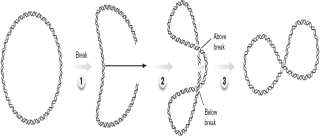
(Essay)
5.0/5 (70)
(70) Hyperthermophilic archaea possess an unusual gyrase called ________, which introduces positive supercoils into the chromosome in order to protect the DNA from ________.
(Multiple Choice)
4.8/5 (70)
(70) DNA and RNA polymerases can only synthesize in the ________ direction.
(Multiple Choice)
4.9/5 (74)
(74) Describe the role of the two RNA polymerases that are involved in the early stages of bacterial DNA replication.
(Essay)
4.9/5 (79)
(79) 
Filters
- Essay(0)
- Multiple Choice(0)
- Short Answer(0)
- True False(0)
- Matching(0)