



 Chat with AI
Exam 17: Origins and Evolution

Exam 1: Microbial Life: Origin and Discovery70 Questions
Exam 2: Observing the Microbial Cell69 Questions
Exam 3: Cell Structure and Function72 Questions
Exam 4: Bacterial Culture, Growth, and Development70 Questions
Exam 5: Environmental Influences and Control of Microbial Growth70 Questions
Exam 6: Viruses70 Questions
Exam 7: Genomes and Chromosomes70 Questions
Exam 8: Transcription, Translation, and Bioinformatics76 Questions
Exam 9: Gene Transfer, Mutations, and Genome Evolution72 Questions
Exam 10: Molecular Regulation73 Questions
Exam 11: Viral Molecular Biology70 Questions
Exam 12: Biotechniques and Synthetic Biology72 Questions
Exam 13: Energetics and Catabolism77 Questions
Exam 14: Electron Flow in Organotrophy, Lithotrophy, and Phototrophy73 Questions
Exam 15: Biosynthesis73 Questions
Exam 16: Food and Industrial Microbiology73 Questions
Exam 17: Origins and Evolution70 Questions
Exam 18: Bacterial Diversity71 Questions
Exam 19: Archaeal Diversity70 Questions
Exam 20: Eukaryotic Diversity69 Questions
Exam 21: Microbial Ecology70 Questions
Exam 22: Microbes in Global Elemental Cycles70 Questions
Exam 23: Human Microbiota and Innate Immunity70 Questions
Exam 24: The Adaptive Immune Response70 Questions
Exam 25: Microbial Pathogenesis70 Questions
Exam 26: Microbial Diseases69 Questions
Exam 27: Antimicrobial Therapy72 Questions
Exam 28: Clinical Microbiology and Epidemiology75 Questions
Select questions type


Human diseases caused by defective mitochondrial DNA include all of the following EXCEPT
(Multiple Choice)
4.8/5  (89)
(89) Evidence for microbial life on Earth dates back to ________ ago.
(Multiple Choice)
4.8/5 (82)
(82) Which of the following did early methanogens use from the early atmosphere to generate energy?
(Multiple Choice)
4.8/5 (92)
(92) In the domains of life, archaea and eukarya differ from each other in that archaea ________ and eukarya ________.
(Multiple Choice)
4.9/5 (85)
(85) The following is correct about a probabilistic indicator for bacterial identification, EXCEPT that
(Multiple Choice)
4.9/5 (83)
(83) The loss of genes encoding for unselected traits is known as
(Multiple Choice)
4.8/5 (89)
(89) The figure below depicts a metabolist model for CO₂ fixation as the basis for biosynthesis as proposed by Morowitz and Wächterhäuser. Discuss the pathway and determine what its outcome is.

(Essay)
4.8/5 (70)
(70) Based on small subunit rRNA phylogeny studies, the current view is that there are ________ domains of life.
(Multiple Choice)
4.9/5 (73)
(73) Mitochondria maintained the essential genes ________ from the ancestral endosymbiont from which they evolved.
(Multiple Choice)
4.9/5 (72)
(72) "Incompletely described," emerging organisms are on their way to be established as new species. In the meantime, they can be designated as all of the following EXCEPT a(n)
(Multiple Choice)
4.8/5 (92)
(92) During the Long-Term Evolution Experiment (LTEE), investigators found a Cit⁺ strain of Escherichia coli that allowed fast growth on citrate buffer after 33,000 generations. The ability to catabolize citrate evolved at this time through
(Multiple Choice)
4.8/5 (85)
(85) The word "symbiosis" is usually understood to mean ________, a relationship in which both partners benefit and may absolutely require each other.
(Multiple Choice)
4.9/5 (79)
(79) The most likely ancestor for today's mitochondria according to the endosymbiotic model is a(n)
(Multiple Choice)
4.7/5 (80)
(80) Use the figure below to describe the appearance of the Cit⁺ mutation in Escherichia coli during the Long-Term Evolution Experiment (LTEE).
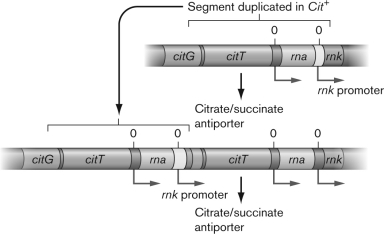
(Essay)
4.7/5 (80)
(80) Analyze the figure below. If a d ¹³C isotope analysis was performed on an unknown geological sample of sedimentary graphite and determined a negative d ¹³C % value, would it be determined that life had existed in that sample or not, and why?

(Essay)
4.7/5 (73)
(73) 
Filters
- Essay(0)
- Multiple Choice(0)
- Short Answer(0)
- True False(0)
- Matching(0)