



 Chat with AI
Exam 14: Biotechnology

Exam 1: An Introduction to Life on Earth85 Questions
Exam 2: Atoms, Molecules, and Life90 Questions
Exam 3: Biological Molecules98 Questions
Exam 4: Cell Structure and Function90 Questions
Exam 5: Cell Membrane Structure and Function95 Questions
Exam 6: Energy Flow in the Life of a Cell90 Questions
Exam 7: Capturing Solar Energy: Photosynthesis102 Questions
Exam 8: Harvesting Energy: Glycolysis and Cellular Respiration97 Questions
Exam 9: Cellular Reproduction133 Questions
Exam 10: Meiosis: the Basis of Sexual Reproduction103 Questions
Exam 11: Patterns of Inheritance98 Questions
Exam 12: Dna: the Molecule of Heredity97 Questions
Exam 13: Gene Expression and Regulation93 Questions
Exam 14: Biotechnology91 Questions
Exam 15: Principles of Evolution97 Questions
Exam 16: How Populations Evolve109 Questions
Exam 17: The Origin of Species89 Questions
Exam 18: The History of Life125 Questions
Exam 19: Systematics: Seeking Order Amid Diversity90 Questions
Exam 20: The Diversity of Prokaryotes and Viruses97 Questions
Exam 21: The Diversity of Protists102 Questions
Exam 22: The Diversity of Plants115 Questions
Exam 23: The Diversity of Fungi107 Questions
Exam 24: Animal Diversity I: Invertebrates101 Questions
Exam 25: Animal Diversity II: Vertebrates118 Questions
Exam 26: Animal Behavior116 Questions
Exam 27: Population Growth and Regulation114 Questions
Exam 28: Community Interactions125 Questions
Exam 29: Energy Flow and Nutrient Cycling in Ecosystems122 Questions
Exam 30: Earths Diverse Ecosystems126 Questions
Exam 31: Conserving Earths Biodiversity109 Questions
Exam 32: Homeostasis and the Organization of the Animal Body95 Questions
Exam 33: Circulation89 Questions
Exam 34: Respiration92 Questions
Exam 35: Nutrition and Digestion91 Questions
Exam 36: The Urinary System99 Questions
Exam 37: Defenses Against Disease104 Questions
Exam 38: Chemical Control of the Animal Body: the Endocrine System133 Questions
Exam 39: The Nervous System118 Questions
Exam 40: The Senses94 Questions
Exam 41: Action and Support: the Muscles and Skeleton90 Questions
Exam 42: Animal Reproduction120 Questions
Exam 43: Animal Development122 Questions
Exam 44: Plant Anatomy and Nutrient Transport95 Questions
Exam 45: Plant Reproduction and Development90 Questions
Exam 46: Plant Responses to the Environment87 Questions
Select questions type


Restriction enzymes are "restricted" in the sense that they normally work on only bacterial DNA.
(True/False)
4.8/5  (84)
(84) Modern forensic biotechnology labs use sophisticated machines to analyze , such as D16, and to determine the number of specific genetic repeats in the samples.
(Multiple Choice)
4.9/5 (80)
(80) Which of the following is NOT a valid difference between traditional and modern forms of biotechnology?
(Multiple Choice)
4.9/5 (64)
(64) Which of the following techniques amplifies a specific region of DNA?
(Multiple Choice)
4.9/5 (70)
(70) The enzymes used to cut genes in recombinant DNA research are called
(Multiple Choice)
4.8/5 (81)
(81) Small, accessory chromosomes found in bacteria that are useful in recombinant DNA procedures are called
(Multiple Choice)
4.9/5 (83)
(83) Based on this figure, how many PCR cycles are necessary to produce 64 copies of the original DNA fragment being amplified? 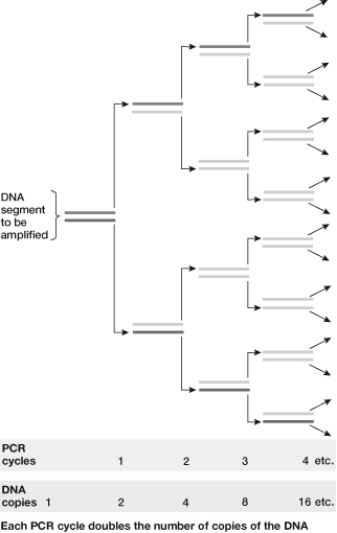
(Multiple Choice)
4.9/5 (92)
(92) The illustrated probe cannot bind to the shown DNA sequence. Which DNA sequence could this probe bind to? 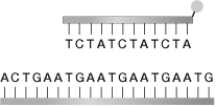
(Multiple Choice)
4.8/5 (63)
(63) All of the following are benefits of sequencing the human genome EXCEPT
(Multiple Choice)
4.9/5 (76)
(76) What is the advantage of using PCR over traditional bacterial cloning to generate large quantities of a specific piece of DNA?
(Essay)
4.9/5 (84)
(84) A radioactively labeled single- stranded DNA can be used to identify a specific piece of DNA in an electrophoresis gel.
(Short Answer)
4.8/5 (74)
(74) Stringent safety rules are not necessary for recombinant DNA research because it is a natural process that occurs in the absence of human intervention.
(True/False)
4.8/5 (78)
(78) How many copies of a particular gene of interest are produced from a single template DNA strand after three cycles of PCR?
(Multiple Choice)
4.8/5 (83)
(83) In nature, DNA recombination occurs but it is random and undirected.
(True/False)
4.7/5 (61)
(61) All of the following are ways in which scientists can transfect an organism EXCEPT
(Multiple Choice)
4.8/5 (80)
(80) Compare and contrast the use of a DNA profile ("DNA fingerprinting") with regular ink fingerprinting.
(Essay)
4.8/5 (80)
(80) 
Filters
- Essay(0)
- Multiple Choice(0)
- Short Answer(0)
- True False(0)
- Matching(0)