



 Chat with AI
Exam 18: The History of Life

Exam 1: An Introduction to Life on Earth85 Questions
Exam 2: Atoms, Molecules, and Life90 Questions
Exam 3: Biological Molecules98 Questions
Exam 4: Cell Structure and Function90 Questions
Exam 5: Cell Membrane Structure and Function95 Questions
Exam 6: Energy Flow in the Life of a Cell90 Questions
Exam 7: Capturing Solar Energy: Photosynthesis102 Questions
Exam 8: Harvesting Energy: Glycolysis and Cellular Respiration97 Questions
Exam 9: Cellular Reproduction133 Questions
Exam 10: Meiosis: the Basis of Sexual Reproduction103 Questions
Exam 11: Patterns of Inheritance98 Questions
Exam 12: Dna: the Molecule of Heredity97 Questions
Exam 13: Gene Expression and Regulation93 Questions
Exam 14: Biotechnology91 Questions
Exam 15: Principles of Evolution97 Questions
Exam 16: How Populations Evolve109 Questions
Exam 17: The Origin of Species89 Questions
Exam 18: The History of Life125 Questions
Exam 19: Systematics: Seeking Order Amid Diversity90 Questions
Exam 20: The Diversity of Prokaryotes and Viruses97 Questions
Exam 21: The Diversity of Protists102 Questions
Exam 22: The Diversity of Plants115 Questions
Exam 23: The Diversity of Fungi107 Questions
Exam 24: Animal Diversity I: Invertebrates101 Questions
Exam 25: Animal Diversity II: Vertebrates118 Questions
Exam 26: Animal Behavior116 Questions
Exam 27: Population Growth and Regulation114 Questions
Exam 28: Community Interactions125 Questions
Exam 29: Energy Flow and Nutrient Cycling in Ecosystems122 Questions
Exam 30: Earths Diverse Ecosystems126 Questions
Exam 31: Conserving Earths Biodiversity109 Questions
Exam 32: Homeostasis and the Organization of the Animal Body95 Questions
Exam 33: Circulation89 Questions
Exam 34: Respiration92 Questions
Exam 35: Nutrition and Digestion91 Questions
Exam 36: The Urinary System99 Questions
Exam 37: Defenses Against Disease104 Questions
Exam 38: Chemical Control of the Animal Body: the Endocrine System133 Questions
Exam 39: The Nervous System118 Questions
Exam 40: The Senses94 Questions
Exam 41: Action and Support: the Muscles and Skeleton90 Questions
Exam 42: Animal Reproduction120 Questions
Exam 43: Animal Development122 Questions
Exam 44: Plant Anatomy and Nutrient Transport95 Questions
Exam 45: Plant Reproduction and Development90 Questions
Exam 46: Plant Responses to the Environment87 Questions
Select questions type


The earliest upright were in a group called australopithecines.
(Short Answer)
4.9/5  (72)
(72) The earliest multicellular animals in the fossil record are
(Multiple Choice)
4.7/5 (74)
(74) The exoskeleton of early marine arthropods can be considered a "pre- adaptation" for life on land because it
(Multiple Choice)
4.8/5 (68)
(68) What species of hominin created the cave paintings at Lascaux, France?
(Multiple Choice)
4.7/5 (71)
(71) The theory that life began in the distant past from nonliving molecules that became able to reproduce themselves is called
(Multiple Choice)
4.8/5 (71)
(71) 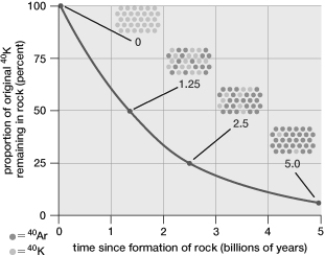 -Based on the graph, if 35% of the original 40K remains in a sample of basalt, what is the approximate age of the rock?
 (Multiple Choice)
5.0/5 (82)
(82) What compounds were used in Miller and Urey's experiment to simulate the atmosphere of early Earth?
(Multiple Choice)
4.7/5 (79)
(79) Cell size is limited by the ability of oxygen, nutrients, and wastes to diffuse through the cell membrane.
(True/False)
4.9/5 (66)
(66) The oldest fossils of anatomically modern are 160,000 years old.
(Short Answer)
4.8/5 (83)
(83) The modern- day group of vertebrates that bridges the evolutionary gap between land- dwelling and water- dwelling organisms is
(Multiple Choice)
4.8/5 (81)
(81) Which of the following scientists was part of a pair who first discovered that cellular reactions can be catalyzed by a ribozyme?
(Multiple Choice)
4.9/5 (80)
(80) Prior to continental drift, North America and Eurasia formed a supercontinent called .
(Short Answer)
4.8/5 (74)
(74) Modern invertebrates first appear in the fossil record during the
(Multiple Choice)
4.9/5 (83)
(83) Fossils are aged by a process that examines the of known radioactive elements.
(Short Answer)
4.9/5 (88)
(88) It has been proposed that large brains evolved in Homo species because
(Multiple Choice)
4.9/5 (66)
(66) 
Filters
- Essay(0)
- Multiple Choice(0)
- Short Answer(0)
- True False(0)
- Matching(0)