



 Chat with AI
Exam 18: The History of Life

Exam 1: An Introduction to Life on Earth85 Questions
Exam 2: Atoms, Molecules, and Life90 Questions
Exam 3: Biological Molecules98 Questions
Exam 4: Cell Structure and Function90 Questions
Exam 5: Cell Membrane Structure and Function95 Questions
Exam 6: Energy Flow in the Life of a Cell90 Questions
Exam 7: Capturing Solar Energy: Photosynthesis102 Questions
Exam 8: Harvesting Energy: Glycolysis and Cellular Respiration97 Questions
Exam 9: Cellular Reproduction133 Questions
Exam 10: Meiosis: the Basis of Sexual Reproduction103 Questions
Exam 11: Patterns of Inheritance98 Questions
Exam 12: Dna: the Molecule of Heredity97 Questions
Exam 13: Gene Expression and Regulation93 Questions
Exam 14: Biotechnology91 Questions
Exam 15: Principles of Evolution97 Questions
Exam 16: How Populations Evolve109 Questions
Exam 17: The Origin of Species89 Questions
Exam 18: The History of Life125 Questions
Exam 19: Systematics: Seeking Order Amid Diversity90 Questions
Exam 20: The Diversity of Prokaryotes and Viruses97 Questions
Exam 21: The Diversity of Protists102 Questions
Exam 22: The Diversity of Plants115 Questions
Exam 23: The Diversity of Fungi107 Questions
Exam 24: Animal Diversity I: Invertebrates101 Questions
Exam 25: Animal Diversity II: Vertebrates118 Questions
Exam 26: Animal Behavior116 Questions
Exam 27: Population Growth and Regulation114 Questions
Exam 28: Community Interactions125 Questions
Exam 29: Energy Flow and Nutrient Cycling in Ecosystems122 Questions
Exam 30: Earths Diverse Ecosystems126 Questions
Exam 31: Conserving Earths Biodiversity109 Questions
Exam 32: Homeostasis and the Organization of the Animal Body95 Questions
Exam 33: Circulation89 Questions
Exam 34: Respiration92 Questions
Exam 35: Nutrition and Digestion91 Questions
Exam 36: The Urinary System99 Questions
Exam 37: Defenses Against Disease104 Questions
Exam 38: Chemical Control of the Animal Body: the Endocrine System133 Questions
Exam 39: The Nervous System118 Questions
Exam 40: The Senses94 Questions
Exam 41: Action and Support: the Muscles and Skeleton90 Questions
Exam 42: Animal Reproduction120 Questions
Exam 43: Animal Development122 Questions
Exam 44: Plant Anatomy and Nutrient Transport95 Questions
Exam 45: Plant Reproduction and Development90 Questions
Exam 46: Plant Responses to the Environment87 Questions
Select questions type


The hypothesis that certain eukaryotic cell structures may have evolved from a prokaryotic cell being engulfed by a eukaryotic cell is called the
(Multiple Choice)
4.9/5  (77)
(77) Current research indicates that hominins originally evolved in which continent?
(Multiple Choice)
4.8/5 (83)
(83) Theories on the atmosphere of early Earth indicate that it lacked
A) CH4.
B) O2.
C) H2.
D) H2O.
E) NH3.
(Essay)
4.8/5 (75)
(75) The "Southern Beech" tree is found in such diverse places as Australia, South Africa, and South America. People did not transplant it. How did it probably get to these widely separated locations?
(Multiple Choice)
4.9/5 (88)
(88) Describe how the mitochondrion evolved as an organelle, using the endosymbiont hypothesis.
(Essay)
4.9/5 (76)
(76)  -While exploring a sulfur spring, a scientist finds a new organism. It is single- celled, lacks a cell wall, has a few internal membranes, and appears to have set up a symbiotic relationship with a species of free- living purple sulfur bacteria that are common in the spring. There are no other organisms within it. This new organism would be considered a(n)
 (Multiple Choice)
4.9/5 (80)
(80) Who is credited with proposing that prebiotic chemical conditions could lead to the evolution of complex molecules and, eventually, to living organisms?
(Multiple Choice)
4.9/5 (73)
(73) Which group of vertebrates was the first to evolve a waterproof egg, which allowed the group to move away from water, deeper onto dry land?
(Multiple Choice)
5.0/5 (76)
(76) The scenario of prebiotic evolution leading to the origin of life on Earth is plausible because
(Multiple Choice)
4.9/5 (70)
(70) The first land plants were restricted to moist, marshy environments because of
(Multiple Choice)
4.9/5 (92)
(92) Which of these characteristics separates primates from other mammals?
(Multiple Choice)
4.9/5 (72)
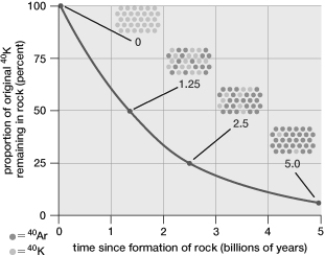
(72)
-Based on the graph, if 60% of the original 40K remains in a sample of basalt, what is the approximate age of the rock?
-Based on the graph, if 60% of the original 40K remains in a sample of basalt, what is the approximate age of the rock? (Multiple Choice)
4.9/5 (81)
(81) Mitochondria contain their own DNA, separate from that of the rest of the cell.
(True/False)
4.8/5 (71)
(71) Birds and mammals have a more active lifestyle than reptiles due to
(Multiple Choice)
4.9/5 (77)
(77) The first hominin species associated with the use of tools was
(Multiple Choice)
4.8/5 (76)
(76) 
Filters
- Essay(0)
- Multiple Choice(0)
- Short Answer(0)
- True False(0)
- Matching(0)