



 Chat with AI
Exam 37: Defenses Against Disease

Exam 1: An Introduction to Life on Earth85 Questions
Exam 2: Atoms, Molecules, and Life90 Questions
Exam 3: Biological Molecules98 Questions
Exam 4: Cell Structure and Function90 Questions
Exam 5: Cell Membrane Structure and Function95 Questions
Exam 6: Energy Flow in the Life of a Cell90 Questions
Exam 7: Capturing Solar Energy: Photosynthesis102 Questions
Exam 8: Harvesting Energy: Glycolysis and Cellular Respiration97 Questions
Exam 9: Cellular Reproduction133 Questions
Exam 10: Meiosis: the Basis of Sexual Reproduction103 Questions
Exam 11: Patterns of Inheritance98 Questions
Exam 12: Dna: the Molecule of Heredity97 Questions
Exam 13: Gene Expression and Regulation93 Questions
Exam 14: Biotechnology91 Questions
Exam 15: Principles of Evolution97 Questions
Exam 16: How Populations Evolve109 Questions
Exam 17: The Origin of Species89 Questions
Exam 18: The History of Life125 Questions
Exam 19: Systematics: Seeking Order Amid Diversity90 Questions
Exam 20: The Diversity of Prokaryotes and Viruses97 Questions
Exam 21: The Diversity of Protists102 Questions
Exam 22: The Diversity of Plants115 Questions
Exam 23: The Diversity of Fungi107 Questions
Exam 24: Animal Diversity I: Invertebrates101 Questions
Exam 25: Animal Diversity II: Vertebrates118 Questions
Exam 26: Animal Behavior116 Questions
Exam 27: Population Growth and Regulation114 Questions
Exam 28: Community Interactions125 Questions
Exam 29: Energy Flow and Nutrient Cycling in Ecosystems122 Questions
Exam 30: Earths Diverse Ecosystems126 Questions
Exam 31: Conserving Earths Biodiversity109 Questions
Exam 32: Homeostasis and the Organization of the Animal Body95 Questions
Exam 33: Circulation89 Questions
Exam 34: Respiration92 Questions
Exam 35: Nutrition and Digestion91 Questions
Exam 36: The Urinary System99 Questions
Exam 37: Defenses Against Disease104 Questions
Exam 38: Chemical Control of the Animal Body: the Endocrine System133 Questions
Exam 39: The Nervous System118 Questions
Exam 40: The Senses94 Questions
Exam 41: Action and Support: the Muscles and Skeleton90 Questions
Exam 42: Animal Reproduction120 Questions
Exam 43: Animal Development122 Questions
Exam 44: Plant Anatomy and Nutrient Transport95 Questions
Exam 45: Plant Reproduction and Development90 Questions
Exam 46: Plant Responses to the Environment87 Questions
Select questions type


As a doctor, you discover a new virus that prevents the body from creating memory cells. Based on what you know about human defenses against disease, you predict that this virus is infecting and destroying which type of white blood cell?
(Multiple Choice)
4.8/5  (84)
(84) The proteins that must be matched as closely as possible between an organ donor and a recipient are the proteins.
(Multiple Choice)
4.7/5 (71)
(71) Which of the following is NOT part of the inflammatory response?
(Multiple Choice)
4.9/5 (83)
(83) HIV weakens a person's ability to fight off other infections by infecting and destroying helper T cells.
(True/False)
4.8/5 (92)
(92) This figure illustrates the structure of an antibody. Which part of the antibody binds to the antigen? 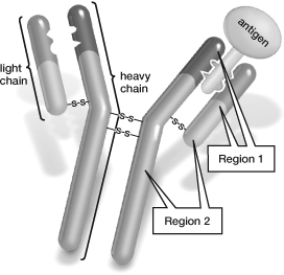
(Multiple Choice)
4.9/5 (83)
(83) When Europeans first came to North America, one of the most disastrous impacts on native populations was the introduction of "Old World diseases." These diseases, such as smallpox, influenza, and plague, devastated the Native American population as the number of settlers grew steadily. One author has called this "the greatest human catastrophe in history, far exceeding . . . the Black Death of Medieval Europe." Based on this scenario and what you know about the immune system, what can you conclude about the Native American and European populations?
(Multiple Choice)
4.9/5 (93)
(93) You are a forensic biologist and have been asked to review the files of an old, unsolved murder case. The autopsy report is missing a lot of important information, but you read that the victim had a thymus gland that was just starting to shrink. Based on this information alone, what can you conclude about the victim?
(Multiple Choice)
4.9/5 (82)
(82) How does a cell "inform" the immune system that it is infected with a virus?
(Multiple Choice)
4.9/5 (78)
(78) Triclosan is a common antibiotic used in antiperspirants, toothpastes, and antibacterial soaps. You are a doctor studying the evolution of bacterial resistance to triclosan. You need to find a population of nonresistant bacteria. Where should you look?
(Multiple Choice)
5.0/5 (79)
(79) HIV may be transmitted from one individual to another by holding hands.
(True/False)
4.8/5 (76)
(76) Which of the following predictions is the most accurate about a person who has normal external barriers and specific internal defenses but lacks nonspecific internal defenses?
(Multiple Choice)
4.8/5 (80)
(80) 
Filters
- Essay(0)
- Multiple Choice(0)
- Short Answer(0)
- True False(0)
- Matching(0)