



 Chat with AI
Exam 8: Harvesting Energy: Glycolysis and Cellular Respiration

Exam 1: An Introduction to Life on Earth85 Questions
Exam 2: Atoms, Molecules, and Life90 Questions
Exam 3: Biological Molecules98 Questions
Exam 4: Cell Structure and Function90 Questions
Exam 5: Cell Membrane Structure and Function95 Questions
Exam 6: Energy Flow in the Life of a Cell90 Questions
Exam 7: Capturing Solar Energy: Photosynthesis102 Questions
Exam 8: Harvesting Energy: Glycolysis and Cellular Respiration97 Questions
Exam 9: Cellular Reproduction133 Questions
Exam 10: Meiosis: the Basis of Sexual Reproduction103 Questions
Exam 11: Patterns of Inheritance98 Questions
Exam 12: Dna: the Molecule of Heredity97 Questions
Exam 13: Gene Expression and Regulation93 Questions
Exam 14: Biotechnology91 Questions
Exam 15: Principles of Evolution97 Questions
Exam 16: How Populations Evolve109 Questions
Exam 17: The Origin of Species89 Questions
Exam 18: The History of Life125 Questions
Exam 19: Systematics: Seeking Order Amid Diversity90 Questions
Exam 20: The Diversity of Prokaryotes and Viruses97 Questions
Exam 21: The Diversity of Protists102 Questions
Exam 22: The Diversity of Plants115 Questions
Exam 23: The Diversity of Fungi107 Questions
Exam 24: Animal Diversity I: Invertebrates101 Questions
Exam 25: Animal Diversity II: Vertebrates118 Questions
Exam 26: Animal Behavior116 Questions
Exam 27: Population Growth and Regulation114 Questions
Exam 28: Community Interactions125 Questions
Exam 29: Energy Flow and Nutrient Cycling in Ecosystems122 Questions
Exam 30: Earths Diverse Ecosystems126 Questions
Exam 31: Conserving Earths Biodiversity109 Questions
Exam 32: Homeostasis and the Organization of the Animal Body95 Questions
Exam 33: Circulation89 Questions
Exam 34: Respiration92 Questions
Exam 35: Nutrition and Digestion91 Questions
Exam 36: The Urinary System99 Questions
Exam 37: Defenses Against Disease104 Questions
Exam 38: Chemical Control of the Animal Body: the Endocrine System133 Questions
Exam 39: The Nervous System118 Questions
Exam 40: The Senses94 Questions
Exam 41: Action and Support: the Muscles and Skeleton90 Questions
Exam 42: Animal Reproduction120 Questions
Exam 43: Animal Development122 Questions
Exam 44: Plant Anatomy and Nutrient Transport95 Questions
Exam 45: Plant Reproduction and Development90 Questions
Exam 46: Plant Responses to the Environment87 Questions
Select questions type


Chemiosmosis in mitochondria directly results in the synthesis of
(Multiple Choice)
4.7/5  (74)
(74) In the glucose activation stage of glycolysis, glucose receives a phosphate group from ATP. This reaction is
(Multiple Choice)
4.8/5 (77)
(77) Which event occurs in the fluid portion of the cytoplasm of a cell undergoing glucose metabolism?
(Multiple Choice)
4.9/5 (91)
(91) Glycolysis and the Krebs cycle reactions both occur in the mitochondria.
(True/False)
4.9/5 (89)
(89) Where does the production of pyruvate occur during glycolysis?
(Multiple Choice)
4.8/5 (97)
(97) During glycolysis in the energy- investing stage, two ATP molecules are "spent" to convert glucose to the highly reactive molecule
(Multiple Choice)
4.8/5 (70)
(70) What molecule is common to both C3 photosynthesis and the process of glycolysis?
(Multiple Choice)
4.9/5 (78)
(78) Which kind of metabolic poison would interfere with the glycolysis stage of cellular respiration?
(Multiple Choice)
4.8/5 (85)
(85) If only one molecule of pyruvate (instead of two) were produced per glucose molecule metabolized in glycolysis, then which of the following would be produced after glycolysis and before the electron transport chain? 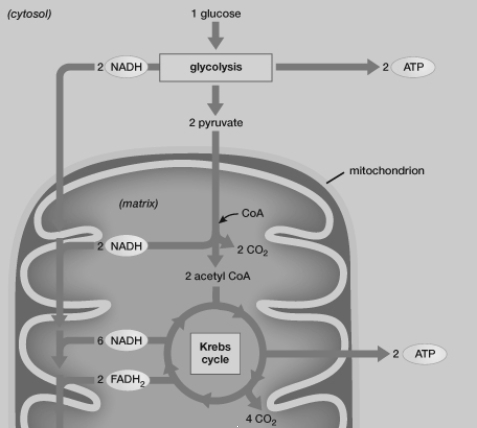
(Multiple Choice)
4.8/5 (85)
(85) The inner membrane of the mitochondria can be compared functionally to the thylakoid membranes of the chloroplast because both contain a system for
(Multiple Choice)
4.8/5 (87)
(87) The metabolic breakdown of one molecule of glucose generates the greatest amount of ATP energy during
(Multiple Choice)
4.9/5 (73)
(73) In the 1940s, some physicians prescribed low doses of a drug called dinitrophenol (DNP) to help patients lose weight. This unsafe drug was quickly abandoned after a few patients died. DNP affects cells by uncoupling the chemiosmotic machinery and making the inner mitochondrial membrane "leaky" to hydrogen ions.
Explain how DNP caused weight loss and, ultimately, death in these dieters.
(Essay)
4.8/5 (74)
(74) After fermentation in human cells, lactate is converted to pyruvate in the
(Multiple Choice)
4.7/5 (84)
(84) During cellular respiration, the pyruvate produced in glycolysis is
(Multiple Choice)
4.9/5 (75)
(75) During which of the following processes is ATP NOT produced?
(Multiple Choice)
4.8/5 (81)
(81) Most of the ATP produced during cellular respiration is generated in the mitochondrial after the movement of hydrogen ions through ATP- synthesizing proteins in the inner membrane of the mitochondrion.
(Short Answer)
4.8/5 (79)
(79) is a series of reactions, occurring under aerobic conditions, in which large amounts of ATP are produced from the breakdown of glucose.
(Short Answer)
4.7/5 (83)
(83) 
Filters
- Essay(0)
- Multiple Choice(0)
- Short Answer(0)
- True False(0)
- Matching(0)