



 Chat with AI
Exam 28: Unemployment and Its Natural Rate

Exam 1: Ten Principles of Economics455 Questions
Exam 2: Thinking Like an Economist643 Questions
Exam 3: Interdependence and the Gains From Trade547 Questions
Exam 4: The Market Forces of Supply and Demand693 Questions
Exam 5: Elasticity and Its Application626 Questions
Exam 6: Supply, Demand, and Government Policies668 Questions
Exam 7: Consumers, Producers, and the Efficiency of Markets547 Questions
Exam 8: Applications: the Costs of Taxation509 Questions
Exam 9: Application: International Trade521 Questions
Exam 10: Externalities543 Questions
Exam 11: Public Goods and Common Resources452 Questions
Exam 12: The Design of the Tax System664 Questions
Exam 13: The Costs of Production649 Questions
Exam 14: Firms in Competitive Markets604 Questions
Exam 15: Monopoly662 Questions
Exam 16: Monopolistic Competition649 Questions
Exam 17: Oligopoly522 Questions
Exam 18: The Markets for the Factors of Production592 Questions
Exam 19: Earnings and Discrimination511 Questions
Exam 20: Income Inequality and Poverty478 Questions
Exam 21: The Theory of Consumer Choice570 Questions
Exam 22: Frontiers in Microeconomics461 Questions
Exam 23: Measuring a Nation S Income547 Questions
Exam 24: Measuring the Cost of Living565 Questions
Exam 25: Production and Growth527 Questions
Exam 26: Saving, Investment, and the Financial System637 Questions
Exam 27: Tools of Finance534 Questions
Exam 28: Unemployment and Its Natural Rate701 Questions
Exam 29: The Monetary System540 Questions
Exam 30: Money Growth and Inflation504 Questions
Exam 31: Open-Economy Macroeconomics: Basic Concepts540 Questions
Exam 32: A Macroeconomic Theory of the Open Economy511 Questions
Exam 33: Aggregate Demand and Aggregate Supply572 Questions
Exam 34: The Influence of Monetary and Fiscal Policy on Aggregate Demand523 Questions
Exam 35: The Short-Run Tradeoff Between Inflation and Unemployment536 Questions
Exam 36: Six Debates Over Macroeconomic Policy354 Questions
Select questions type


Eric was laid off two months ago. He has not searched for other work because he is expecting to be recalled to work. The Bureau of Labor Statistics counts Eric as
(Multiple Choice)
4.9/5  (96)
(96) Most spells of unemployment are short. About half of unemployment spells end with an exit from the labor force.
(True/False)
5.0/5 (93)
(93) The efficiency-wage theory of worker health is more relevant for less developed countries than rich countries.
(True/False)
4.9/5 (97)
(97) Figure 28-6 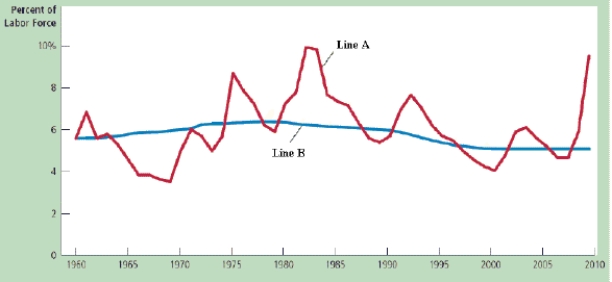 -Refer to Figure 28-6. What type of unemployment is measured by the differences between lines A and B?
 (Short Answer)
4.9/5 (67)
(67) Figure 28-3 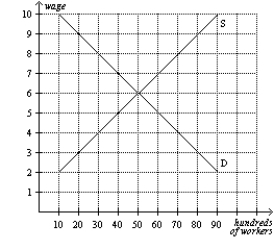 -Refer to Figure 28-3. If the government imposes a minimum wage of $8, then employment will decrease by
 (Multiple Choice)
4.9/5 (87)
(87) Causes of the decline in the U.S. men's labor-force participation rate over the past several decades include young men now staying in school longer than their fathers and grandfathers did, older men now retiring earlier and living longer, and more fathers now staying at home to raise their children.
(True/False)
4.7/5 (77)
(77) Figure 28-7 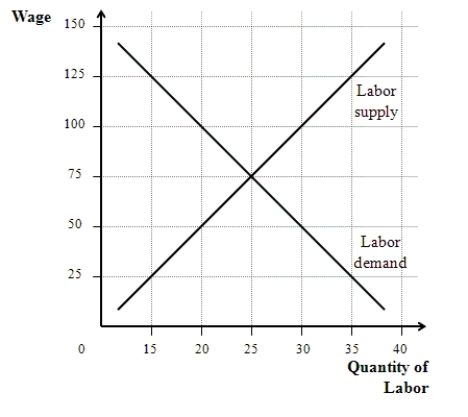 -Refer to Figure 28-7. If the minimum wage increases from $100 to $125, how many additional workers will be unemployed?
 (Short Answer)
5.0/5 (80)
(80) Which of the following is not a commonly-cited explanation for the dramatically increasing labor-force participation rates for women from 1950 to the present?
(Multiple Choice)
4.8/5 (86)
(86) Explain how the following apparently contradictory statement can be true: Most spells of unemployment are short, and most unemployment observed at any given time is long-term.
(Essay)
4.9/5 (80)
(80) The unemployment that results from the process of matching workers and jobs is called structural unemployment.
(True/False)
4.8/5 (72)
(72) Minimum-wage laws are one reason there is always some unemployment in the U.S. economy.
(True/False)
4.8/5 (70)
(70) Most spells of unemployment are short, and most unemployment observed at any given time is short-term.
(True/False)
4.8/5 (69)
(69) Minimum-wage laws matter most for the least skilled and least experienced members of the labor force, such as teenagers.
(True/False)
4.8/5 (73)
(73) Table 28-6 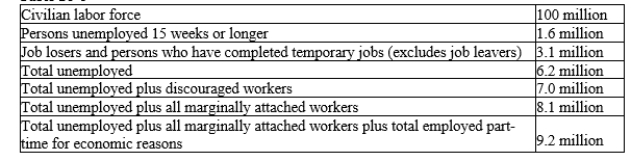 -Refer to Table 28-6. What is the U-4 measure of labor underutilization?
 (Multiple Choice)
4.8/5 (83)
(83) If unions were formed in more industries, the supply of labor in other industries would
(Multiple Choice)
4.8/5 (80)
(80) 
Filters
- Essay(0)
- Multiple Choice(0)
- Short Answer(0)
- True False(0)
- Matching(0)