



 Chat with AI
Exam 28: Unemployment and Its Natural Rate

Exam 1: Ten Principles of Economics455 Questions
Exam 2: Thinking Like an Economist643 Questions
Exam 3: Interdependence and the Gains From Trade547 Questions
Exam 4: The Market Forces of Supply and Demand693 Questions
Exam 5: Elasticity and Its Application626 Questions
Exam 6: Supply, Demand, and Government Policies668 Questions
Exam 7: Consumers, Producers, and the Efficiency of Markets547 Questions
Exam 8: Applications: the Costs of Taxation509 Questions
Exam 9: Application: International Trade521 Questions
Exam 10: Externalities543 Questions
Exam 11: Public Goods and Common Resources452 Questions
Exam 12: The Design of the Tax System664 Questions
Exam 13: The Costs of Production649 Questions
Exam 14: Firms in Competitive Markets604 Questions
Exam 15: Monopoly662 Questions
Exam 16: Monopolistic Competition649 Questions
Exam 17: Oligopoly522 Questions
Exam 18: The Markets for the Factors of Production592 Questions
Exam 19: Earnings and Discrimination511 Questions
Exam 20: Income Inequality and Poverty478 Questions
Exam 21: The Theory of Consumer Choice570 Questions
Exam 22: Frontiers in Microeconomics461 Questions
Exam 23: Measuring a Nation S Income547 Questions
Exam 24: Measuring the Cost of Living565 Questions
Exam 25: Production and Growth527 Questions
Exam 26: Saving, Investment, and the Financial System637 Questions
Exam 27: Tools of Finance534 Questions
Exam 28: Unemployment and Its Natural Rate701 Questions
Exam 29: The Monetary System540 Questions
Exam 30: Money Growth and Inflation504 Questions
Exam 31: Open-Economy Macroeconomics: Basic Concepts540 Questions
Exam 32: A Macroeconomic Theory of the Open Economy511 Questions
Exam 33: Aggregate Demand and Aggregate Supply572 Questions
Exam 34: The Influence of Monetary and Fiscal Policy on Aggregate Demand523 Questions
Exam 35: The Short-Run Tradeoff Between Inflation and Unemployment536 Questions
Exam 36: Six Debates Over Macroeconomic Policy354 Questions
Select questions type


Within the U.S. population, teenagers (ages 16-19) have lower rates of labor-force participation than adults of prime working age (ages 25-54), regardless of race or gender.
(True/False)
4.8/5  (68)
(68) Michael decides to hire some additional workers for his roofing company. The equilibrium wage is $17 per hour. Efficiency wage theory suggests that it is reasonable for Michael to offer
(Multiple Choice)
4.9/5 (69)
(69) Sandy has graduated from college and is devoting her time to searching for a job. She has seen plenty of openings but has not yet been offered one that best suits her tastes and skills. Sandy is
(Multiple Choice)
4.7/5 (74)
(74) Meredith is looking for work as a computer programmer. Although her prospects are good, she has not yet taken a job. Julie is looking for work in a steel mill. Every time she shows up for an interview, there are more people looking for work than there are openings. Someone waiting in line with her tells her it has been that way for a long time.
(Multiple Choice)
4.9/5 (82)
(82) If all workers and all jobs were the same such that all workers were equally well suited for all jobs, then there would be no frictional unemployment.
(True/False)
4.8/5 (87)
(87) Today, unions play a larger role in Europe than they do in the U.S.
(True/False)
4.9/5 (79)
(79) From time to time, the demand for workers has risen in one region of the United States and fallen in another. This illustrates
(Multiple Choice)
4.8/5 (75)
(75) Some people who are employed or who are not making serious effort to find employment will report themselves as unemployed. Some people who want to find work will be counted as out of the labor force.
(Multiple Choice)
4.8/5 (85)
(85) Changes in the products for which a nation has a comparative advantage create sectoral shocks leading to an increase in frictional unemployment.
(True/False)
4.8/5 (82)
(82) Table 28-4
2010 Labor Data for Adults (ages 16 and older) in Meditor 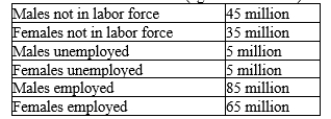 -Refer to Table 28-4. What is the adult female population in Meditor?
 (Multiple Choice)
4.9/5 (80)
(80) Suppose that some country had an adult population of about 46 million, a labor-force participation rate of 75 percent, and an unemployment rate of 8 percent. How many people were employed?
(Multiple Choice)
4.8/5 (83)
(83) One reason economies always experience some unemployment is job search.
(True/False)
4.9/5 (78)
(78) Unemployment insurance is designed to offer workers full protection against job loss.
(True/False)
4.8/5 (75)
(75) Minimum wage laws help explain the natural rate of unemployment if they create a surplus in any labor market.
(True/False)
4.9/5 (86)
(86) Why might a favorable change in the economy, such as technological improvement or a decrease in the price of imported oil, be associated with an increase in frictional unemployment?
(Essay)
4.9/5 (81)
(81) Table 28-4
2010 Labor Data for Adults (ages 16 and older) in Meditor
-Refer to Table 28-4. What is the adult female labor-force participation rate in Meditor?
-Refer to Table 28-4. What is the adult female labor-force participation rate in Meditor? (Multiple Choice)
4.9/5 (84)
(84) Suppose that some country had an adult population of about 25 million, a labor-force participation rate of 60 percent, and an unemployment rate of 6 percent. How many people were employed?
(Multiple Choice)
4.9/5 (84)
(84) Suppose that some country had an adult population of about 25 million, a labor-force participation rate of 60 percent, and an unemployment rate of 6 percent. How many people were unemployed?
(Multiple Choice)
4.8/5 (76)
(76) 
Filters
- Essay(0)
- Multiple Choice(0)
- Short Answer(0)
- True False(0)
- Matching(0)